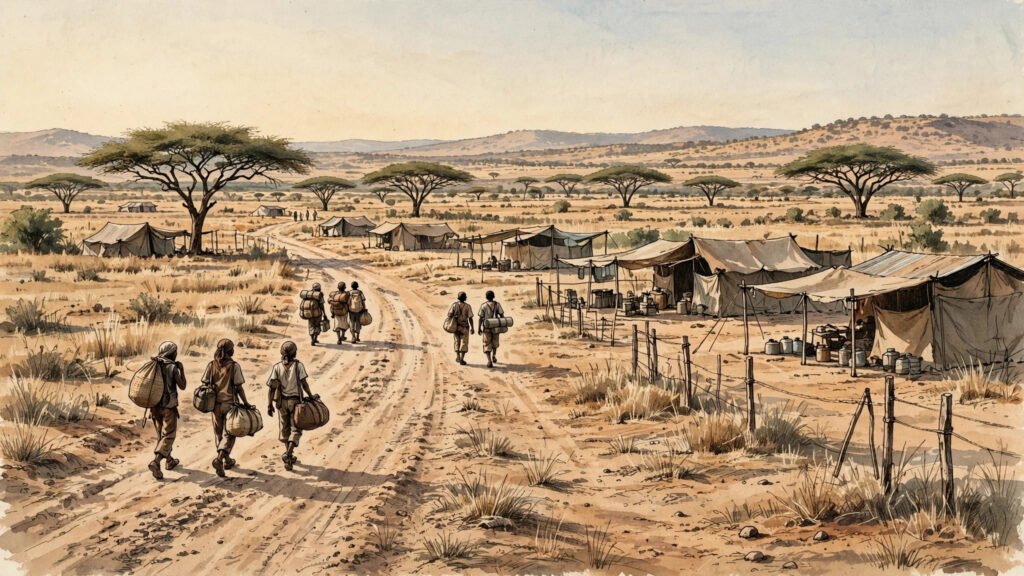
Around 36,600 people have fled into northern Kenya following an uptick in fighting on the Ethiopian side of the border, according to the United Nations migration agency, the International Organization for Migration (IOM). The movement, reported on Tuesday, October 27, 2026, is the latest displacement from a border area where forces from Ethiopia’s Somali and Oromia regions have been in conflict for more than two decades.
The people who crossed the border did so after recent escalations in fighting that began last week, the IOM said. They are now in northern Kenya, where the immediate challenge is not only shelter, but water, food, health care and protection, at a time when the communities hosting them already have limited resources of their own.
Key Takeaways
- Around 36,600 people have fled into northern Kenya after renewed fighting on the Ethiopian side of the border, according to IOM.
- Nearly 11,000 of those who fled have sought sanctuary in the compound of the Oriental Mission Church, while the remaining 25,600 are hosted by communities along the border.
- IOM is working with Kenya’s government and the UN refugee agency UNHCR to collect displacement data and assess needs including water, shelter, food, health support and protection.
What the UN Migration Agency Reported
The figure of around 36,600 comes from the IOM, the UN agency that tracks migration and displacement. It describes people who fled into northern Kenya, not people who remained inside Ethiopia, and it reflects the situation as reported on October 27, after fighting escalated in the previous week. As with any fast-moving displacement, the number is a snapshot: it can change as more people arrive, as counting improves, or as some people move on.
Within that total, the split reported by IOM tells two different stories about where people are staying. Nearly 11,000 people have sought sanctuary within the large compound of the Oriental Mission Church (OMC), a Korean-American Christian organisation based in Los Angeles that does missionary and humanitarian work in Kenya. The remaining 25,600 people are being hosted by communities along the border. Most of those who fled are being hosted by communities along the border, despite those communities already facing limited resources.
Most of those who fled are being hosted by communities along the border, despite those communities already facing limited resources.
Where People Are Staying
The reception point described in the UN report is in the Moyale area, on the Kenya side of the border, where people who fled fighting in Ethiopia have gathered at a reception area. Moyale sits astride the Ethiopia-Kenya border, and it has long been a crossing point for traders, families and, in times of conflict, people seeking safety. That geography matters: when fighting flares on one side of the border, the nearest safety is often just across it, in towns and villages that were not built to absorb thousands of arrivals at once.
The two forms of shelter reported so far show how that absorption is happening in practice. A church compound can offer a single, identifiable place where large numbers of people can gather, be counted and receive help. Community hosting, by contrast, is more dispersed: families and neighbours take people in, share food and water, and provide a roof, often without any formal camp structure. Both forms of shelter depend on the same basic supplies, and both put pressure on local water sources, clinics and food stocks.
That is why the IOM said it is working with the Kenyan government and the UN refugee agency, UNHCR, to collect and manage displacement data and to assess humanitarian needs. Counting who has arrived, where they are staying and what they need is the first step before larger aid can be planned, and it is especially important when most people are not in a single camp but spread across border communities.
- Around 36,600 people have fled into northern Kenya, according to IOM.
- Nearly 11,000 are sheltering in the Oriental Mission Church compound.
- The remaining 25,600 are hosted by communities along the border.
- Forces from Ethiopia’s Somali and Oromia regions have fought for over two decades over boundary demarcations and resources.
- Assessed needs include water and sanitation, shelter, essential household items, food, health support and protection.
Why Fighting Has Flared Again
The conflict behind this displacement is not new. Forces from the Somali and Oromia regions in southern Ethiopia have been fighting for over two decades over boundary demarcations and resources, according to the UN report. Boundary disputes in this part of Ethiopia are about more than lines on a map: they affect grazing land, water points, trade routes and which communities control access to them, and they have repeatedly produced cycles of fighting, displacement and return.
The latest wave, the IOM said, follows escalations since last week. The report does not give a single trigger for the renewed fighting, and it does not attribute the displacement to one side. What it does establish is the sequence that matters for the people affected: fighting intensified on the Ethiopian side of the border, and thousands of people then crossed into Kenya seeking safety.
The new displacement comes in a period when Ethiopia has already been in the headlines for deadly violence in its Oromia region, with recent attacks that killed at least 60 Orthodox Christians. That is a separate reported episode from the border fighting described here, but it underlines a wider point: different parts of Ethiopia are facing different forms of violence at the same time, and each produces its own humanitarian consequences.
What Displaced People Need Now
So far, the IOM has identified needs for water and sanitation, shelter and essential household items, food assistance, health support and protection. Those categories are standard in the early days of a displacement, because they cover survival first: clean water to drink, a place to sleep, food, basic medical care, and safety for people who may have fled with little more than what they could carry.
Protection is a particular concern when people arrive in large numbers and are spread across communities rather than gathered in one place. It covers the work of making sure vulnerable people, including children, older people and people travelling alone, are identified and supported, and that arrivals are not exposed to further harm. The IOM also stressed the need to pay special attention to the needs of host communities, who are accommodating most of the displaced, despite already limited resources.
Across the wider region, aid agencies have also issued warnings of famine risk in Sudan, a reminder that the Horn of Africa and its neighbours are facing several humanitarian pressures at once. That context does not change the facts of this border displacement, but it does explain why resources, attention and aid logistics are stretched: agencies are responding to more than one crisis in the same region at the same time.
What to Watch Next
What to watch next is what the article has already set out: whether the fighting on the Ethiopian side of the border eases or escalates further, whether more people cross into northern Kenya, and whether the displacement data being collected by IOM, the Kenyan government and UNHCR leads to a clearer picture of needs. The other tests are whether water, shelter, food, health support and protection reach both the people in the church compound and the larger number hosted by border communities, and whether host communities themselves receive the support they need while accommodating most of the displaced. Until those questions are answered, the verified picture remains the one reported by IOM: around 36,600 people have fled into northern Kenya, nearly 11,000 are sheltering at the Oriental Mission Church compound, and 25,600 are hosted by communities along the border.