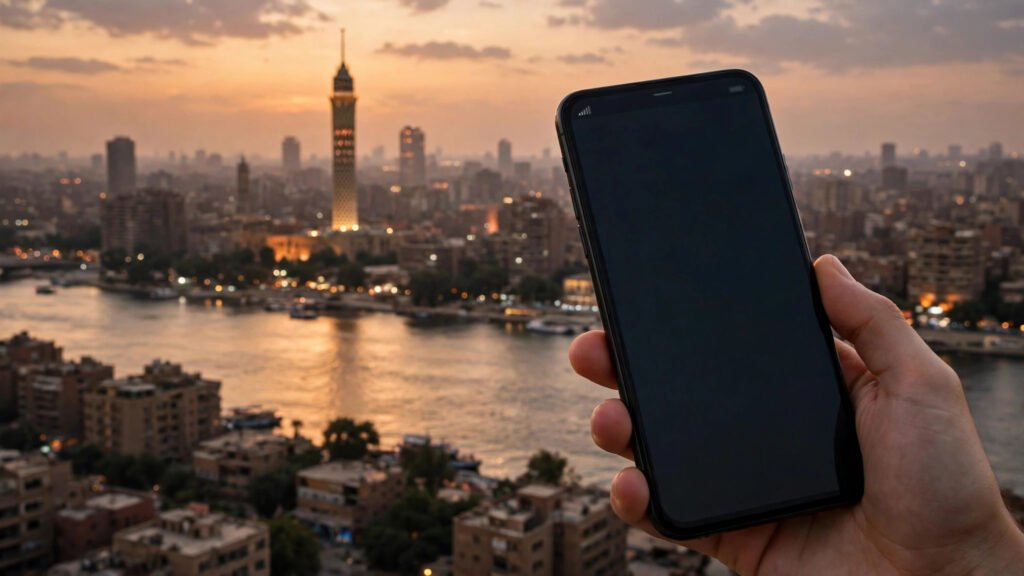
In Cairo in the evening, the pattern is familiar: the video that played fine in the afternoon suddenly buffers, photos take longer to send, and a simple page refuses to load. The phone still shows signal bars, so the connection looks fine — but nothing moves quickly. For many people in Egypt, this is not a one-off glitch. It is the peak-hour slowdown, and it usually has more than one cause.
Mobile internet speed is not decided by one thing. It depends on how many people are using the same tower at the same time, how far you are from that tower, what stands between you and it, and what your own phone is doing in the background. In a country as large and as densely populated in its cities as Egypt, all of these factors can line up at once — especially in the evening.
Key Takeaways
- Evening slowdowns in Egypt are usually caused by network congestion, when thousands of phones share the same tower at once.
- Coverage, thick building walls and underground spots can weaken the signal even when the phone still shows bars.
- Simple steps like switching to Wi-Fi, moving near a window or pausing background downloads often help more than restarting the phone again and again.
The evening rush: too many phones, one tower
The biggest reason for peak-hour slowness is congestion. A mobile tower can only carry a certain amount of data at once. In the evening, when people come home from work and school, millions of them go online at the same time — watching videos, making video calls, scrolling social media and sending messages. At peak hours, the problem is rarely your phone alone — it is thousands of phones asking one tower for data at the same time.
Video is the heaviest load of all. One video stream uses far more data than a message or a web page, so when a whole neighbourhood starts watching videos at once, everyone shares a slower connection. That is why the same phone can feel fast late at night, when fewer people are online, and slow at eight in the evening.
This kind of slowdown is not unique to Egypt. People searching for why 4G feels slow on a phone in Pakistan run into the same evening congestion, and slow 5G on phones in the United States often comes down to the same sharing problem.
Coverage is not the same everywhere
Egypt’s mobile networks cover the big cities well, but coverage and capacity are not equal everywhere. In central Cairo, Alexandria and other large cities, towers are close together and built for heavy use. In newer suburbs, fast-growing districts and smaller towns, the network may still be catching up with the number of people moving in.
Distance matters too. The further you are from a tower, the weaker and slower the connection tends to be. That is why a phone can work well on one street and struggle a few streets away, and why the same problem shows up as weak mobile signal in rural Germany — distance from the tower hurts speed everywhere.
At peak hours, the problem is rarely your phone alone — it is thousands of phones asking one tower for data at the same time.
Walls, basements and lifts
Sometimes the problem is not the network at all, but the building you are in. Thick concrete walls, metal structures, underground floors and lifts all weaken mobile signals. A phone in a basement flat, a parking garage or a lift shaft may show a signal but struggle to hold a fast data connection.
This is easy to test: if the internet speeds up noticeably when you step outside or move near a window, the building was part of the problem. It also explains why the connection can feel fine in one room of a flat and poor in another.
Your phone and plan also matter
An older phone can also be part of the story. Phones that only support older network generations cannot use the faster parts of the network, even when a newer tower is nearby. A phone full of apps updating, backing up photos or downloading files in the background is also quietly using the same connection you are trying to browse on.
Some mobile plans also slow down after a certain amount of high-speed data is used, as part of a fair-use policy. If the internet always gets slower at the same point in the month, the plan — not the network — may be the reason, and it is worth checking the plan’s terms before blaming the tower.
What actually helps
- Switch to Wi-Fi at home in the evening, when the mobile network is busiest.
- Move near a window or step outside to test whether the building is weakening your signal.
- Pause background downloads, cloud backups and app updates while you need a fast connection.
- Try again later in the evening or early morning, when fewer people share your tower.
- Restart the phone once if the connection stalls completely — but do not expect a restart to fix congestion.
None of these steps will turn a congested tower into an empty one. But together, they remove the problems you can control, so the speed you get is the best the network can offer at that moment. If the connection is slow everywhere, all day, on more than one phone, the issue is more likely the network or the plan — and that is worth raising with the operator, with the time of day and the location noted.
What to Watch Next
The evening slowdown in Egypt comes down to a few linked causes: too many people sharing the same tower at once, uneven coverage between areas, buildings that weaken the signal, and phones and plans that add their own limits. The fixes that help most are the simple ones — Wi-Fi at home, a spot with a clearer signal, background apps paused, and heavy downloads saved for quieter hours. As networks keep expanding and more capacity is added in busy areas, peak-hour speeds should improve — but on any crowded evening, sharing the tower is still the first thing to remember.