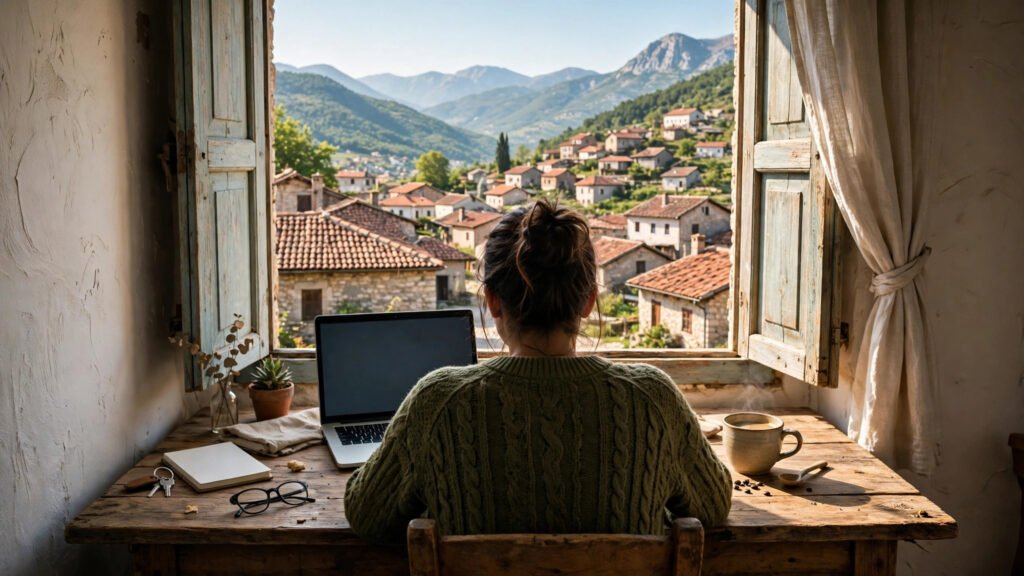
For a growing number of people in North Macedonia, the working day no longer starts with a commute to an office in Skopje. It starts at a kitchen table, in a spare room, or at a small desk by a window in a town far from the capital, with a laptop open and a first video call of the day already waiting. The question many people ask is simple: how do North Macedonians work online for clients abroad from small towns, and what does that kind of work actually look like?
The short answer is that it is ordinary work, done through ordinary tools. A designer sends drafts to a client in another country. A translator turns a document from one language into another. A programmer fixes a problem in code, a virtual assistant organises somebody else’s inbox and calendar, and a language tutor teaches a lesson over video. The client may never visit North Macedonia, and the worker may never visit the client’s office. The work travels over the internet instead.
Key Takeaways
- Many North Macedonians now work online for clients abroad using a laptop, a steady internet connection, and video and messaging tools.
- Small towns suit this work because living costs and daily routines are calmer, but a reliable connection and a quiet place to work still matter most.
- The biggest practical challenges are time zones, finding steady clients, getting paid across borders, and avoiding isolation while working alone.
Why Small Towns Work for Online Work
North Macedonia is a small country, and its towns are close to family, to nature, and to a slower daily rhythm than a big city. For someone who works online, that can be a real advantage. There is less time lost in traffic, fewer distractions from a busy office floor, and a home that can double as a workplace. A worker in a town near a lake or in the mountains can finish a project, step outside for a walk, and return to the next task without the day feeling like a race.
That does not mean every small town is equally easy to work from. The office, for many of these workers, is simply wherever the connection is steady and the work can get done. A home with a reliable connection, a backup option such as a phone hotspot, and a corner that stays quiet during calls matters far more than a fashionable address. Workers often learn this quickly: the first thing they check in a new place is not the view, but whether video calls hold up without freezing.
The office, for many of these workers, is simply wherever the connection is steady and the work can get done.
What Kind of Work Do They Do?
The range of online work is wide, and it keeps growing as more businesses hire remotely. Some of the most common kinds of work include design and illustration, writing and translation, software and website work, bookkeeping and administrative support, customer support by chat and email, and online tutoring. A person who speaks more than one language has an extra advantage, because clients abroad often need help in exactly the languages spoken across the Balkans and beyond.
Many workers start small. A first client may come through a recommendation from a friend, a short trial project, or a freelance marketplace where clients post jobs and workers send proposals. That first project matters more than any profile page, because a happy client tends to return with more work and to recommend the worker to others. Over time, a handful of steady clients can replace a long list of one-off jobs, and the working week becomes more predictable.
It is also common for online work to sit alongside other parts of life. A student may take on small projects between classes. A parent may work while children are at school. Someone who already has a local job may take on evening projects to build skills and savings. The flexibility is the point, but it also means the worker has to manage their own time, because nobody else sets the schedule.
How a Typical Workday Runs
A typical day for a remote worker in a small North Macedonian town often starts with messages. Clients in other time zones may have written overnight, so the morning begins with replies, a check of deadlines, and a plan for the day. Then come the focused hours: the design, the code, the translation, or the lesson preparation that needs quiet concentration. Calls tend to cluster in the late morning or afternoon, when working hours overlap with clients abroad.
Good remote workers build small routines to protect that focus. They keep regular working hours even though nobody is watching the clock. They keep a separate workspace when they can, even if it is only one end of a table. They take real breaks, because staring at a screen all day without moving helps nobody. And they keep a simple record of hours and payments, since freelance work means keeping track of your own business.
- Steady internet and a quiet corner matter more than a city address.
- Repeat clients, earned through good early work, bring steadier income than constant new jobs.
- Language skills open doors to clients in many different countries.
- Clear daily routines protect focus when nobody else sets the schedule.
The Practical Problems Nobody Should Ignore
Working online from a small town is not without problems, and honest advice should name them. Time zones are the first. A client several hours behind or ahead can mean early mornings or late evenings for calls, and deadlines need careful planning so that nobody is surprised. The second problem is payment: getting paid across borders can involve fees, waiting times, and paperwork, so workers usually agree on payment terms in writing before a project starts, and they keep records of every invoice.
The third problem is steadiness. Freelance work can be uneven, with busy months followed by quiet ones, so experienced workers try to keep more than one client and to save during good months. The fourth problem is quieter but real: working alone at home can feel isolating. Many workers deal with this by working sometimes from a cafe, meeting other freelancers, joining online communities in their field, or simply keeping regular contact with friends and family during the day. In neighbouring countries, similar questions come up about how people handle money and daily life: in Kosovo, for example, many people rely on money sent home from abroad alongside phone-based daily routines, while Estonia shows how far a country can go when it chooses to run public services online. And across the region, cash is still part of everyday life for many people, which is worth remembering when a worker is paid digitally but spends locally.
What It Means for Towns and Families
When people can earn online without leaving their hometown, the effects reach beyond one household. Young people who might otherwise move away for work can stay closer to family. Local cafes, shops, and landlords gain customers who work nearby all day rather than commuting away. Skills spread too: one person who learns design or programming online often teaches a friend, a sibling, or a neighbour, and a small town slowly builds its own informal network of digital workers.
None of this happens automatically. It depends on connections that stay reliable, on schools and courses that teach useful digital skills, and on clients abroad who trust workers they have never met in person. Trust is built project by project, with clear communication, honest deadlines, and work delivered as promised. For workers who get those basics right, a small town in North Macedonia can be a perfectly serious place to build a career that reaches across borders.
What to Watch Next
The pattern to watch is whether more North Macedonians in small towns keep building steady online careers, with repeat clients, reliable connections, and quiet workspaces at home. If the practical problems are handled well — time zones planned, payments agreed in writing, savings kept for quiet months, and isolation kept in check — then working online for clients abroad can remain a realistic way of life far from the capital, built on the same simple formula: a laptop, a steady connection, and work delivered as promised.