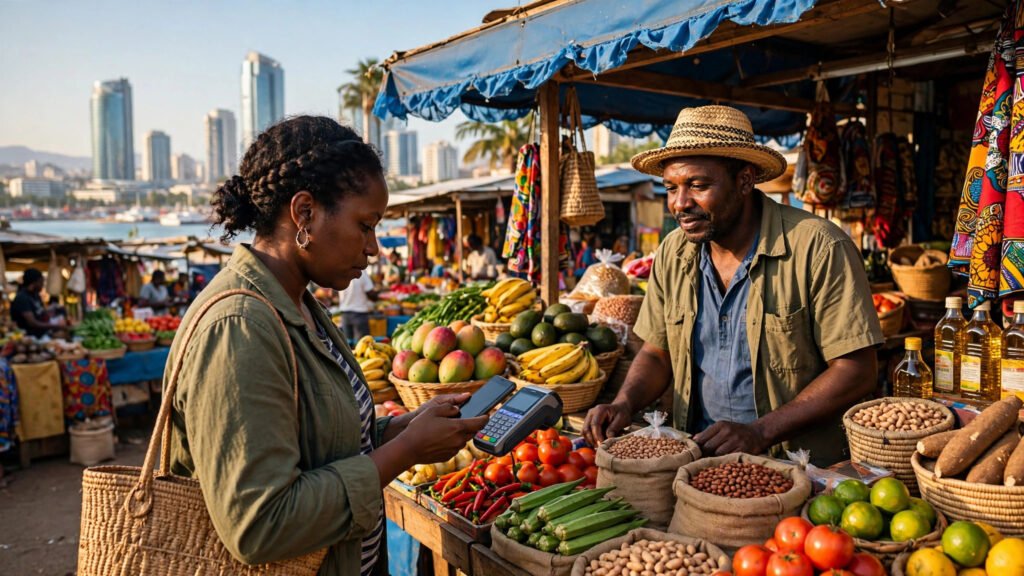
At a busy market stall in Luanda, a shopper does not reach for notes and coins. She opens an app on her phone, confirms the amount, and the payment is done. The seller does not need to hunt for change, and the buyer does not need to carry a thick wallet through a crowded street. For many Angolans, this small daily moment explains a much bigger shift in how money moves.
The question people often ask is simple: why Multicaixa Express, and why now? The answer is not about one clever feature. It is about a payment tool that fits Angola’s banks, its shops, and the phones people already use every day.
Key Takeaways
- Multicaixa Express turns a bank-linked phone into a way to transfer money, pay bills, and buy goods without handling cash.
- It fits daily life in Angola because it works through the country’s existing Multicaixa banking network rather than asking shops and customers to start from scratch.
- Cash and cards still have a place, but phone payments solve everyday problems such as finding change, carrying cash, and paying from a distance.
What Is Multicaixa Express?
Multicaixa is Angola’s long-established interbank network, the system behind the country’s widely used ATM cards. Multicaixa Express is its mobile companion: an app that links to a bank account and lets the user make payments and transfers from a phone.
In practice, that means everyday money tasks can happen without a trip to a bank branch or an ATM. A user can send money to another person, pay for services, top up a phone, and settle a purchase at a participating merchant. The phone becomes the point of sale, the wallet, and the receipt in one device.
That simplicity matters. Angola’s economy still involves a great deal of face-to-face trade, from formal shops to open markets and small neighbourhood businesses. A payment method only spreads if it works in those real places, not just in large stores.
Why Cash Is Hard Work in Daily Life
Cash feels simple until you use it all day. Notes tear, coins add up, and change runs out at exactly the wrong moment. Carrying larger sums also brings a worry that many shoppers would rather avoid, especially on busy transport routes and in crowded markets.
For sellers, cash creates its own chores. Takings must be counted, stored safely, and carried to a bank. A phone payment removes several of those steps. The money moves directly between accounts, and both sides have a record of what was paid.
For many Angolans, the phone has become the wallet they already carry everywhere.
Why Cards Alone Do Not Solve the Problem
Bank cards are familiar in Angola, thanks to Multicaixa, but a card still needs a terminal, power, and a connection to work. Small sellers do not always have that equipment, and a customer cannot easily pay a friend or a supplier with a card alone.
A phone app closes that gap. It does not replace the bank card; it extends what the same bank account can do. A seller who cannot afford or maintain a card terminal can still accept a phone payment, and a buyer can pay without handing over a physical card.
This is a pattern seen across southern Africa. In neighbouring countries, phone-based money has also grown because it reaches people and places that traditional card terminals do not. Readers who follow that trend may recognise the same logic in why Mozambicans pay with M-Pesa instead of bank cards and in why Zambians pay with mobile money instead of bank cards.
What Makes Express Fit Angolan Life
The strongest reason for Express is fit. It builds on a network Angolans already trust for ATM withdrawals, so users do not have to learn a completely new financial world. They link the account they already have and use the phone they already carry.
- Pay a shop or a service provider without carrying cash or searching for change.
- Send money to family or friends without meeting in person or visiting a branch.
- Settle bills and top up a phone from the same app, instead of queuing for each task.
- Keep a digital record of payments, which makes household budgeting easier to follow.
That combination is especially useful in a country where distances are long and daily schedules are tight. A payment that can be made from home, from work, or from a market stall saves a journey, and a saved journey can save a whole morning.
The same everyday logic helps explain why people in Botswana pay with mobile money instead of bank cards: when the phone is already in your hand, it is often the easiest place to keep your money too.
How a Typical Payment Works
A typical Express payment follows a short, familiar routine. The buyer opens the app and chooses whether to pay a merchant, transfer money to another person, or settle a bill. They enter or confirm the amount, check the recipient, and approve the transaction. The seller receives confirmation, and the sale is complete.
There is no single correct version of this routine, because merchants and services set up their own payment steps. The shared idea, though, is that the phone handles the part of the transaction that used to need cash, a card reader, or a visit to a counter.
What Still Limits Phone Payments
Phone payments are not a complete answer yet. A flat battery, a weak mobile signal, or a phone without enough storage can all interrupt a transaction. Some sellers still prefer cash, and some customers still prefer to see and hold their money before they part with it.
Trust also takes time. People who have always paid in cash may want to watch a payment succeed several times before they rely on it for larger amounts. Younger users and city shoppers tend to adopt new tools first, while adoption in smaller towns and rural areas follows as coverage, phones, and merchant acceptance improve.
None of this means the shift is stopping. It means the shift is gradual, moving stall by stall, shop by shop, and household by household, rather than changing overnight.
What to Watch Next
Watch whether more small sellers, from market traders to neighbourhood shops, start accepting phone payments as a normal option alongside cash. Watch whether bill payments, top-ups, and person-to-person transfers keep pulling everyday spending onto the phone. And watch whether trust grows as more Angolans see phone payments succeed in ordinary places, day after day.
If those trends continue, Multicaixa Express will not need to replace cash in a single leap. It will simply keep doing what it already does best: making the payment that used to need notes, coins, and change into something that fits in a pocket.