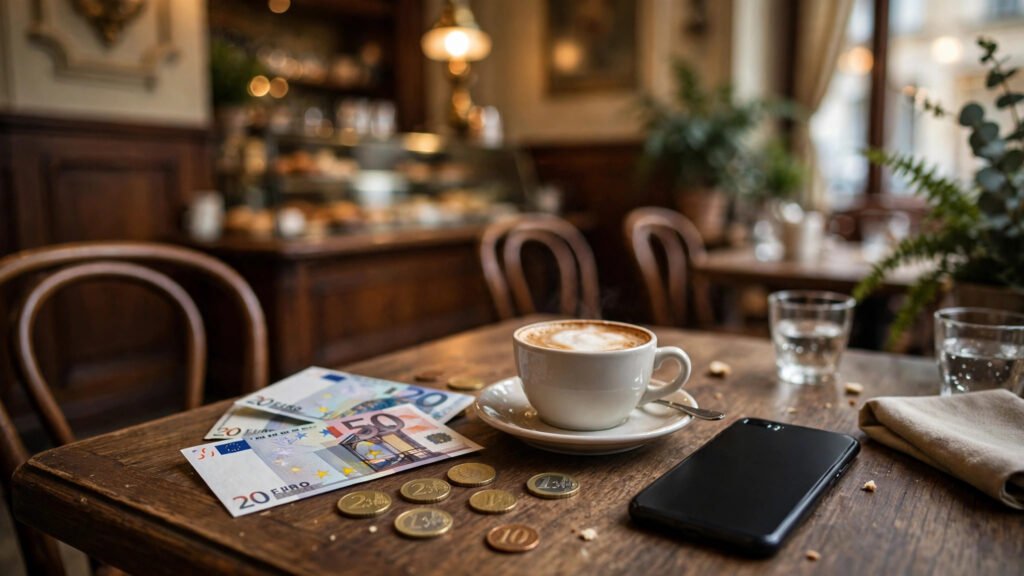
Walk into a bakery in Vienna, a guesthouse in the Alps, or a small market stall anywhere in Austria, and you will often see the same familiar scene: a customer hands over coins and banknotes, the shopkeeper counts out change, and everyone moves on without a card reader in sight. Austria has modern banks, fast internet, and contactless cards like any other European country, yet cash still plays a much bigger role in everyday life here than it does in many neighbouring countries. Why do Austrians still pay with cash so often?
The short answer is that cash fits how many Austrians like to live, spend, and keep control of their money. It is not that Austria missed the digital revolution. It is that many people here made a conscious choice, and the habit has stuck.
Key Takeaways
- Cash gives many Austrians a clear, hands-on sense of what they are spending.
- Privacy, small businesses, and everyday habits all help keep cash in circulation.
- Cards and phones are growing, but cash remains a normal, accepted way to pay.
Cash Makes Spending Feel Real
For a lot of people, the biggest appeal of cash is simple: you can see it leaving your wallet. When you pay with a card or a phone, the money feels abstract. The number on a screen changes, but nothing in your hand changes. With cash, the cost of a coffee, a loaf of bread, or a train ticket is physical and immediate.
That feeling matters for budgeting. Many Austrians, especially older shoppers and families keeping a close eye on weekly spending, find it easier to stay on track when they take out a set amount of cash and spend only that. Once the notes are gone, the budget for the day or the week is done. There is no surprise at the end of the month, and no need to check an app to know where the money went.
Cash also avoids the small mental friction of digital payments: no PIN to remember, no phone battery to worry about, no app update standing between you and the checkout. For a quick purchase, handing over coins is often the fastest option of all.
Privacy Is a Deeply Held Value
Another reason cash endures in Austria is privacy. A cash payment leaves no digital trail. It does not show up in a bank statement, it is not logged by an app, and it is not tied to a profile of spending habits. For people who value keeping their private life private, that matters a great deal.
This is not only about hiding anything. It is about a broader Austrian attitude that personal information should stay personal unless there is a good reason to share it. Paying cash for a meal, a gift, or a newspaper is a small, everyday way of exercising that choice. Digital payments, by contrast, create records by design, and many Austrians are simply not in a hurry to give up the anonymous option.
Cash gives many Austrians a clear, hands-on sense of what they are spending, and that feeling is hard for a card or a phone to replace.
Small Businesses and Local Life
Austria’s economy is full of small businesses: family-run bakeries, butchers, cafés, mountain huts, farmers’ markets, and village shops. In many of these places, cash has long been the default, and changing the whole payment setup costs money and effort that a small business may not want to spend.
Card terminals come with fees and contracts, and for a shop selling low-priced items, those costs add up. Cash avoids them entirely. It also works when the internet connection is slow or unreliable, which can still happen in rural valleys and busy market halls. A note or a coin never needs a signal.
There is a social side too. In a traditional Viennese coffee house or a village inn, paying cash feels like part of the ritual. The exchange at the counter, the small talk, the tip left on the saucer — all of it belongs to an unhurried way of doing things that many Austrians are proud of.
Tipping and Everyday Customs
Tipping customs also help explain the habit. In Austria, it is common to round up a bill or add a small tip when paying, and doing that with cash is straightforward. You hand over the notes, say the amount you want to pay, and the rest is the tip. With a card, tipping can feel more awkward, especially if the terminal does not offer a tip option.
Cash is also the natural choice for many small, everyday transactions that are still part of Austrian life: paying for a parking meter, buying a ticket from a machine, giving children pocket money, or splitting a bill at a table. These are moments where reaching for a wallet is simply easier than reaching for a phone.
Generations and Habits
Habits formed over decades do not disappear overnight. Older Austrians grew up in a world where cash was the only way to pay, and many of them see no reason to change a system that has always worked. Younger Austrians are more likely to tap a card or a phone, but they often grow up in households where cash is still normal, so the habit passes on in a softer form.
This generational mix means Austria is not standing still. Contactless payment is now common in supermarkets, chain stores, and city transport, and younger shoppers use digital wallets more than their parents do. But because cash never stopped being accepted, there was never a moment when people were forced to abandon it — so it never went away.
How Austria Compares With Its Neighbours
Austria is not alone in holding on to cash. In Japan, another highly advanced country, cash also remains a normal part of daily life, as explained in why so many Japanese people still use cash despite advanced technology. Small shops and everyday customs play a similar role there. In Greece, too, cash is still the go-to choice in many small shops, a pattern explored in why Greeks still pay cash in so many small shops.
The contrast is Sweden, where cash has faded much further and card and phone payments dominate daily life, as described in why Swedes barely use cash anymore. Austria sits somewhere between these extremes: digital payment is widely available, but cash has kept its place at the table.
- Cash helps many Austrians budget by making spending visible and tangible.
- Privacy and a preference for keeping personal data out of payment records support cash use.
- Small businesses, rural areas, and tipping customs all keep cash practical.
- Younger shoppers use cards and phones more, but cash remains widely accepted.
Is Cash in Austria Disappearing?
The honest answer is that cash is slowly losing ground, but it is not disappearing. Card acceptance has improved a lot in recent years, even in smaller shops, and contactless payment is now an everyday sight in Austrian cities. During busy periods, many people reach for a card simply because it is quick.
At the same time, there is a strong public attachment to keeping cash available. Many Austrians see cash as a backup that should always exist — for privacy, for emergencies, and for people who do not want, or cannot easily use, digital payment. As long as shops keep accepting it and people keep asking for it, cash will keep circulating.
That balance may be the real Austrian story. Rather than a race to go fully cashless, Austria has settled into a mix: cards and phones for convenience, cash for control, privacy, and tradition. Visitors who arrive with only a card can usually get by in cities, but carrying some cash is still wise, especially outside the big cities and in small, family-run places.
What to Watch Next
Watch whether card acceptance keeps spreading into Austria’s smallest shops and rural businesses, and whether younger shoppers gradually tip the balance toward digital payment. Watch too for any public debate about keeping cash available, since privacy and choice remain central to how Austrians think about money. For now, the pattern is clear: Austria is modernising its payments, but it is doing so on its own terms, and cash is still very much part of everyday Austrian life.