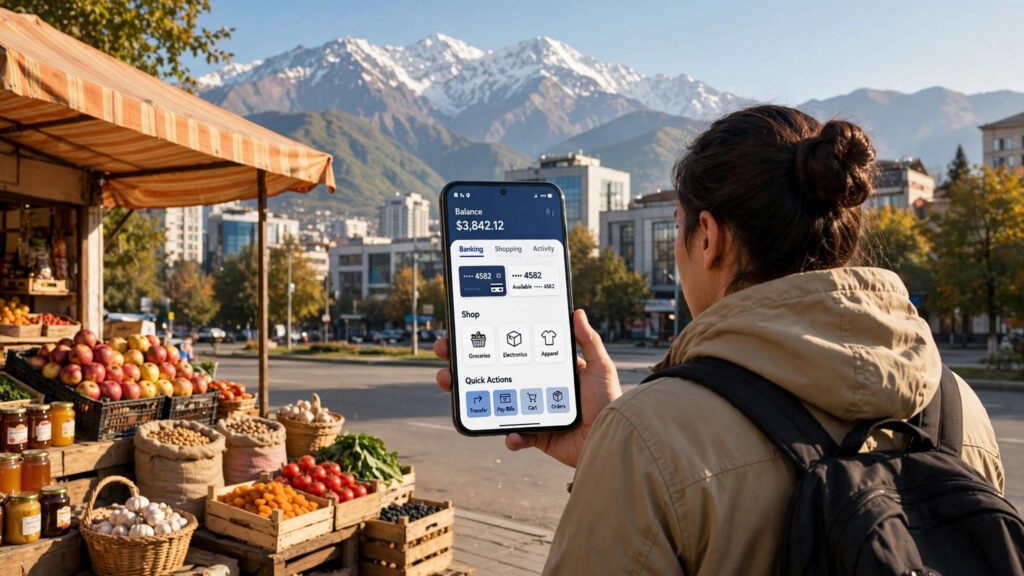
For many people in Kazakhstan, the smartphone has quietly replaced the wallet, the bank branch, and even the shopping centre. One app in particular sits at the centre of that change: Kaspi. Ask a visitor what surprises them most about everyday life in Almaty or Astana, and the answer is often the same — almost everything, from paying for lunch to buying a washing machine, seems to happen through a single app.
So why do Kazakhstanis use the Kaspi app for almost everything? The short answer is convenience built up over time. Kaspi started as a banking service and gradually added payments, shopping, and everyday services in one place, so people no longer needed a different app, card, or website for each small task. Once friends, family, and shops all used the same system, it became the easiest way to get things done.
Key Takeaways
- Kaspi grew from a banking service into an everyday app covering payments, transfers, bills, and shopping in one place.
- Its popularity comes from convenience: one app, one account, and a system that friends, family, and shops already use.
- The trade-off is dependence — when so much runs through one app, a lost phone or a flat battery matters more than it used to.
What Is the Kaspi App?
Kaspi, often written as Kaspi.kz, is best described as a super-app: a single application that bundles together services that in many other countries live in separate apps. At its core is banking — an account, a card, and the ability to move money. Around that core, Kaspi added a marketplace where people can browse and buy goods, a payments system for shops and services, and tools for paying regular bills.
For a new arrival, the most visible part is the QR code payment. In cafes, small shops, and market stalls, a printed QR code at the counter lets a customer pay by scanning it with a phone instead of handing over cash or a card. The payment is confirmed on the spot, and both sides get a record of it. That simplicity matters in busy everyday settings, where speed and a clear receipt are both welcome.
Transfers between people work in a similarly simple way. Instead of asking for long bank details, people often send money using a phone number linked to the recipient’s account. Splitting a restaurant bill, sending money to a family member, or paying a friend back for a ticket becomes a task that takes seconds rather than a trip to a bank.
Why One App Took Over Daily Life
The first reason is habit. When one app already handles a person’s bank account, it is natural to use the same app for the next task too. Each added service makes the app more useful, and each useful addition makes people open it more often. Over time, the app stops feeling like a banking tool and starts feeling like a daily companion.
The second reason is network effect, a simple idea with a big impact: a payment system is most useful when everyone else uses it too. In Kazakhstan, Kaspi reached a point where shops expected it, friends expected it, and service providers accepted it. That shared expectation is similar to what happened with mobile payments in India, where a common system made paying by phone the normal choice rather than the unusual one.
The third reason is that shopping and banking sit side by side. A person can browse a product, compare options, pay for it, and arrange delivery without leaving the app or re-entering payment details. For larger purchases, paying in instalments through the same account is part of the same flow. That joined-up experience is a big part of why people describe Kaspi as something they use for almost everything, not just for money.
Once friends, family, and shops all used the same system, it became the easiest way to get things done.
How Kaspi Fits Into an Ordinary Day
Picture an ordinary day in Almaty. Morning coffee is paid for by scanning a code. A utility bill is settled from the same app during a break at work. A birthday gift is ordered in the evening and tracked until it arrives. A transfer to a relative in another city goes through without a visit to a branch. None of these steps is remarkable on its own, but together they explain why the app earns so much screen time.
The same pattern appears in other countries where one app has become a daily hub. In South Korea, for example, a single messaging app grew into a platform for chatting, paying, and booking services, as explored in our look at why South Koreans use KakaoTalk for almost everything. The details differ from country to country, but the underlying appeal is the same: fewer apps, fewer passwords, and fewer steps between wanting something and getting it.
Government and everyday services have followed a similar path elsewhere too. Ukraine’s Diia app gathered official documents and public services into one phone-based place, a shift described in our article on why Ukrainians use the Diia app for almost everything. Kaspi is not a government app, but it shows the same direction of travel: daily life, bundled into a phone.
- One account covers banking, QR payments at shops, transfers by phone number, bill payments, and online shopping.
- QR codes make paying quick in cafes, markets, and small shops, with an instant record for both sides.
- Shopping and paying in one flow removes repeated sign-ins and re-entered card details.
- The system’s value grows as more friends, family, and shops use it — the network effect in action.
Is There a Downside to Using One App for Everything?
There are trade-offs worth keeping in mind. Relying on one app means relying on one phone, one battery, and one account. A lost phone, a forgotten password, or a day without mobile signal can suddenly block payments, shopping, and transfers all at once. That is why keeping a backup payment method, such as a physical card or some cash, remains sensible even for the most enthusiastic app users.
Security also deserves attention. Because so much sits behind a single sign-in, protecting that account matters more than protecting any one card. A strong passcode, the phone’s built-in lock, and care about phishing messages that pretend to come from a bank are basic habits that protect the whole bundle of services at once.
Finally, not everyone moves at the same speed. Older users, people in rural areas with weaker connectivity, and visitors without a local account may still prefer cash or a card. A system that works brilliantly for regular users still needs room for those who pay another way, and most shops in Kazakhstan do still accept other payment methods alongside app payments.
What to Watch Next
Kaspi’s story is really a story about convenience winning over complexity. It grew from banking into payments, shopping, and bills because each new service made the app more useful, and because friends, family, and shops adopted the same system. That combination of one account, quick QR payments, and a joined-up shopping experience is why Kazakhstanis use it for almost everything.
What to watch next is whether that model keeps spreading: whether more everyday services join the same app, whether other countries develop their own super-apps along similar lines, and how users balance convenience with the need for a backup when one app does so much. For now, the lesson for visitors is simple — in Kazakhstan, the phone is the wallet, and Kaspi is the app most people reach for first.