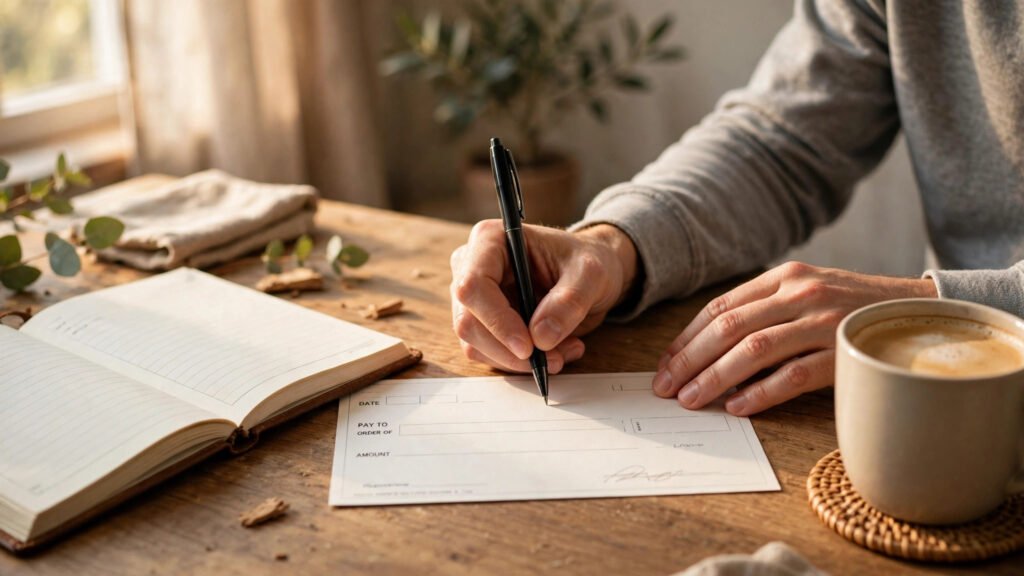
In a country where a phone can pay for coffee in seconds, the paper check should have disappeared years ago. Yet walk into many American homes and you will still find a checkbook in a drawer, and many landlords, small businesses, and older Americans still reach for it every month. The check is not thriving, but it is not dead either — and the reasons it survives say a lot about how Americans actually handle money.
Key Takeaways
- Paper checks survive in the United States because landlords, small businesses, and older payers still rely on them for rent, bills, and gifts.
- A check leaves a clear paper trail and gives the payer control over exactly when money leaves the account.
- Phone payments and bank transfers are replacing checks, but the change is gradual because habits, systems, and trust change slowly.
A habit built over generations
For much of the twentieth century, the check was the standard way to pay someone without cash. Salaries were paid by check, bills were paid by check, and balancing a checkbook was a basic household skill. Millions of Americans grew up with that routine, and routines are hard to break — especially for payments that happen only once a month, like rent.
When a payment is rare and familiar, there is little pressure to change it. A tenant who has paid rent by check for years sees no reason to learn a new app, set up a new account, or hand bank details to a new service. The check works, the landlord accepts it, and the month ends the same way it always has.
Rent, small businesses, and gifts
Rent is the check’s strongest remaining ground. Many landlords, especially smaller ones, still ask for checks because they are simple to receive and easy to record. A check can be handed over in person, slipped into a drop box, or posted, and it arrives with the tenant’s name and the month written on it.
Small businesses use checks for similar reasons. A local contractor, a cleaning service, or a community group may not want to pay card-processing fees or set up a payment terminal for occasional jobs. A check costs the receiver nothing extra to accept, and it fits neatly into a paper-based bookkeeping routine.
Checks also survive as gifts. Money tucked into a birthday card or a wedding card still often arrives as a check, because it feels more personal than a bank transfer and more considered than cash — and it can be written for any amount.
Control and a paper trail
One quiet advantage of a check is control. When you write a check, the money does not leave your account the moment you hand it over; it leaves when the check is deposited and cleared. For people managing tight monthly budgets, that gap matters, and it makes the timing of a payment feel more predictable.
A check also creates its own record. The payer keeps a copy or a stub, the bank statement shows the cleared check, and the receiver has a document with a name, a date, and an amount. For taxes, for disputes, or simply for remembering what was paid, that trail is reassuring in a way that a quick tap on a phone sometimes is not.
A check creates its own record, and that paper trail is reassuring in a way that a quick tap on a phone sometimes is not.
Why the rest of the world moved faster
The United States is unusual here. In many other countries, instant bank transfers became the default years ago. In Canada, for example, cheques have largely been replaced by Interac e-Transfer, which moves money straight between bank accounts using an email address or phone number. In Spain, phone payments like Bizum have become an everyday habit for splitting bills and paying small shops.
Part of the difference is infrastructure: countries that built a single, free, instant bank-transfer system early gave people an obvious replacement for the check. The United States, with thousands of banks and a patchwork of payment apps, never had one single switch everyone could flip. Instead, Americans got many options — cards, apps, bank bill pay, and checks — and different groups picked different ones.
Cash tells a similar story elsewhere. Even in Germany, where cash remains popular despite cards and phones, old payment habits fade slowly when the replacement is not clearly better for everyone.
The phone is quietly changing the check itself
Ironically, the phone has also kept the check alive. Mobile deposit — photographing a check with a banking app instead of visiting a branch — removed one of the biggest annoyances of receiving a check. A landlord or a small business can now deposit a check from the kitchen table, which makes accepting checks far less of a chore than it used to be.
At the same time, the same phone offers the check’s replacements: bank bill pay, which sends a payment directly from an account, and peer-to-peer apps for sending money to friends and family. Younger Americans, who rarely encounter checks at all, tend to skip them entirely and go straight to these options.
The risks that remain
Checks are not without problems. A paper check carries a name, an account number, and a signature, and once it is posted or handed over, it can be stolen, altered, or copied. Banks and consumer advisers regularly warn that checks are a target for fraud in a way that an encrypted phone payment is not. That risk is one more reason the slow drift away from checks is likely to continue, even if it takes years.
- Checks survive mainly for rent, small-business payments, and gifts.
- They offer control over timing and a clear paper record of each payment.
- Mobile deposit made receiving checks easier, which slowed their decline.
- Instant transfers and payment apps are the main replacements — but adoption is uneven.
- Fraud risk is the strongest argument against keeping checks for much longer.
What to Watch Next
Checks in the United States are fading rather than vanishing. Younger payers are moving to bank transfers and payment apps, landlords are gradually accepting digital rent payments, and mobile deposit has softened the inconvenience of the checks that remain. The paper trail and the sense of control still keep checks in the drawer for many households, but each year the drawer opens a little less often — and the question is no longer whether checks will disappear, but how long the last ones will take to go.