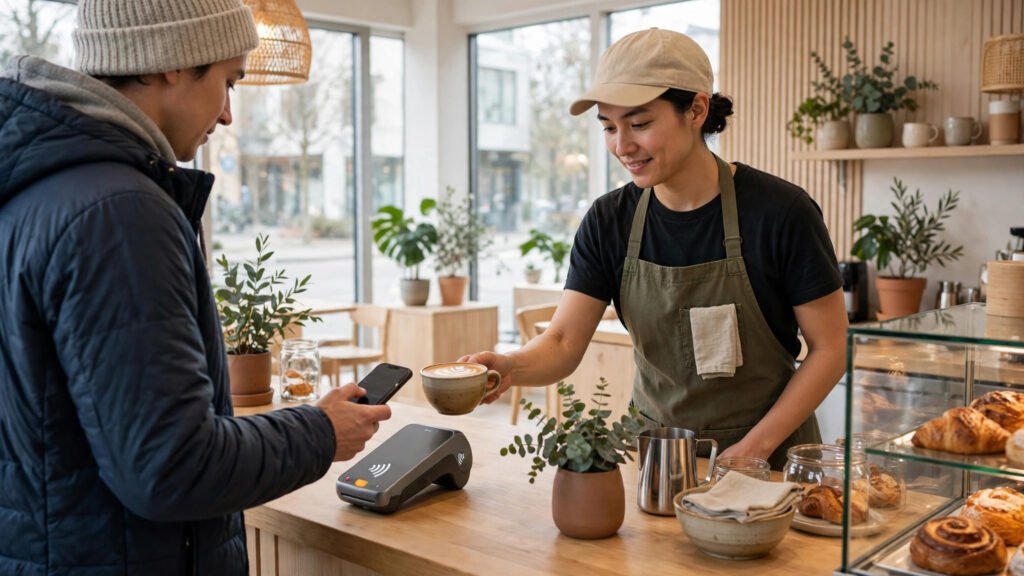
Try paying with cash in a Swedish café and you may get a polite look of surprise. The card reader is ready, the phone is ready, and the person behind the counter may have to check whether the till even holds change. In Sweden, paying by card or phone is not a novelty — it is the normal way everyday life works, from a coffee in Stockholm to a bus ticket in a small town.
So why do Swedes barely use cash anymore? The short answer is that the alternatives became easier, faster, and more trusted over time, and cash slowly stopped being the default. Shops, banks, and customers moved in the same direction, and once most people stopped carrying notes and coins, businesses had less reason to handle them.
Key Takeaways
- In Sweden, cards and phone payments are the normal way to pay, and cash is now the exception rather than the rule.
- The shift happened gradually, as shops, banks, and customers all found card and phone payments easier to use.
- Cash has not vanished completely, and questions remain about what happens when systems fail or when someone cannot pay digitally.
How Cash Quietly Lost Its Place
The change in Sweden did not happen in a single moment. It grew out of everyday habits. Paying by card at the supermarket felt quick. Splitting a bill with a phone app felt simpler than sorting out coins. A market stall that once took only cash started taking cards, and customers who had stopped carrying cash could finally buy without a trip to a cash machine.
Trust played a large part. People came to see card and phone payments as safe and reliable for small amounts as well as large ones. When a payment method works the same way in a big city shop and a village kiosk, people stop thinking about it. It simply becomes how paying works, and cash becomes something you only reach for on rare occasions.
Banks and shops also moved away from handling large amounts of cash. Handling notes and coins takes time, storage, and security, and for a small business, a card payment that goes straight into the account can be simpler to manage. As fewer customers paid cash, the case for keeping a full cash routine grew weaker, and the cycle continued.
Swish and the Phone in Your Pocket
One reason the shift stuck is that Sweden’s phone payments fit real life. Swish, the mobile payment service widely used in Sweden, lets people send money to each other with a phone, which makes splitting a restaurant bill, paying a friend back, or sending money to a family member a matter of moments. It works because so many people already use it — a payment app is only useful if the person on the other side has it too.
That everyday usefulness matters more than any single feature. A phone is already in most people’s pockets, and using it to pay does not require carrying anything extra. For younger Swedes in particular, who may rarely visit a bank branch or a cash machine at all, the phone is simply where money lives. Older shoppers have adopted cards and phones too, though at their own pace, and many shops still accept more than one way to pay.
Once most people stopped carrying notes and coins, businesses had less reason to handle them, and the cycle continued.
The contrast with neighbouring countries shows how local habits shape the same technology. In Finland, phone payments have become a normal part of daily life too, while in Germany, cash still holds a strong place beside cards and phones. Sweden sits at the cashless end of that spectrum, not because Swedes were ordered to give up cash, but because the digital options fitted their routines so well.
What About the Places Cash Still Matters?
Even in Sweden, cash has not disappeared entirely. Some people still prefer it, some small sellers still accept it, and some situations still call for it. A visitor who arrives with only cash may find that many places prefer a card, but that does not mean cash is refused everywhere. It is better to think of Sweden as card-first rather than cash-free.
There are also real questions about resilience. What happens when a card terminal stops working, when a phone battery dies, or when a payment system goes offline for a few hours? In a country where so few transactions use cash, a system outage can feel bigger than it would in a place where cash is still common. That is why the debate in Sweden is not only about convenience — it is also about keeping a backup that works when the digital route fails.
The same question applies to inclusion. Not everyone finds digital payments easy. Some older people, some people with disabilities, and some newcomers still settling into Swedish life may find cash simpler or more reassuring. A payment system that works for most people still needs to work for them, and that tension is part of why cash keeps coming up in Swedish public discussion even as its everyday use falls.
- Cards and phone payments are the normal way to pay in Sweden, from cafés to market stalls.
- Swish makes sending money between people quick, which helped phone payments become an everyday habit.
- Shops handle less cash as fewer customers use it, which makes cash less practical over time.
- Cash has not vanished, and outages or access problems show why a backup still matters.
- Sweden is card-first rather than fully cash-free, and visitors should still carry a card as their main way to pay.
What Visitors Should Know
If you are visiting Sweden, plan to pay mainly by card or phone. Most hotels, restaurants, shops, and transport services accept cards, and you are unlikely to need large amounts of cash for a normal trip. It is still sensible to carry a small amount of cash as a backup, and to check before you travel whether your own card works abroad without a problem.
It also helps to watch how locals pay. If everyone ahead of you in a queue taps a card or a phone, follow the same routine and you will fit right in. If a small stall does accept cash, that is a bonus rather than the norm. In Spain, instant phone payments play a similar everyday role, which shows how different countries can reach a similar result — fewer notes and coins, more taps — through their own local systems.
What to Watch Next
Sweden’s cashless shift is unlikely to reverse, but the questions around it will keep shaping the debate. How shops and banks handle outages, how people who struggle with digital payments are supported, and whether cash keeps a small but protected role are all questions that will decide what card-first really means in practice. For now, the Swedish till tells the story clearly: the card reader is ready, the phone is ready, and cash, while still around, is no longer the way most Swedes pay.