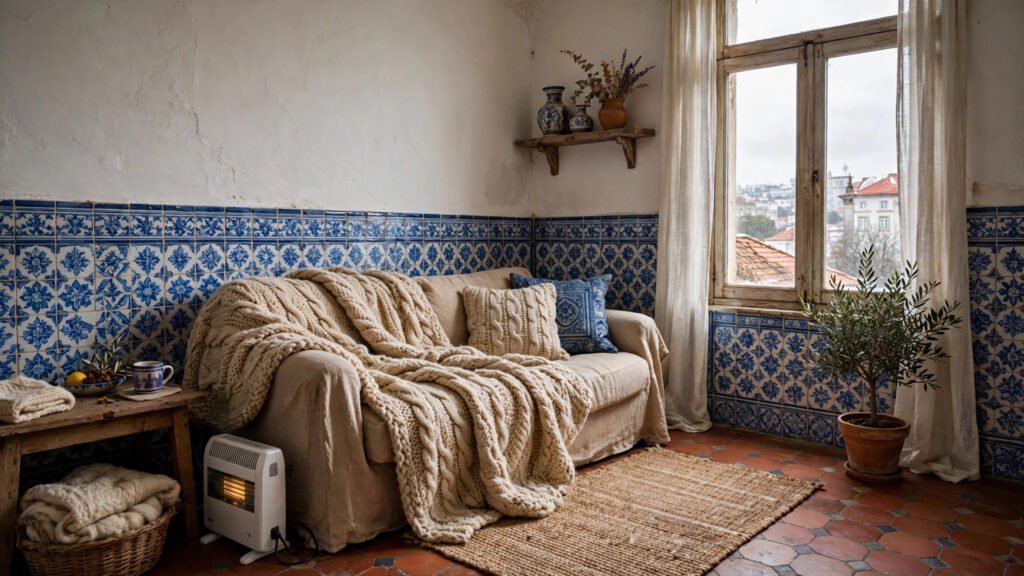
Visitors to Portugal in winter often notice something surprising. Outside, the sun may be shining and cafés may still have tables on the pavement, yet inside many homes it feels colder than expected. The reason is simple: a large number of Portuguese homes were never built with central heating, and many still do not have it today.
This is not a story of people choosing to be cold. It is a story of climate, history, building traditions and cost, all coming together in a country where homes were designed first for long, hot summers. Understanding why Portuguese homes often have no central heating explains a lot about daily life in Portugal, from thick blankets on the sofa to the portable heater humming in the corner of the living room.
Key Takeaways
- Many Portuguese homes were built to stay cool in summer, not warm in winter, so central heating was often left out entirely.
- Instead of one system for the whole home, people commonly heat one room at a time with portable heaters, fireplaces or air conditioning units.
- Adding central heating later is possible but often costly and complicated in older apartment buildings.
Why Portugal Built Homes for Summer, Not Winter
Portugal is famous for its sunshine, and for much of the year that reputation is well earned. Summers are long and hot, especially in the south, and homes were traditionally designed to cope with heat. Thick stone walls, small windows, shutters and tiled floors all help keep a house cool when the temperature climbs.
The trouble is that the same features can make a home feel cold in winter. Stone and tile hold the cold just as they hold the cool in summer, and single-glazed windows and draughty shutters let warm air escape. Winters in Portugal are generally milder than in northern Europe, with far fewer days of freezing weather, so builders and homeowners historically saw central heating as an expense they could do without.
That thinking shaped whole generations of housing. Apartment blocks built in the middle of the last century commonly had no heating system at all, or only a fireplace in the living room. The idea was that a mild winter could be managed with a fire, an extra blanket and a warm sweater indoors, rather than a boiler and radiators in every room.
What People Use Instead of Central Heating
Life without central heating does not mean life without any heating. Most Portuguese households warm their homes room by room, only where and when they need it. A portable electric heater in the living room in the evening, a fireplace on a cold weekend, or an air conditioning unit switched to its heating mode are all common sights.
This room-by-room approach has its own logic. Heating a single room where the family is gathered costs less than heating an entire apartment all day, and in a mild climate the heating season is shorter than in colder countries. Many people also open shutters and windows on sunny winter days to let the sun warm the rooms for free, then close everything up as the evening chill sets in.
At the same time, the approach has clear downsides. Bedrooms and bathrooms can stay cold, mornings can be uncomfortable, and damp can become a problem in homes that are rarely heated through. Anyone moving to Portugal from a country where every room is warm at the touch of a thermostat often finds this the biggest everyday adjustment.
Heating a single room where the family is gathered costs less than heating an entire apartment all day, and in a mild climate the heating season is shorter than in colder countries.
The North-South Difference
Portugal is not one single climate, and the heating picture changes a lot from north to south. In the north, around cities like Porto and Braga, winters are cooler and wetter, and fireplaces and wood stoves have long been part of home life. In the Algarve in the far south, winters are warmer and shorter, and some homes get by with very little heating at all.
Just as everyday habits differ across borders in Europe — for example, how Spaniards pay with Bizum instead of cash and cards — housing habits differ within Portugal itself. A home in a mountain village in the interior faces a very different winter from an apartment on the Lisbon coast, and heating reflects that local reality.
Newer homes tell a different story again. Modern building rules place much more emphasis on insulation, double glazing and energy efficiency, so a recently built apartment is far more likely to have proper heating and to hold its warmth. The gap is mostly in the older housing stock, which still makes up a large share of the homes people actually live in.
Why Retrofitting Is Not Simple
If central heating is so useful, why not simply add it to every older home? The answer is that retrofitting is often expensive and complicated. Installing a boiler, pipes and radiators in a finished apartment means major building work, and in a shared apartment block the decision usually involves the whole building, not just one owner.
Old habits also play a part, much as they do elsewhere in Europe. Germans still paying cash when cards and phones work everywhere shows how a familiar way of doing things can persist long after alternatives exist, and the same is true of heating in Portugal: many people grew up in homes heated room by room and see no reason to change a system that, for them, works well enough.
Cost is the other barrier. A full central heating installation is a major investment, and for households watching their budgets, a portable heater bought when needed feels far more manageable. Energy prices also shape the choice, since heating a whole home through the winter can add up quickly even in a mild climate.
- Portuguese homes were traditionally designed to beat summer heat, not winter cold.
- Room-by-room heating keeps costs down but leaves bedrooms and bathrooms chilly.
- Northern Portugal faces colder, wetter winters than the sunny south.
- Newer homes are far better insulated and more likely to have proper heating.
- Retrofitting older apartments is costly and often needs the whole building to agree.
What to Watch Next
Change is happening, but it is gradual. Newer homes are better insulated and better heated, and energy-efficiency improvements are slowly reaching older buildings too. For now, though, the Portuguese winter routine remains much as it has been: heat the room you are in, keep a blanket close, and make the most of the winter sun. For visitors and newcomers, knowing this before arrival makes the first cold evening far less of a surprise — and a warm sweater, as any Portuguese household will tell you, is still part of the dress code indoors.