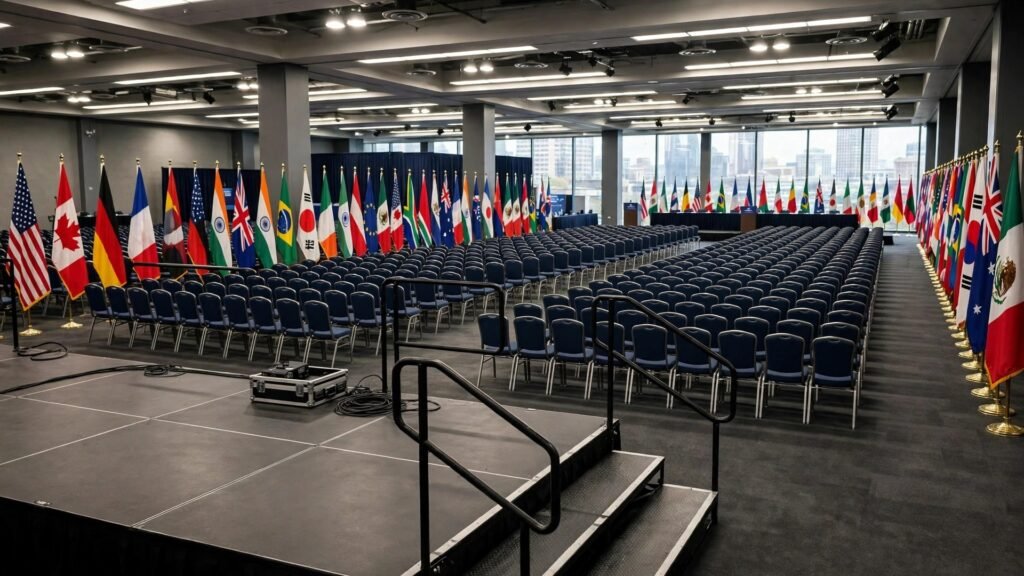
Foreign ministers from the Group of 20 leading economies skipped their traditional group photograph as their meeting opened in Atlanta on Friday, October 30, 2026, after European representatives objected to the presence of Russia. The missing photograph became the meeting’s most visible symbol of a divide that the two days of talks could not paper over.
The United States State Department removed the so-called family photo from the official agenda, and ministers began their first session without posing for photographers. A US official said Washington did not want the photograph to become a spectacle or a distraction. According to reports, US Secretary of State Marco Rubio cancelled the traditional picture after several European officials threatened to boycott it or walk out over Russia’s participation.
Russia is being represented at the Atlanta meeting by Foreign Minister Sergei Lavrov. His presence has been contentious from the start: several G20 countries had already raised concerns about the United States inviting Russia despite Moscow’s war against Ukraine, which began in February 2022.
Key Takeaways
- G20 foreign ministers skipped their traditional group photo in Atlanta after European officials objected to being photographed alongside Russia’s Sergei Lavrov.
- The US State Department removed the family photo from the agenda to avoid a spectacle, and the talks otherwise proceeded as planned.
- The episode exposed the depth of the split over Russia ahead of the G20 leaders’ summit scheduled for Miami in December.
Europe draws a line on a photo with Lavrov
European officials had made their position clear before the first session. German Foreign Minister Johann Wadephul told reporters: “In no case will there be a family photo with European partners and Mr. Lavrov together because … there is no normalcy with Russia.” A Western diplomat said a third of the participants, including Australia and Canada, had made clear they opposed the idea of being photographed alongside Lavrov.
Polish Foreign Minister Radosław Sikorski, who also serves as Poland’s deputy prime minister, called the cancellation of the group photograph “the right decision.” The British Foreign Office reiterated the United Kingdom’s longstanding policy of avoiding direct bilateral engagement with Russian ministers over the war in Ukraine.
European officials had earlier suggested there might be two separate pictures, one with Lavrov and one without. In the end, there was no group photograph at all. The Quad foreign ministers also met in Atlanta on the sidelines of the same week of diplomacy, a reminder of how crowded the city’s diplomatic calendar had become.
The missing photograph became the meeting’s most visible symbol of a divide that the two days of talks could not paper over.
Ukraine looms over the Atlanta talks
The photograph dispute did not come out of nowhere. European G20 members back Ukraine, which has objected to recent decisions by US President Donald Trump on Russia, including a deal to buy diesel and the waiving of some sanctions. Those objections have added strain to transatlantic unity on the war, and the Atlanta meeting put that strain on public display.
At the same time, Western support for Kyiv’s defences continues: the United States has approved a major Patriot missile sale for Ukraine, a reminder that the practical work of backing Ukraine carries on even as the symbolism of summit diplomacy frays.
Rubio opened the talks, which otherwise proceeded as planned, with an appeal for unity on issues threatening international security and global trade. The agenda in Atlanta was substantive, covering the wars and economic pressures shaping the global order, but the story that travelled furthest was the photograph that never happened.
- The G20 foreign ministers’ meeting in Atlanta opened on October 30, 2026, without its customary group photo.
- European officials objected to posing alongside Russian Foreign Minister Sergei Lavrov.
- Germany’s Johann Wadephul said there could be no family photo with European partners and Lavrov together.
- Poland’s Radosław Sikorski called cancelling the photo “the right decision.”
- The talks themselves went ahead as planned, with Rubio urging unity on security and trade.
What the skipped photo says about the G20
The group photograph is usually the easiest part of a summit: a few minutes of choreography that signals, whatever the disagreements behind closed doors, that the world’s major economies can still stand together. Its absence in Atlanta said the opposite. For the Europeans who refused it, posing with Lavrov would have implied a normalcy they do not accept while the war in Ukraine continues. For Washington, cancelling it avoided a walkout that would have been more damaging still.
The episode also fits a wider pattern in this G20 cycle. The Atlanta meeting is intended to lay the groundwork for the G20 leaders’ summit, which President Trump is scheduled to host at his Miami golf club in December. How leaders handle the same question, of who stands beside whom, will now be watched even more closely. Sikorski’s blunt approval of the cancellation, and the political turbulence back home in Poland, underline that for several European governments, the domestic politics of appearing alongside Russia are as fraught as the diplomacy itself.
What to Watch Next
The Atlanta talks will now feed into preparations for the December leaders’ summit in Miami, where the question of Russia’s place in the room will return. The ministers’ decision to proceed with their sessions despite the photograph dispute shows the G20 can still meet and talk, but the empty space where the group photo should have been will linger as the image of this summit. Whether December produces a photograph, or another conspicuous absence, will say much about where the world’s major economies stand on Russia, on Ukraine, and on each other.