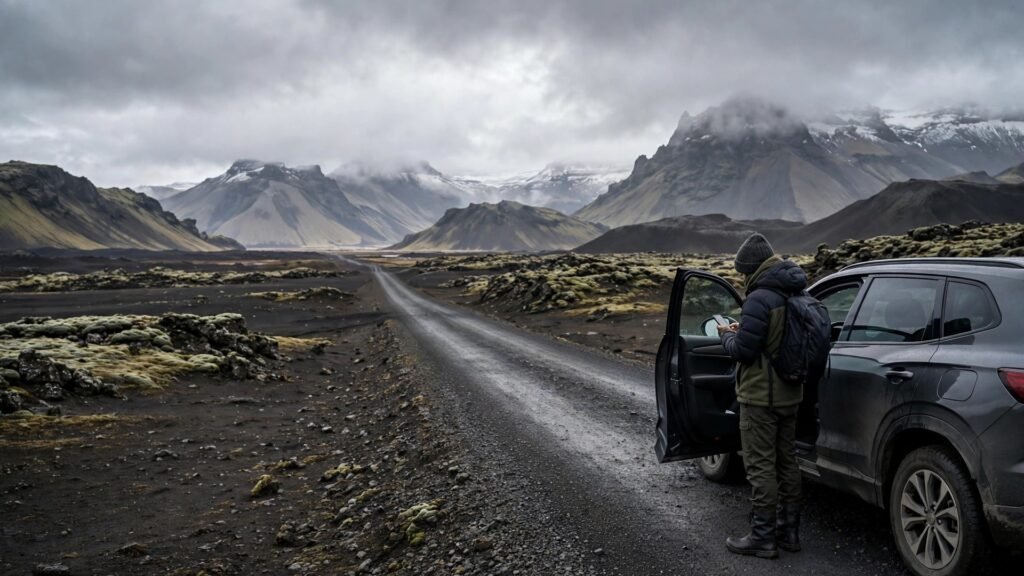
In Iceland, checking a phone before a journey is not a nervous habit. It is part of the journey itself. Before setting off across the island, many Icelanders open the weather forecast, the road conditions and the daylight hours, and only then decide when to leave, which route to take, or whether to wait. For visitors, this can look like over-caution. For people who live with Iceland’s weather, it is simply common sense.
Key Takeaways
- Iceland’s weather can change fast, so a forecast check is a safety step, not just a convenience.
- Road conditions matter as much as weather, especially on gravel roads and mountain routes.
- Daylight, wind and seasonal conditions shape when Icelanders travel and which route they choose.
Why the Weather Check Comes First
Iceland sits in the North Atlantic, where weather systems arrive quickly and conditions can differ sharply from one part of the country to another. Sunshine in Reykjavik does not mean clear skies an hour’s drive away, and a calm morning can turn into a windy afternoon. That is why a single glance out of the window is rarely enough. The phone gives a fuller picture: wind strength, rain or snow, temperature, and how conditions are expected to change during the hours of the trip.
Wind deserves special attention in Iceland. Strong gusts can make driving difficult, especially for larger vehicles, and can turn loose gravel into a hazard. Checking the wind forecast helps drivers decide whether to delay a journey, take a more sheltered route, or avoid an exposed stretch of road altogether. In winter, the same check covers snow, ice and reduced visibility, all of which can transform a familiar road into something very different.
The habit is also practical for everyday life, not only for long road trips. A short drive to work, a school run, or a walk with children can all depend on whether a storm is on its way. In a country where the weather is a constant topic of conversation, the phone has become the fastest way to turn that conversation into a decision.
Roads, Not Just Weather
Weather alone does not tell the whole story. Iceland’s road network includes paved main roads, gravel roads, and mountain roads that are only open in certain seasons. Some routes close in winter, others become difficult after heavy rain, and roadworks or closures can change a plan at short notice. Checking road conditions before leaving helps drivers avoid arriving at a closed road with no easy alternative.
This matters most outside the capital region. In remote areas, the next petrol station, the next town, or the next place to ask for help can be a long way off. A driver who knows the road ahead is passable, and knows where the journey might slow down, travels with far less uncertainty. That is a large part of why the phone check feels so routine: it replaces guesswork with information before the car ever moves.
In Iceland, the phone check replaces guesswork with information before the car ever moves.
What Icelanders Actually Check
The pre-trip phone routine usually covers a small set of questions, asked in the same order almost every time. The answers together decide whether the trip goes ahead as planned.
- Weather and wind: the forecast for the whole route, not just the starting point, with attention to gusts and storms.
- Road conditions: whether roads are open, wet, icy or under repair, and whether mountain roads are passable.
- Daylight: sunrise and sunset times, which change dramatically between summer and winter in Iceland.
- Warnings and alerts: official weather warnings and travel advice for the areas the journey will pass through.
- The return journey: whether conditions will still be safe hours later, when it is time to come home.
Official sources play a central role in this routine. Iceland’s meteorological service provides forecasts and warnings, the road authority reports on road conditions and closures, and travel safety information brings the two together for drivers and visitors. Using official information, rather than relying on a single app’s general forecast, is part of what makes the habit reliable.
Daylight, Seasons and the Aurora Factor
Daylight is another reason the phone comes out before every trip. In summer, Iceland enjoys very long days, and it can be easy to lose track of time on the road. In winter, daylight is short, and a journey that feels comfortable at midday can end in darkness. Checking sunrise and sunset times helps drivers plan their departure so they are not caught on an unfamiliar road after dark.
Seasonal conditions add further layers. Winter brings ice, snow and storms, while spring thaw and autumn rain can affect gravel roads. Summer brings its own considerations, including busy tourist routes and mountain roads that open only when conditions allow. The phone check adapts to the season: the same habit, applied to different risks at different times of year.
For many Icelanders, and for visitors too, the phone is also the tool for checking aurora forecasts on clear winter nights. That is a lighter side of the same habit — using real-time information to decide whether a late-night drive into dark skies is worth it. It shows how deeply the phone has become part of how people read the Icelandic landscape.
What Visitors Can Learn From the Habit
Visitors to Iceland benefit enormously from adopting the same routine. Tourists sometimes assume that a short distance on the map means a short, easy drive, but in Iceland distance, weather and road surface all matter. A phone check before leaving the hotel can prevent a wasted journey to a closed road, a difficult drive in worsening weather, or an unplanned night in an unfamiliar place.
The habit is also a reminder to plan the return journey, not just the outward one. Conditions that are fine in the morning may not be fine in the evening, and daylight that feels generous at noon disappears quickly in winter. Icelanders check their phones before every trip because they know the landscape rewards preparation. People in other countries shaped by natural forces develop similar habits, whether that means checking phones across scattered North Atlantic islands or staying connected across a vast Arctic island. In each case, the phone is less a distraction from the landscape than a way of travelling through it safely.
What to Watch Next
The phone check itself is unlikely to disappear. As forecasts improve, road information becomes more detailed, and alerts reach drivers faster, the pre-trip routine will only become more precise. What will keep mattering is the judgement behind it: knowing when to wait, when to change route, and when a journey is better made another day. In Iceland, that judgement starts with a phone, a forecast, and a road report — checked before every trip, because the weather, the roads and the daylight can all change before the journey is over.