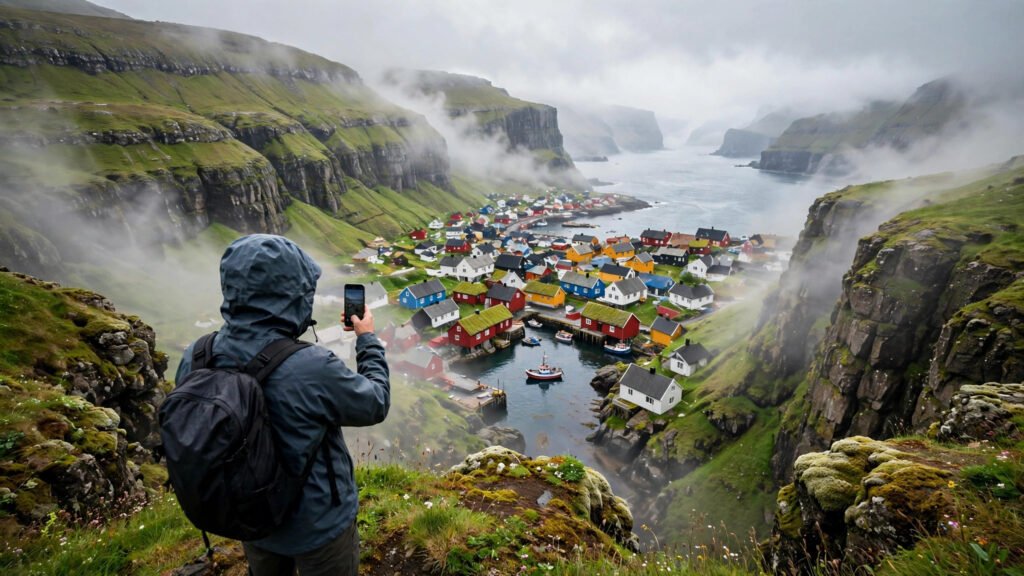
The Faroe Islands sit in the North Atlantic, between Iceland, Norway and Scotland, and daily life there is shaped by water, weather and distance. Villages are spread across a chain of steep, green islands, separated by fjords and open sea. In that setting, a phone is not only a gadget for spare moments. For many Faroe Islanders, it is the tool that holds work, travel, family life and news together.
That is why the question keeps coming up in searches: why do Faroe Islanders rely on their phones so much? The answer is not about one app or one habit. It is about living in a place where the next village can be a tunnel, a ferry ride or a stretch of sea away, and where the weather can change a plan in an hour.
Key Takeaways
- Scattered islands, fjords and fast-changing weather make the phone the main way to check travel, work and safety before leaving home.
- Phones link fishing, farming, small businesses and remote work to customers, buyers and colleagues far beyond one village.
- For families spread across islands, the phone keeps everyday contact, school life and community news within reach.
Islands, Weather and Distance Make the Phone Essential
On a map, the Faroes look small. On the ground, they feel spread out. A short journey can mean a drive through a tunnel under the sea, a wait at a ferry terminal, or a careful look at the forecast before setting out. When fog rolls in, wind picks up or a sailing is delayed, the first thing many people check is a phone.
That habit is practical rather than fashionable. A phone can show whether a route is open, whether a boat is running, and whether conditions are likely to improve later in the day. It can also carry the message that changes everything: a delayed departure, a cancelled crossing, or a family member asking to meet at a different time.
People who live on smaller or more remote islands feel this most. A trip to a larger town for shopping, a medical appointment, a school event or a work meeting is not a quick walk around the corner. It is a planned journey, and the phone is where the plan is made, checked and, when needed, changed.
In the Faroes, the phone is often the difference between a wasted journey and a journey that works.
Work at Sea, on Land and Online
Fishing has long been central to Faroese life, and phones now sit alongside older skills rather than replacing them. Fishers, harbour workers and people in fish processing use phones to coordinate landings, arrange transport, talk to buyers and keep in touch with crews. When timing matters, a message can save a long wait at the quay.
Farming on steep hillsides and small fields is also shaped by distance. Sheep farming and other rural work often take people away from the house for much of the day, and a phone keeps them reachable. It carries weather updates, messages from family, and the small decisions that keep a working day moving.
At the same time, many Faroe Islanders work in offices, schools, health services, tourism and small businesses, and some work online for clients elsewhere. For them, the phone is a second workplace: emails, calls, calendars, documents and video meetings all travel in a pocket. In a country where a specialist, a customer or a colleague may be on another island, that kind of connection is not a luxury. It is how work gets done.
Tourism adds another layer. Visitors arrive by sea and air, often with tight schedules and questions about routes, weather and places to stay. Local hosts, guides, drivers and shopkeepers use phones to answer questions, confirm bookings and adjust plans when the weather changes. A clear message can turn a confusing day into a good one.
Family, School and Everyday Services
Families in the Faroes are often spread across islands. Children may study in one place, parents may work in another, and grandparents may live in a village reached only by tunnel or ferry. Phones keep those everyday threads alive: a morning message, a photo from school, a call on the way home, or a shared plan for the weekend.
For young people, the phone is also part of school and social life. Lessons, homework, messages from teachers and contact with friends all pass through it. For older residents, it can be a way to stay part of village life even when travel is harder, whether that means a video call with family, news from a community group, or a message from a neighbour.
Everyday services have followed the same path. Banking, shopping, appointments, tickets and official information are increasingly handled online, and the phone is the easiest device for many people to use. That matters most where the nearest office or shop is not nearby. Instead of a long journey for a simple task, a phone can often settle it in minutes.
This pattern is familiar in other island places too. In Cape Verde, phones help people stay connected across nine inhabited islands, while in Greenland, phones bridge enormous distances across a vast Arctic island. The Faroes are smaller, but the same logic applies: when the sea is between you and the people you need, the phone shortens the distance.
- Travel first: check ferries, tunnels and weather on the phone before a journey between islands.
- Work second: fishing, farming, tourism and online work all depend on fast, clear messages.
- Family third: calls, photos and group chats keep island families close across the water.
- Services fourth: banking, bookings and appointments are often easiest from a phone.
Travel Between Islands
Travel is where the phone proves its value most clearly. A Faroese day can involve a tunnel, a road over a mountain pass, a ferry crossing and a walk through a village in changing weather. Each leg depends on the one before it, so a delay in one place can affect the whole journey.
Phones help people adapt. A traveller can check a sailing, warn a host about a late arrival, rearrange a meeting, or choose a different route. A driver can share a location with family. A visitor can find the next connection instead of waiting without information. None of this removes the sea or the weather, but it removes much of the uncertainty around them.
It also helps in winter, when daylight is short and storms are more common. Checking conditions before leaving home is a simple safety habit, and the phone makes it easy. A quick look at a forecast, a message from a ferry operator, or a warning from a local group can be the reason a journey is postponed rather than attempted in poor conditions.
Staying Connected When the Weather Turns
North Atlantic weather deserves respect. Wind, rain, fog and rough seas are part of life in the Faroes, and they shape how people plan. The phone does not control the weather, but it helps people live with it. Forecasts, travel updates, school messages and community notices all arrive on the same device, often before a person leaves the house.
That is also why cash is used less and less in many everyday settings, a shift seen across the Nordic region. In Iceland, phones and cards have largely replaced cash for daily payments, and Faroese life follows a similar pattern: a phone can pay, book, confirm and record in one place, which is useful when a journey already involves several steps.
None of this means the phone replaces face-to-face life. Village halls, churches, sports clubs, harbours and family kitchens remain at the centre of Faroese community life. The phone simply makes it easier to get there, to know what is happening, and to stay in touch when distance or weather gets in the way.
What to Watch Next
The pattern described here is unlikely to change soon. Scattered islands will still need ferries and tunnels, weather will still change plans, and families will still live across the water from one another. What may change is how smoothly phones handle those everyday tasks, as connections improve, services move further online, and travel information becomes clearer.
For Faroe Islanders, the phone will probably remain what it already is: a practical companion for island life. It checks the journey, carries the workday, keeps family close, and helps a small, spread-out community feel connected across the North Atlantic.