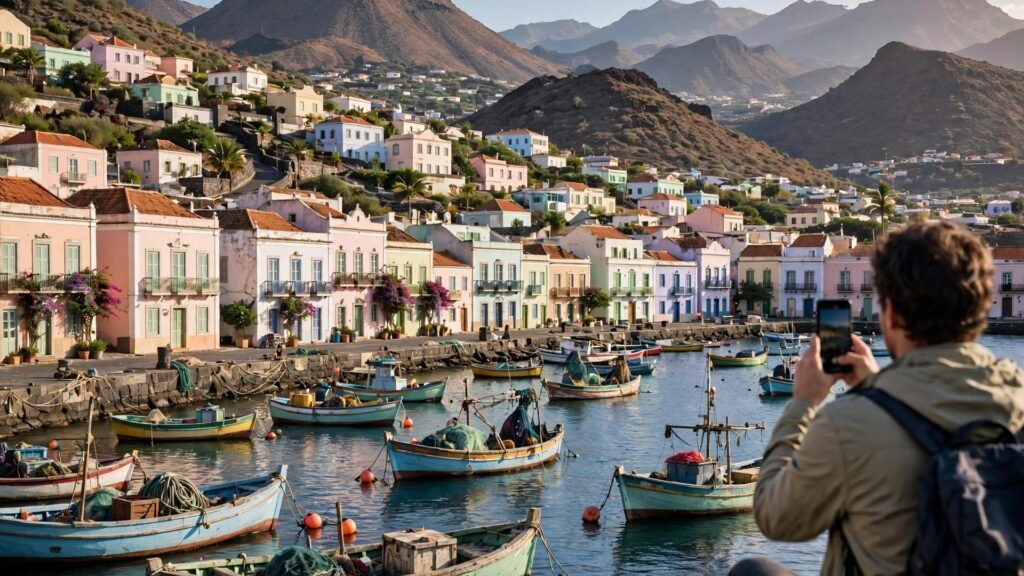
Cape Verde is not one place. It is an archipelago in the Atlantic Ocean, off the west coast of Africa, made up of ten islands, nine of them inhabited. Between those islands lies open sea. That one fact shapes almost everything about daily life here, and it explains why the mobile phone has become the most important object in a Cape Verdean pocket.
On a single island, a phone is convenient. Across nine islands, it is the bridge. It carries family news, money, work, travel plans and music from one shore to another, often faster than any boat or plane can. For many Cape Verdeans, the phone is not just a device. It is how the country holds together.
Key Takeaways
- Cape Verde is nine inhabited islands separated by sea, so the phone bridges distances that boats and planes cannot always cover.
- Families spread across islands and abroad stay close through calls, messages and mobile money sent on the phone.
- Fishermen, small traders, students and musicians all use the phone to plan, sell, learn and share their work.
An archipelago life, lived at a distance
The islands of Cape Verde stretch across a wide patch of ocean. Santiago holds the capital, Praia, and the largest population. São Vicente is home to Mindelo, the cultural port city famous for music. Santo Antão is steep and green, Sal and Boa Vista are flat and dry, and Fogo rises around a volcano. Each island has its own character, its own pace and its own weather.
That spread means families are rarely all in one place. A brother may work on Sal, a sister may study in Praia, and parents may live on a quieter island. Cousins and childhood friends may have moved abroad years ago. In a country where so many people live far from the people they love, staying in touch is not a luxury. It is a daily need, and the phone is how it happens.
Islanders have always found ways to stay connected. Letters travelled by boat, and radio carried voices across the water. The phone simply does what those older tools did, instantly and in both directions. A voice note in the morning, a photo at lunch and a video call in the evening can keep a family feeling like one household, even when its members sleep on different islands.
When the sea decides the schedule
Travel between the islands depends on ferries and flights, and both depend on the sea and the wind. A rough crossing can delay a ferry. A change in weather can shuffle a day’s plans. When that happens, the phone becomes the first place people turn.
Travellers check whether a boat is running before they leave home. Families waiting at a port hear about a delay in a message rather than by standing for hours at the quay. A fisherman deciding whether to go out looks at the forecast on his phone before he unties his boat. In island life, good information saves wasted journeys, and the phone delivers it while there is still time to change plans.
This is a pattern shared by other island nations, where scattered shores make the phone essential. In Comoros, where people rely on their phones across three islands, the same logic applies on a smaller map, and in Seychelles, where islanders do almost everything on phones across scattered islands, distance has pushed daily life onto the screen in much the same way.
Family first, across the ocean
Cape Verde has a large diaspora. Generations of Cape Verdeans have moved abroad for work and study, and many families count members in Portugal, the United States, the Netherlands, France and beyond. For these families, the phone is the family table.
Birthdays are celebrated on video calls. Grandparents meet grandchildren they have never held, on a screen. News of a birth, a wedding or a loss travels in minutes rather than weeks. The phone does not replace a visit home, and nobody pretends it does. But between visits, it keeps the bond warm and current.
Money follows the same path. Relatives abroad send support home, and mobile channels have made that help easier to receive and use. A payment that once depended on a long journey or a middleman can now arrive on a phone and be spent in a local shop the same day. For households spread across islands and continents, that speed matters.
For many Cape Verdeans, the phone is not just a device. It is how the country holds together.
Work, trade and the small business phone
The phone is also a workplace. Small traders photograph their goods and share them with customers on another island. Guesthouse owners answer bookings by message. Musicians record a new morna or funaná track and send it to friends before it ever reaches a stage. Taxi drivers, guides and market sellers arrange their day around calls and messages.
For fishermen, the phone is a practical tool. Weather, wind and sea conditions shape every decision, and a wrong call can waste fuel or put a crew at risk. Checking conditions before setting out, and staying reachable while at sea, has become part of the routine. When the catch comes in, the phone helps find buyers quickly, so fresh fish does not wait long on the quay.
Students use the phone in a similar way. Study materials, class groups and exam news travel through messaging apps, and a student on a smaller island can keep up with classmates in the capital without travelling for every question. The phone cannot replace a classroom, but it shrinks the distance between islands in a way that matters for learning.
Two languages, one screen
Language is another reason the phone fits Cape Verde so well. Portuguese is the official language, used in schools, government and formal writing. Cape Verdean Creole, or Kriolu, is the language of home, friendship, music and everyday conversation. Most Cape Verdeans move between the two without thinking.
The phone follows that rhythm. A formal message to an office may be written in Portuguese, while a voice note to a cousin arrives in Kriolu, warm and fast. Voice notes are especially popular, because they carry tone, laughter and feeling in a way typed text cannot. For older relatives who may read slowly or not at all, a voice note is simply easier, and it keeps them fully part of the conversation.
Music travels the same way. Cape Verde’s music is known far beyond its shores, and new songs spread phone to phone before they reach radio. A track recorded in a small studio in Mindelo can be heard on another island the same evening, and by the diaspora abroad soon after. The phone has become the country’s loudest loudspeaker.
- Nine inhabited islands, one ocean between them — the phone is the everyday bridge.
- Family calls, voice notes and mobile money keep islanders and the diaspora close.
- Ferries, flights, fishing and small trade all run on phone information and messages.
- Portuguese and Kriolu share the screen, with voice notes carrying the warmth of home.
- Music, news and study materials travel phone to phone across the archipelago.
Why the phone matters more here than on the mainland
On a mainland, a person can drive to the next town. In Cape Verde, the next town may be on another island, across hours of sea. That simple difference changes what a phone is for. It is less of a gadget and more of a piece of infrastructure, as basic as a road or a harbour.
Islanders know the phone has limits. Coverage can vary, especially in remote valleys and on smaller islands. Batteries run down, and charging is not always simple. A screen cannot carry a sack of grain or a sick relative to hospital. But for communication, coordination and connection, nothing else in daily life does so much, so quickly, for so many people.
The same is true in other scattered island states. In Maldives, where people rely on phones across scattered islands, the phone fills the same gap between atolls, proving that island geography, more than any single app, is what makes the phone indispensable.
What to Watch Next
As connections between the islands improve, the phone’s role is likely to grow rather than shrink. Better coverage on smaller islands would make remote learning, telemedicine and online trade easier for people who currently travel furthest for services. More reliable inter-island information would help travellers, fishermen and traders plan with greater confidence.
What will not change is the reason behind it all. Cape Verdeans rely on their phones because their country is spread across the sea, their families are spread across the world, and the phone is the thread that keeps them together. The islands are separate, but the conversation never stops.