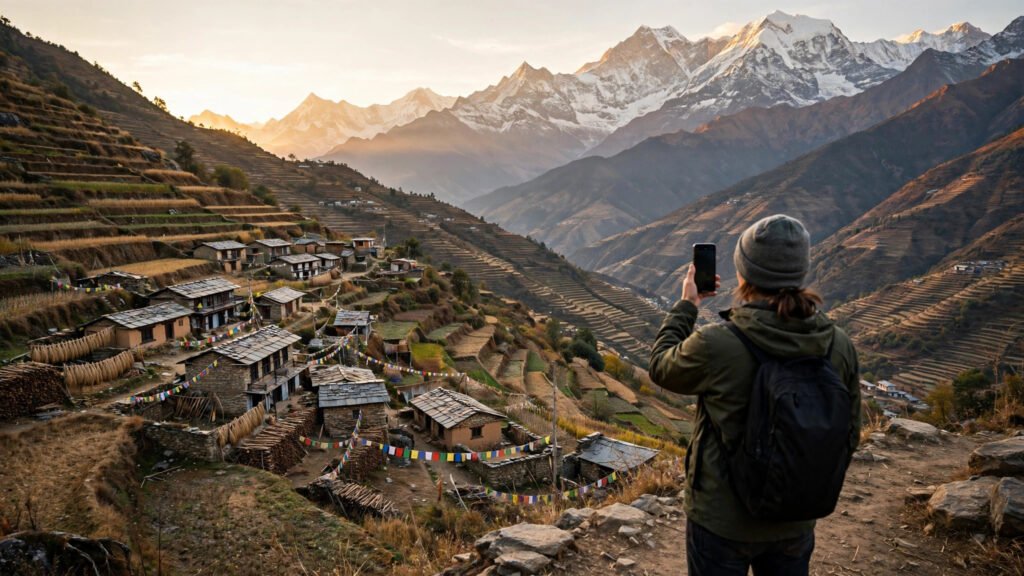
In Nepal, geography shapes almost everything. Villages sit on steep hillsides, valleys are separated by rivers and ridges, and a journey that looks short on a map can take hours on foot. For many Nepalese, the phone has become the practical answer to that distance. It is not only a device for chatting. It is how families stay in touch, how money moves, how news travels, and how everyday errands get done when the nearest town is far away.
The question is not really why people in Nepal use phones. People everywhere do. The more interesting question is why the phone matters so much here, and why it often replaces a trip, a queue, or a paper form rather than simply adding to them. The answer lies in the mountains, in migration, and in the way daily life is organised around villages that are close in feeling but far apart in travel time.
Key Takeaways
- Nepal’s steep terrain makes travel slow, so a phone often replaces a long journey.
- Phones help families stay connected and move money when relatives work far from home.
- Mobile services work best when they are simple, affordable, and useful without a trip to town.
When a Short Distance Takes a Long Time
In the hills and mountains, distance is measured less in kilometres and more in time. A neighbouring settlement may be visible across a valley, yet reaching it can mean a steep climb down, a river crossing, and a climb back up. Roads can be blocked by landslides in the rainy season, and winter conditions can make some routes harder still. In that setting, a phone call is not a luxury. It can save a whole day.
That is why phones are used for the small checks that prevent wasted journeys. A farmer can ask whether a shop has stock before setting out. A parent can check whether a school is open. A traveller can ask about road conditions before leaving home. Each call is small, but together they change how a week is planned. In a country where a neighbouring village can be a day’s walk away, a phone call can close a distance that roads cannot.
Staying Close Across Far Distances
Many Nepalese families live apart for work. Some members work in Kathmandu or another city, while others remain in their home village. Others work abroad and send support home. For these families, the phone is the main thread that holds daily life together. Voice calls, messages, photos, and video calls carry birthdays, health updates, school news, and simple reassurance that everyone is well.
This matters even more when travel is expensive or difficult. A short video call can let grandparents see a grandchild who lives far away. A message can share news the same day instead of waiting for someone to travel. The phone does not replace family visits, but it keeps the gap between visits from feeling like silence.
Money Without a Long Trip to Town
Paying and receiving money is another place where phones change daily life. In villages far from a bank branch, a trip to town for a simple payment can cost time and transport money. Mobile wallet apps and mobile banking let people pay bills, top up a phone balance, and receive money without making that trip every time. For households that depend on money sent by relatives, being able to receive and use funds on a phone can make the difference between a quick errand and a lost day.
The same pattern is visible in other places where branches are far apart. In the Himalayan neighbour Bhutan, people also pay by phone instead of cash in many everyday situations, and across the open steppe in Mongolia, phone banking reaches places where a branch visit would be a long journey. Nepal fits that wider story: when the land is hard to cross, the service that travels lightest wins.
News, Weather, and Practical Information
Phones are also a first source of practical information. Weather matters for planting, harvesting, and travel. News about road closures, school timings, market days, and local events spreads quickly through messages and social apps. In rural areas, a forwarded message from a trusted neighbour or a local group can be more useful than a formal notice posted far away, because it arrives where people already are.
That speed has limits, and it is worth naming them. Not every message is accurate, and not every area has strong coverage. In remote valleys, a signal can be weak or disappear behind a ridge. Charging a phone can also be a challenge where electricity is limited. The phone is therefore best understood as a tool that helps a lot, not as a complete solution to distance.
In a country where a neighbouring village can be a day’s walk away, a phone call can close a distance that roads cannot.
Why Simplicity Matters More Than Features
For a phone service to work well in Nepal, it has to be simple. People need clear menus, local language options where possible, and steps that work on basic handsets as well as newer smartphones. A service that needs a fast connection, a large download, or a complicated form will struggle in places where the connection is slow or the phone is shared within a family.
Cost matters too. A service that saves a bus fare and a day of travel is valuable, but only if using it does not eat up the saving in data or fees. That is why the most useful phone habits in Nepal tend to be practical ones: a short call instead of a trip, a mobile payment instead of a queue, a message instead of a missed connection. The technology succeeds when it disappears into the errand itself.
- Terrain makes travel slow, so phones replace many journeys.
- Calls and messages keep migrant families connected day to day.
- Mobile payments save trips to town for bills and received money.
- Weather, road, and market news spreads fastest by phone.
- Simple, low-cost services work best in areas with weak coverage.
Daily Life in Towns Looks Different, Too
In Kathmandu and other towns, phones are woven into a different kind of daily life. People order food, book rides, follow classes, run small businesses, and sell goods through social apps. Students use phones for study material and group work, and shopkeepers use them to talk to suppliers and customers. In Sri Lanka, too, many people run daily life from their phones, and the pattern is familiar: once messaging, payments, and information sit in one device, fewer errands need a separate trip.
The difference between town and village is therefore one of degree, not direction. In towns, the phone adds convenience. In remote villages, it often adds access itself. That is why the same device can feel like a comfort in one place and a necessity in another, even within the same country.
What to Watch Next
What happens next in Nepal will depend less on new features and more on the basics already described here: better coverage in valleys and remote settlements, simpler services, affordable data, and reliable ways to charge a phone. If those basics improve, phones will keep replacing long journeys for calls, payments, and practical news. If coverage and cost remain uneven, the phone will still help, but its benefits will reach some villages faster than others. Either way, the reason Nepalese rely on their phones is unlikely to change soon, because the mountains that make the phone so useful are not going anywhere.