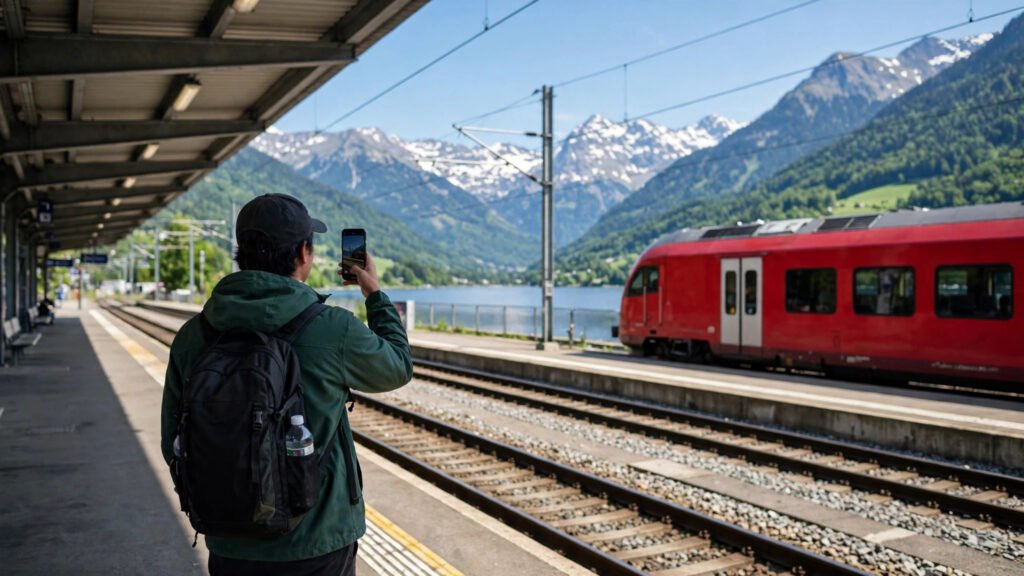
Switzerland is a country where a train journey can cross a language border without ever leaving the railway. A traveller may board in a German-speaking town, change trains in a French-speaking city, and arrive somewhere Italian is spoken on the platform signs. Before any of that begins, most travellers do one small thing: they check their phones.
That quick check is not really about the phone itself. It is about the journey. Swiss trains run often, connections can be tight, and a platform change or a delayed train can turn a smooth trip into a missed connection. The phone holds the timetable, the platform, the connection and the ticket in one place, so the journey can be planned before leaving home and adjusted on the way.
Key Takeaways
- Swiss train journeys often cross language regions, so a phone check helps travellers follow timetables, platforms and announcements in more than one language.
- Connections can be tight, and checking before departure helps travellers spot delays, platform changes and the fastest route.
- The phone also carries the ticket and the rest of the journey, from the station to the final stop, in one place.
A Small Country With Several Languages
Switzerland has four national languages, and in everyday travel three of them are hard to miss: German, French and Italian are all used in different regions, with Romansh spoken in parts of the south-east. For a traveller, that means station names, announcements and signs can change partway through a journey, even when the train itself does not change.
A phone helps because it can show the journey in the language the traveller understands best. A route that looks confusing on a station board can become clear on a screen: the departure time, the platform, the changes and the arrival time, all in one list. For visitors, that clarity matters even more, because a place name can look quite different in another language, and a missed letter can mean a missed stop.
Language is not the only reason to check. Switzerland’s rail network is dense, with many small stations, branch lines and mountain routes. A journey that looks simple on a map may involve two or three changes, and the best route can depend on the time of day. Checking first means choosing the route that fits the day, rather than discovering the changes at the station.
Connections, Platforms and Delays
The most practical reason Swiss travellers check their phones is connection time. Many journeys are built around short changes, where one train arrives and the next leaves a few minutes later. That works well when everything runs on time, but a delay of even a few minutes can matter. A phone check before leaving home shows whether the connection is still comfortable, and a check during the journey shows whether a later train is a better choice.
Platform changes are another everyday reason. At a busy station, a train may leave from a different platform than usual, and the information on the departure board can change quickly. A phone that updates with the latest platform saves a walk across the station and the worry of standing on the wrong side. For travellers with luggage, children or a tight connection, that detail is worth more than it sounds.
A phone check before leaving home shows whether the connection is still comfortable, and a check during the journey shows whether a later train is a better choice.
Delays, engineering work and weather can also change a journey, especially on mountain routes where conditions matter. A traveller heading into the Alps may want to know whether the route is running normally before setting out, rather than finding out at a valley station. The phone does not remove the delay, but it does remove the surprise.
Tickets, Passes and the Whole Journey
For many Swiss travellers, the phone is also where the ticket lives. A ticket bought on the phone cannot be left at home, it can be bought at the last minute, and it can be shown to a conductor without searching through a bag. That convenience fits a country where many people travel by train every day, for work, school and leisure.
The same habit is visible in other kinds of Swiss phone use. Many residents already pay for everyday things with their phones, and the Swiss pay with TWINT instead of cards or cash for many small purchases. Train travel fits that pattern: planning, paying and proving the journey all happen on the same device, and the paper ticket becomes the exception rather than the rule.
That does not mean paper has disappeared. Ticket machines, staffed counters and printed timetables still exist, and they matter for visitors, for older passengers and for anyone whose phone battery is low. The healthiest version of the change is a mixed one: the phone as the easy default, with other options kept available for everyone else.
Why Neighbours Travel Differently
Switzerland’s neighbours show how local habits shape phone use in travel. In Liechtenstein, a small Alpine country between Switzerland and Austria, daily life often crosses a border before breakfast, and Liechtensteiners run daily life on their phones between two borders, from banking to bus timetables. The phone there is a bridge between countries, just as in Switzerland it is a bridge between language regions.
Further east, Slovaks pay for trains, buses and parking with their phones, because a ticket on the phone removes queues and the risk of a lost paper ticket. The details differ — Slovakia’s story is about payment, Switzerland’s is about planning across languages — but the underlying habit is the same: the phone makes a complicated journey feel simple.
- Check the whole route, not just the first train, so changes and language regions are clear before departure.
- Watch for platform changes at busy stations, where the departure board can change quickly.
- Keep a backup option in mind, such as a later connection, in case a delay shortens the change time.
- Charge the phone before a long journey, especially on mountain routes where the ticket and timetable both live on it.
- Remember that paper tickets and staffed help still exist for travellers who need them.
What the Phone Check Cannot Fix
A phone check is useful, but it has limits. It cannot make a delayed train run on time, and it cannot create a connection that does not exist. On a very busy day, or when weather closes a mountain route, the best the phone can do is show the next available option and help the traveller decide whether to wait, reroute or travel another day.
There is also a limit to how much information helps. A journey with three changes, two languages and a platform change can look overwhelming on a small screen, and some travellers still prefer to ask at a counter or follow the station signs. That is not a failure of the phone; it is a reminder that a good journey needs clear information in more than one form.
Finally, the phone depends on battery and signal. Tunnels, mountain valleys and busy stations can all interrupt a connection, and a phone that runs out of charge leaves the traveller without a timetable or a ticket. Experienced travellers plan for that too: a charged phone, a note of the key departure times, and the knowledge that station staff can help when the screen goes dark.
What to Watch Next
Swiss travellers check their phones before train journeys because the journeys themselves ask for it: several languages, tight connections, changing platforms and routes that cross regions in a single trip. The phone brings the timetable, the platform, the connection and the ticket together, and that makes the journey easier to plan and easier to change.
What comes next is likely to be more of the same, done more smoothly: timetables, tickets and live updates joining up in fewer places, with paper and staffed help kept for those who need them. The phone will not make Swiss trains run any faster, but it will keep making a journey across language regions feel like one journey, rather than several separate ones.