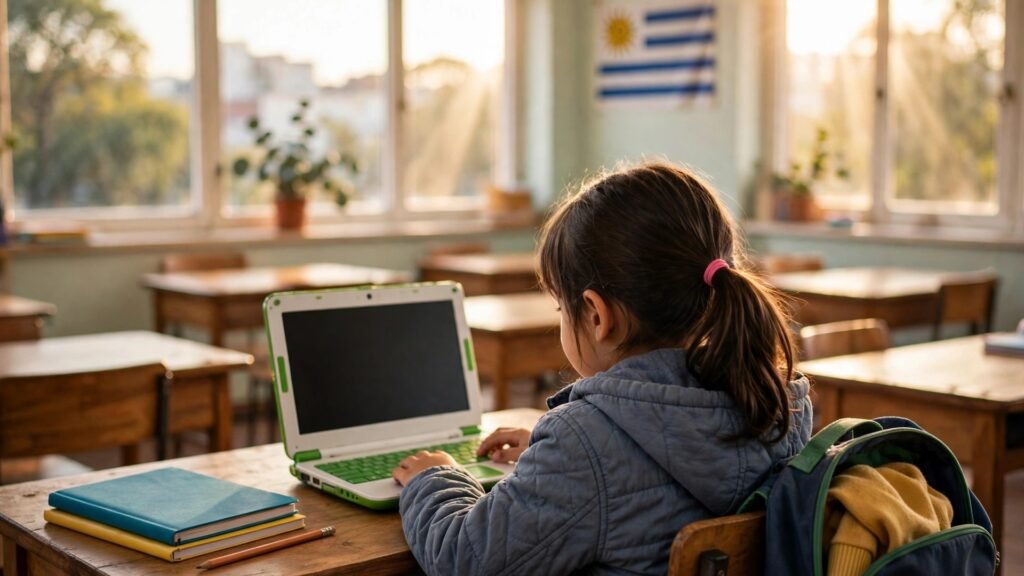
In most countries, a school computer is something children share: a lab they visit once a week, a trolley wheeled between classrooms, a device that belongs to the school. In Uruguay, the picture is different. There, a laptop is something a schoolchild owns and carries home, because the country decided years ago that every child in a state primary school should have one of their own.
The programme behind that decision is called Plan Ceibal. It is one of the most talked-about education technology projects in the world, and it is still shaping how Uruguayan children learn, do homework and connect to the internet today. Here is how it works, why Uruguay chose this path, and what other countries can learn from it.
Key Takeaways
- Plan Ceibal gives every child in Uruguay’s state primary schools their own laptop to use at school and at home.
- The programme pairs the devices with classroom connectivity, teacher training and learning platforms, rather than handing out hardware alone.
- Its goal is equal access: a child’s family income should not decide whether they can learn with a computer.
What Is Plan Ceibal?
Plan Ceibal began in 2007, when Uruguay’s government set out to close the digital gap between children from different backgrounds. The idea was simple and ambitious at the same time: put a small, rugged laptop into the hands of every pupil in a state primary school, and connect schools to the internet so the machines were genuinely useful.
The name comes from the ceibo, Uruguay’s national flower, and the programme quickly became a national symbol. Over time it expanded beyond primary schools into secondary education, with devices and platforms adapted for older students. Teachers received training and support, and schools were given the connectivity and technical help needed to keep the programme running day to day.
Importantly, the laptop is not a reward for good grades or a device reserved for a few classrooms. It belongs to the child’s learning: it travels between school and home, it holds their schoolwork, and it gives them a way to explore, practise and create outside lesson time.
Why Laptops, and Not Just Computer Labs?
Uruguay’s choice was deliberate. A shared computer lab means a child might get an hour of screen time a week, under supervision, on a machine they cannot personalise. A personal laptop changes that relationship completely. The child learns to care for a device, to organise their own files, to type, to search and to build things over weeks and months rather than in a single lesson.
That ownership also changes what happens at home. When the laptop goes home, parents and siblings see it too. In many households, the school laptop was the family’s first computer, and the first reason to get connected. Homework, reading and school projects began to flow through a device the whole family could gather around, which is one reason the programme is often described as a social project as much as a technology one.
In many households, the school laptop was the family’s first computer, and the first reason to get connected.
How It Works in Practice
A child receives a laptop through their state school, configured for learning with educational software and access to the country’s learning platforms. Teachers plan lessons around the devices, using them for reading, maths practice, research, writing and creative projects. The platforms let teachers set work, follow progress and share resources, while students can practise at their own pace.
Connectivity is the other half of the design. A laptop without internet is a much smaller tool, so schools were connected and public wireless access points were set up in many communities. When a device breaks or a child moves school, there are repair and support arrangements, because a programme that depends on every child having a working machine has to plan for the days when one stops working.
Teachers sit at the centre of all of this. Training and classroom support matter more than the hardware itself: a laptop only improves learning when the teacher knows how to weave it into a lesson, when to put it away, and how to help a pupil who is stuck. Uruguay invested in that side of the programme alongside the devices, which is a large part of why it lasted while similar one-laptop projects elsewhere faded.
- Every state primary school pupil gets their own laptop, not a shared lab machine.
- Devices travel between school and home, so learning does not stop at the school gate.
- Classroom connectivity, learning platforms and teacher training support the hardware.
- Repair and support systems keep devices working, because a broken laptop helps nobody.
What Changed for Children and Families?
For children, the biggest change is familiarity. A pupil who has used their own laptop since primary school arrives at secondary school already comfortable with typing, searching, presenting and creating digital work. Those are everyday skills in modern workplaces, and they are far easier to build over years of daily use than in occasional computer lessons.
For families, the change is access. A household that could not afford a computer suddenly has one, along with a reason to learn how it works. Parents help with homework on the same screen their child uses at school, and children often teach their parents in return. That two-way learning is one of the programme’s most human effects, and it is hard to measure with test scores alone.
For the country, the change is a generation growing up with digital skills as a normal part of schooling rather than a privilege. Uruguay is a small country, and Plan Ceibal gave it an outsized reputation in education technology circles, with delegations and researchers visiting to see how a nationwide rollout actually works in practice.
The Challenges Nobody Hides
No programme of this size runs without problems, and Plan Ceibal is no exception. Devices break, batteries age, and keeping thousands of laptops repaired takes constant organisation. Connectivity in remote rural areas has always been harder than in cities, and not every home has the same quality of internet access, so the experience is not identical for every child.
Teachers also face a real workload question: planning digital lessons, managing devices in a classroom and keeping up with new platforms takes time and training. And a laptop is a tool, not a teacher. Used badly, it can distract as easily as it can help, which is why classroom routines, guidance and offline activities still matter. The honest version of the story is that the programme works best where the teaching, the connectivity and the support all line up — and that takes ongoing effort, not a one-time purchase.
Those challenges are also the reason the programme keeps evolving. Devices have been refreshed, platforms have been updated, and the focus has shifted over time from simply distributing laptops to making sure they support good teaching. The lesson for other countries is not that handing out laptops fixes education, but that a long-term plan built around access, teachers and connectivity can narrow a gap that money alone would leave wide open.
For more on how other countries approach everyday digital access, see why mobile internet in Lithuania is so fast and cheap, why mobile data in Finland is unlimited, and why Estonians do almost everything online.
What to Watch Next
Plan Ceibal continues to evolve as devices are refreshed and platforms updated, and its long-term test is whether the focus stays on good teaching, reliable connectivity and working support rather than on the laptops alone. For Uruguay’s schoolchildren, the laptop is already a normal part of learning — and for other countries watching, the programme remains a reminder that equal access to technology starts with a decision, not a device.