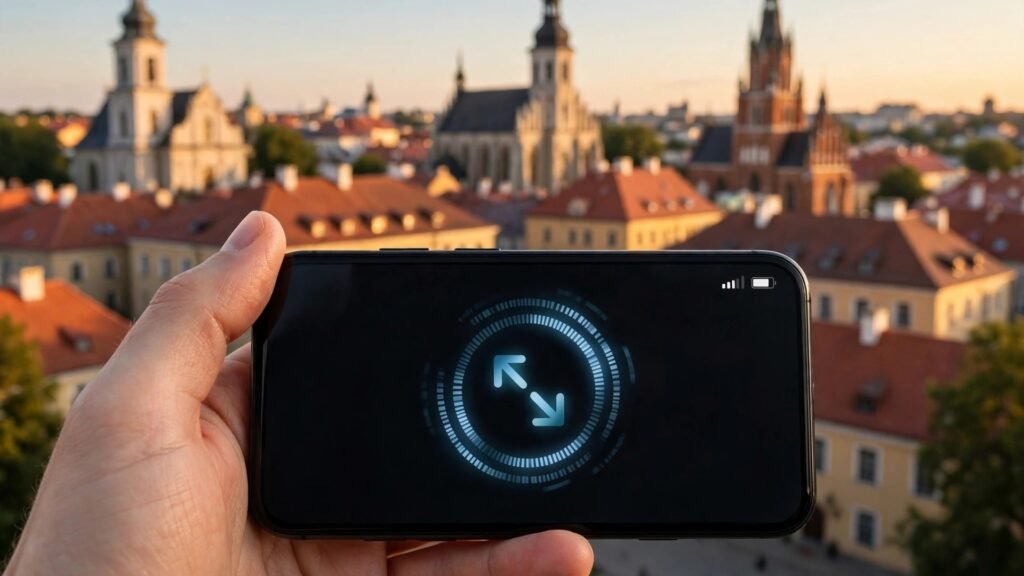
Ask someone who has just visited Vilnius what surprised them about daily life, and the answer is often unexpectedly practical: the phone just works, quickly, almost everywhere. Pages load without a long wait, maps refresh smoothly on the move, and video calls rarely stutter. For a small Baltic country, Lithuania has built a reputation for mobile internet that feels fast and affordable at the same time.
There is no single reason for that. It is the result of several things lining up: competing mobile networks, a compact and well-connected country, and users who expect a lot from their phones. Put together, they explain why Lithuanians tend to treat fast mobile data as normal rather than as a luxury.
Key Takeaways
- Lithuania’s mobile networks compete hard for customers, which keeps plans and speeds under constant pressure.
- A compact, well-covered country makes it easier to build strong mobile coverage than in a vast, spread-out one.
- Everyday habits — maps, messaging, banking and streaming on the go — push networks to keep improving.
A small country with a big mobile habit
Lithuania is a small country by population and area, and that size works in its favour when it comes to networks. Covering towns and cities, and the roads between them, is a more manageable job than covering a huge territory with remote regions far apart. Vilnius, Kaunas and Klaipeda are well served, and smaller towns are not the afterthought they can be in larger countries.
That matters because mobile internet is only as good as the nearest tower. When coverage is dense, phones spend less time hunting for a weak signal and more time connected to a strong one. The result is the feeling users notice most: pages open, videos start, and calls stay clear without much fuss.
Lithuanians are also heavy phone users. Messaging, social media, navigation, mobile banking and streaming are all part of ordinary daily life, much as they are across Europe. When almost everyone carries a smartphone and uses it constantly, networks cannot afford to stand still — slow service would be noticed immediately.
Competition keeps prices honest
Another piece of the puzzle is competition. Lithuania has several mobile operators fighting for the same customers, and in a small market every subscriber counts. That rivalry shows up in the offers people see: generous data allowances, flexible plans and regular network upgrades presented as reasons to switch or stay.
Competition does not only affect prices. It affects investment too. An operator that falls behind on speed or coverage risks losing customers to a rival that is visibly better, so networks keep upgrading their equipment and expanding capacity. For users, that means the experience tends to improve over time rather than stay frozen.
In Lithuania, fast mobile internet is not treated as a luxury — it is simply what people expect their phone to do.
The same pattern appears in other countries where mobile markets are competitive. In Romania, fast and cheap mobile internet grew out of a similar mix of rivalry and dense networks, while Finland’s unlimited mobile data culture shows what happens when generous allowances become the norm.
What fast really means in daily life
Speed on paper is one thing; speed in daily life is another. What Lithuanians actually feel is responsiveness: a map that reroutes instantly in traffic, a video that starts without buffering, a photo that uploads before you have put the phone away. Those small moments add up to a sense that the connection can be trusted.
- Dense coverage in cities and towns keeps signals strong where most people live and travel.
- Competing operators invest in upgrades to win and keep customers.
- Everyday phone habits — navigation, banking, messaging and streaming — reward networks that stay fast.
- A compact country makes nationwide coverage a realistic goal, not a distant one.
Rural areas still tell a different story in places, as they do in most countries. A farm track or a forest road will not always match a city centre for speed, and indoor coverage can vary from building to building. But the gap between town and countryside is narrower than in many larger countries, which is part of why the overall impression is so positive.
The role of newer networks
Newer mobile technology has added another layer. As 5G has rolled out in Lithuanian cities, it has brought extra capacity to busy places where many people use their phones at once — stations, shopping streets, events and campuses. Even users who are not on 5G benefit, because older networks become less crowded when some traffic moves to the new one.
This is a familiar story elsewhere too. In Singapore, famously reliable mobile internet rests on dense infrastructure and constant investment, and Lithuania’s experience rhymes with it on a smaller scale: build the network well, keep upgrading it, and users stop thinking about it at all.
Why it stays affordable
Affordability is relative, and what feels cheap to one person may not to another. But Lithuanian mobile plans are generally seen as good value because competition forces operators to pack a lot into a monthly plan, and because the cost of running a compact network is spread across a population that uses mobile data heavily.
There is also a cultural factor. When people expect mobile internet to be fast and reasonably priced, they shop around, compare plans and switch when a better deal appears. That behaviour itself keeps the market honest: operators know that customers will leave if value slips.
What to Watch Next
Lithuania’s mobile story is still being written. The questions now are whether rural coverage keeps closing the gap with cities, whether newer networks keep capacity ahead of growing demand, and whether competition continues to deliver value as technology changes. What is already clear is the habit at the heart of it: Lithuanians expect their phones to work quickly and affordably, and the networks have learned to meet that expectation. That combination — a compact country, competing operators and demanding users — is why mobile internet in Lithuania feels fast and cheap, and why it is likely to stay that way.