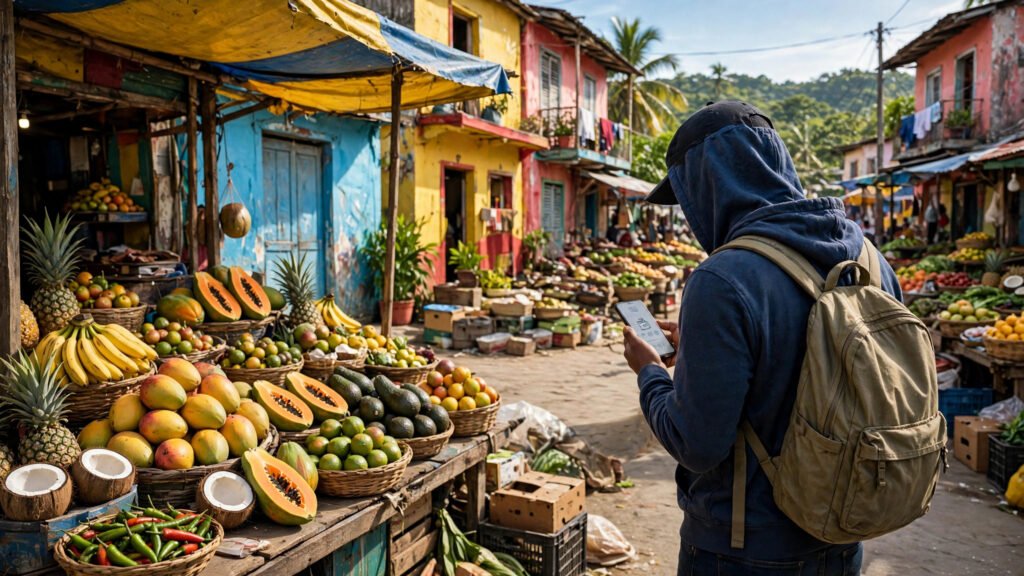
In Haiti, the phone in your pocket is often your bank. For many Haitians, paying with MonCash — the mobile money service from Digicel — is not a clever tech trick. It is simply how everyday money moves: a market seller gets paid, a relative sends help from another town, a bill gets settled, all without a trip to a bank branch or a handful of banknotes.
Bank cards exist in Haiti, but they never became the default for daily life the way they did in some other countries. Bank branches are concentrated in larger towns and cities, card terminals are far from universal, and many small traders work entirely in cash or on a phone. MonCash filled the gap in between: a way to store value, send it, and spend it using a phone number.
- MonCash lets Haitians send, receive, and spend money from a phone, without needing a bank account or a card terminal.
- It fits daily life in Haiti, where bank branches are scarce outside larger towns but mobile phones are widespread.
- Small merchants, market traders, and families sending money across the country all use the same simple phone-based system.
What MonCash Actually Is
MonCash is a mobile money wallet tied to a phone number. A user loads money into the wallet through an agent or a transfer, keeps a balance on the phone, and then sends money to another phone number, pays a participating merchant, or withdraws cash at an agent when notes are needed. The account is the phone itself, which matters in a country where opening and maintaining a formal bank account can feel distant, slow, or out of reach for people living far from a branch.
The system is designed to work on ordinary phones, not only on expensive smartphones. That is a crucial detail. A wallet that only worked on the newest handset would leave out exactly the people who need it most. Because MonCash works through the mobile network, a basic phone can be enough to send and receive money, check a balance, and pay.
Why Bank Cards Never Took Over Daily Spending
Cards need infrastructure at both ends: a bank account for the buyer, and a terminal, a reliable connection, and a bank relationship for the seller. In much of Haiti, that chain breaks down. A roadside vendor, a market trader, or a moto-taxi driver is unlikely to have a card terminal, and many customers do not carry a bank card at all. Cash fills that gap, but cash has its own problems — it can be lost or stolen, it is hard to send across distance, and it runs out exactly when a shop needs change.
Mobile money solves the distance problem in a way cash cannot. Money sent from Port-au-Prince can reach family in another part of the country in minutes, without anyone travelling with notes in a pocket. For households that depend on support from relatives in other towns, or from family abroad sending money home, that speed and safety matters more than any card reward scheme.
For many Haitians, the phone is not an alternative to the bank — it is the bank they actually use.
How People Use It Day to Day
Start with a market morning. A buyer pays a stallholder by transferring money to the seller’s phone number, and the seller sees the payment arrive before handing over the goods. No change is needed, no card machine has to connect, and both sides have a record of the payment on their phones. The same pattern repeats for small services: a phone credit top-up, a delivery payment, or a contribution to a family expense.
Traders like it for a second reason: it keeps takings safer. A seller who is paid on the phone does not have to carry a day’s earnings home in cash. And a buyer who runs out of notes is not stuck — as long as there is balance on the phone, the purchase can still go ahead. Similar phone-first habits shape daily spending elsewhere in the Caribbean and beyond: in Jamaica, a digital dollar was created to reach people outside the card system, and in Guyana, shoppers pay with mobile money instead of bank cards for much the same reason — the phone reaches places the card network does not.
- Phone-number wallets work without a bank branch visit.
- Money moves across distance in minutes, not days.
- Market traders get paid without handling large amounts of cash.
- Basic phones can use mobile money, not just smartphones.
The Role of Agents
Behind every mobile money system is a network of agents — small shops and kiosks where people load money onto their phones or turn a phone balance back into cash. In Haiti, these agents are often the same neighbourhood shops people already visit. That familiarity matters. A person who has never set foot in a bank can walk into a local shop, hand over cash, and watch their phone balance rise. The agent network is, in effect, the branch network, spread across streets and towns where formal banks never built.
Agents also help new users learn the system. Sending money for the first time can feel risky, and having a shopkeeper walk a customer through it — confirming the number, checking the balance, explaining the steps — builds the trust that makes the second and third transfers routine. In a country where neighbours have turned to phone-based dollars when local money feels unreliable, trust in the tool itself is half the adoption story.
What About Cash and Cards?
MonCash has not replaced cash in Haiti, and it is unlikely to do so soon. Many purchases are still made with notes, especially in rural markets and for the smallest amounts. Cards still have a place in larger stores, hotels, and formal businesses. What mobile money has done is add a middle layer: faster than travelling with cash, simpler than opening a card account, and available wherever there is a mobile signal.
There are limits, too. A phone wallet is only as good as the network it runs on, and a drained battery or a dead zone can still stop a payment. Fees apply to some transactions, and users need to guard their phone and their PIN the way they once guarded a wallet. None of that has stopped the habit from spreading, because for most daily payments the phone option remains the most practical one on offer.
Why This Matters Beyond Haiti
Haiti’s story is part of a wider pattern: where banks are thin on the ground and phones are everywhere, the phone becomes the payment system. The wallet that wins is rarely the most advanced one. It is the one that works on the phones people already own, through the shops they already visit, for the amounts they actually spend. MonCash won that test in Haiti by being simple, local, and useful on an ordinary day — paying a trader, helping family, settling a bill — rather than by promising a cashless future.
What to Watch Next
Watch whether more formal businesses, billers, and services accept phone wallets alongside cash and cards, and whether the agent network keeps spreading into smaller towns. If it does, MonCash will keep growing not as a replacement for banks, but as the everyday layer Haitians actually reach for — the phone-based way to pay, send, and receive that fits how money already moves in Haiti.