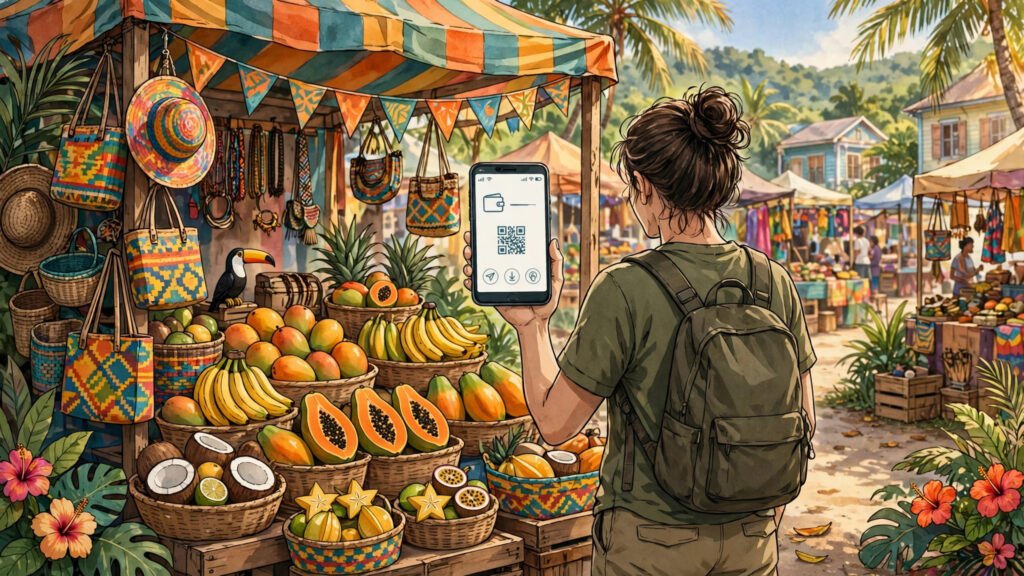
Guyana is a country where a bank branch is not always around the corner. Outside Georgetown and a handful of larger towns, reaching a bank can mean a long trip, and for many people that trip simply is not worth it for an everyday payment. That is the gap mobile money fills, and it is why a phone-based wallet like MMG has found a real place in daily life.
MMG is the mobile money wallet offered by GTT, Guyana’s long-established telecom provider. Instead of a bank card, the wallet lives on a mobile phone. Money can be sent to another person, received from family, or used to pay for goods and services, all without a traditional bank account sitting behind every transaction.
Key Takeaways
- MMG turns a mobile phone into a wallet, so payments do not depend on a nearby bank branch.
- It suits everyday life in Guyana because sending money and paying bills can be done from the phone.
- For people without bank cards, a phone wallet can be the simplest way to pay and receive money.
Why Bank Cards Never Became the Default
In many countries, cards became normal because banks, card machines and reliable card acceptance grew up together. In Guyana, that chain has gaps. Smaller shops and market vendors may not have a card terminal, and not everyone has a bank account or a card in the first place. Cash stayed practical because it works everywhere, with no machine and no account needed.
Mobile money does not try to replace cash overnight. It offers something cash cannot do as easily: move money over distance in minutes. A person in Georgetown can send money to family in another region without handing over physical notes or waiting for someone to travel. That single ability explains a lot of its appeal.
What MMG Actually Does
At its simplest, MMG lets a user hold money in a mobile wallet tied to their phone number. From there, they can transfer funds to other wallet users, pay for services, and settle bills. Agents and top-up points help people put cash into the wallet, which matters in a country where cash is still common and not everyone is paid into a bank account.
The design suits how people already use their phones. Guyanese households are used to topping up mobile credit, so the idea of loading value onto a phone is familiar. A wallet builds on that habit rather than asking people to learn a completely new financial routine.
A wallet builds on that habit rather than asking people to learn a completely new financial routine.
Distance Is the Real Reason
Guyana is a large country with a small, spread-out population. Villages and farming communities can be far from the nearest town, and river and road travel can be slow. In that setting, a payment system that works wherever there is mobile signal has an obvious advantage over one that needs a branch or a terminal.
That is also why mobile money tends to spread through family networks first. One person starts using it to receive money from relatives, then uses the same wallet to pay a bill, then shows a neighbour how it works. Trust travels person to person, and so does the wallet.
Remittances and Everyday Bills
Many Guyanese families have relatives working abroad or in another part of the country, and money sent home is a regular part of household budgets. A mobile wallet gives that money a place to land that is quicker to reach than a distant bank counter, and easier to use for the next payment.
Everyday bills are the other quiet driver. Paying for electricity, phone service or other utilities from a wallet saves a journey and a queue. It is not a dramatic change, but it is the kind of small convenience that makes people keep using a service week after week.
- Phone-based wallets work wherever there is mobile signal, not only near a bank branch.
- Cash-in points let people who are paid in cash still use a digital wallet.
- Transfers between family members are one of the strongest reasons to keep a wallet active.
- Bill payments and small purchases turn a wallet from a one-off tool into a daily habit.
Why Not Just Use a Bank App?
Bank apps are useful, but they assume the user already has a bank account and a card. A mobile wallet lowers that barrier: the phone itself is the starting point. For students, market traders, domestic workers and people in rural areas, that lower barrier can be the difference between using digital payments and staying cash-only.
Security still matters, and users need to protect their phone and their wallet PIN just as carefully as they would guard cash. But the basic idea remains simple: the wallet makes money easier to move, not harder to understand.
Similar stories are playing out across the Caribbean and beyond, where phone wallets fill gaps left by thin branch networks. In Fiji, for example, many people pay with M-PAiSA instead of cash, while in Honduras Tigo Money serves people without bank cards, and in Mozambique M-Pesa fills a similar role. Guyana’s version follows the same logic, shaped by its own geography and its own telecom landscape.
What to Watch Next
Mobile money in Guyana will keep growing only if it stays easy to use, easy to top up, and easy to trust. Wider agent coverage, more places accepting wallet payments, and clear help when something goes wrong will matter more than any single new feature. If those basics keep improving, a phone wallet could quietly become the most normal way to pay for many Guyanese — not because cards failed, but because the phone was already in everyone’s hand.