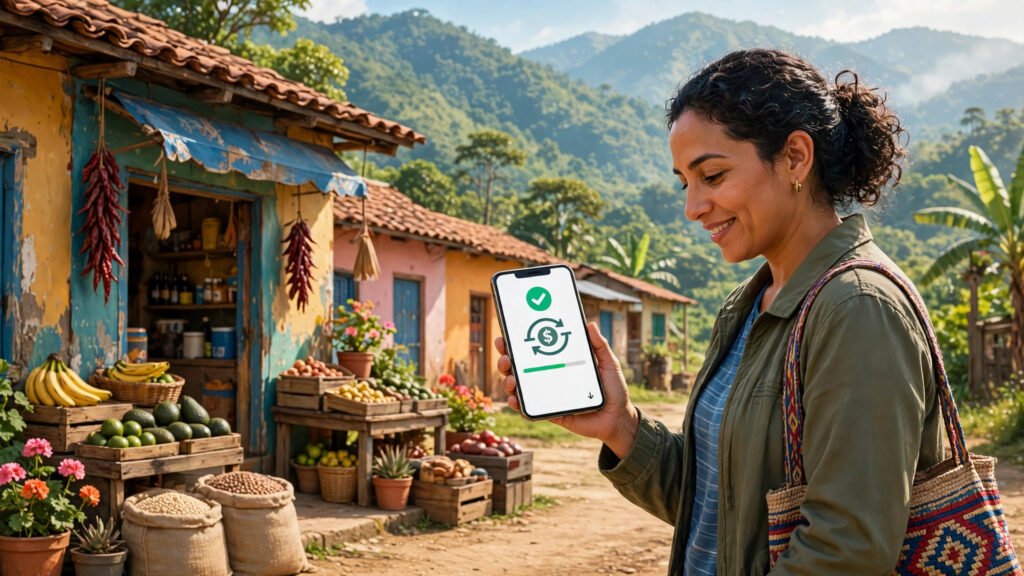
For many families in Honduras, a message on a phone can mean more than a letter in the post or a trip to a bank branch. It can mean that money sent by a relative working abroad has arrived, ready to be collected, spent on groceries, or saved for school costs. That is why, across towns and villages, receiving money from abroad has increasingly become a phone-first task rather than a bank-counter task.
Honduras has a large community of people living and working abroad, especially in the United States. Many of them send money home regularly to support parents, children, partners, and extended family. For the people receiving that money, the question is rarely whether help will come. It is how quickly, safely, and conveniently they can get hold of it. Phones have changed the answer to that question.
Key Takeaways
- Many Honduran families depend on money sent home by relatives working abroad, and phones now make receiving it faster and simpler.
- Phone-based transfers and local collection points reduce long trips to distant bank branches, especially outside major cities.
- Banks still have a role, but for everyday family support, the phone has become the most practical first step.
Why the Phone Fits Daily Life in Honduras
The most practical reason is distance. Honduras is a country of cities, market towns, farming communities, and mountain villages, and a bank branch is not always nearby. A trip to town can take time, cost money for transport, and mean a day away from work or family duties. A phone, by contrast, is already in the pocket. When a transfer arrives, the recipient can be told straight away, check the details, and plan the next step without first travelling anywhere.
That convenience matters even more for people who receive money often but in modest amounts. Family support is usually not a single large payment. It is a steady flow of smaller transfers that cover food, transport, medicine, school supplies, and household bills. Making each of those transfers depend on a bank visit would add friction to every single one. A phone removes much of that friction, so help can be used when it is needed, not days later.
There is also the question of timing. Money sent from abroad often arrives when a family need is urgent: a bill is due, a child needs supplies, or a relative needs care. Waiting for a branch to open, queuing, and filling in forms can turn a simple transfer into a lost day. A notification on a phone gives the family information immediately, and that information itself is valuable, because it lets them plan with confidence.
How Phone-Based Receiving Usually Works
In practice, receiving money by phone in Honduras usually follows a familiar pattern. A relative abroad sends money through a transfer service or app. The recipient in Honduras gets a message or notification confirming that the money is available. Depending on the service, the recipient may then collect cash from a local agent or shop, move the money into a mobile wallet, or use it to pay for goods and services directly.
Local collection points are a key part of the system. Small shops, pharmacies, and agent outlets in towns can act as places where people collect transfers, which means recipients do not always need to reach a large city. For families in rural areas, that shorter journey can be the difference between collecting money the same day and waiting until a longer trip is possible.
For younger and more digitally comfortable recipients, a mobile wallet adds another option. Money can stay on the phone and be used gradually, rather than being collected all at once in cash. That can help with budgeting, because the balance is visible on screen, and it can reduce the need to carry a large amount of cash home. Not everyone uses a wallet, and cash collection remains important, but the phone gives families a choice they did not have before.
Why Banks Have Not Disappeared
None of this means banks are irrelevant in Honduras. Banks still hold savings, handle larger transactions, and provide services that a phone alone cannot. Many people who receive money by phone also use banks for other needs, and some transfers still end up in a bank account.
The shift is better understood as a change in first step, not a replacement of the whole system. When a family member abroad sends support, the phone is now often the first place the recipient hears about it, checks it, and decides what to do next. The bank may still be part of the journey, but it is no longer the only doorway. That is why phone-based receiving feels so natural: it fits around work, childcare, and travel, instead of asking family life to fit around branch opening hours.
Trust also plays a role. People tend to use the method their family and neighbours already use. When relatives abroad, local agents, and shopkeepers all understand the same phone-based process, it becomes easier to ask questions, solve problems, and feel confident that the money will arrive. A system that neighbours can explain is a system people will keep using.
- Distance to a bank branch makes phone notifications and local collection points far more practical for many families.
- Regular, smaller family transfers work better on a phone than through repeated bank visits.
- Local agents and shops shorten the final step between a transfer arriving and a family being able to use it.
- Mobile wallets give some recipients the option to hold and spend money gradually instead of collecting it all in cash.
- Banks still matter for savings and larger needs, but the phone is now often the first step in receiving family support.
What This Means for Honduran Families
For the family receiving money, the phone has turned a formal errand into a normal part of the day. A parent can check a transfer while preparing a meal, a student can confirm help with study costs without missing class, and a grandparent can ask a younger relative to help read a message and plan a collection trip. That everyday ease is the real story, more than any single app or service.
It also connects two parts of Honduran life that are often far apart: relatives working abroad and families at home. A transfer is not only money. It is a sign that someone far away is thinking of home, and the speed of a phone message keeps that connection close. When money arrives quickly, the family can respond quickly too, with a thank-you message, a photo, or news from home.
As with similar patterns in neighbouring countries, families in Guatemala receive money through remittance apps and agents, while people in Tonga receive money from abroad on their phones instead of at banks, and Comorians receive money from abroad on their phones for many of the same practical reasons: distance, timing, and everyday convenience.
For the family receiving money, the phone has turned a formal errand into a normal part of the day.
What to Watch Next
Phone-based receiving in Honduras is likely to keep growing as more people become comfortable with mobile wallets, local agents expand their reach, and transfer services make their processes simpler. Banks will remain part of the picture for savings and larger needs, but the phone is already the most practical first step for everyday family support. For Honduran families, the change is simple to sum up: money from abroad now arrives first as a message, and only then as a trip, a collection, or a payment, and that order makes daily life easier.