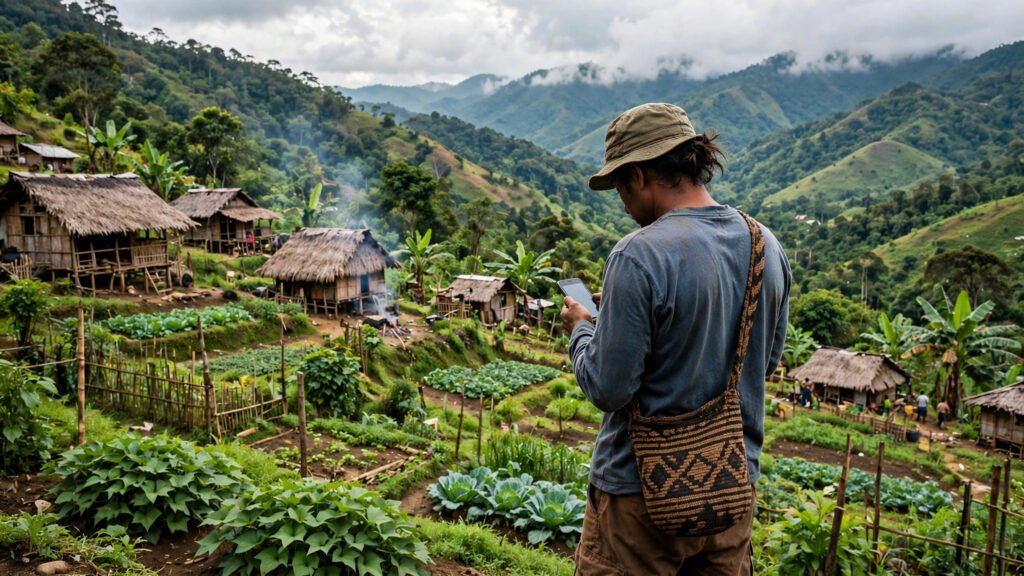
Why do Papua New Guineans rely on their phones for money across rugged islands and highlands? The short answer is distance. In a country where the road to a bank can be longer than the road to the next village, the phone becomes the branch.
Key Takeaways
- Bank branches are far from many villages, so a phone wallet saves long and costly trips.
- Phones let families send and receive money, pay for everyday needs, and trade without carrying large amounts of cash.
- Signal, charging, and trust still limit phone money, so cash has not disappeared.
Papua New Guinea is a country of steep highlands, dense forests, scattered islands, and many small communities spread far apart. For a lot of people, reaching a town with a bank branch means a long journey by road, boat, or on foot, and that journey can take a whole day or more. A phone, by contrast, is already in the pocket. That simple difference explains why mobile money and phone-based payments have become part of everyday life for so many Papua New Guineans.
The distance problem
Banking works best when a branch is close by. In much of Papua New Guinea, it is not. Villages may be separated by mountains, rivers, and stretches of sea, and roads do not reach everywhere. Travelling to town costs time and transport money, and it can mean leaving gardens, market stalls, and family duties behind for a day. When a payment, a transfer, or a small purchase can be handled on a phone instead, the trip is no longer needed.
This is a pattern seen across other island nations too, where phones fill gaps left by distance. In the Pacific, Solomon Islanders use their phones as a bank, a radio and a marketplace for similar reasons: a single device saves long journeys and keeps people connected to money, news, and trade.
What a phone wallet actually does
A phone wallet lets a person store value on a mobile account and move it with a few steps on a basic phone or a smartphone. Money can be sent to a relative, received from family, used to pay a bill, or passed to a trader. Local agents, often based in small trade stores, help people put cash into a wallet or take cash out again, so even someone without a bank account nearby can join in.
For many users, the appeal is practical rather than technical. There is no form to fill in at a distant branch, no queue at a counter, and no need to plan a whole journey around one transaction. The wallet is open whenever the phone has signal and charge, including early in the morning before market day or late in the evening after work.
In a country where the road to a bank can be longer than the road to the next village, the phone becomes the branch.
Why carrying cash is hard
Cash still matters in Papua New Guinea, and it is still used in markets and villages every day. But carrying cash over long distances has its own problems. Notes can be lost or damaged by rain, rivers, and rough travel. A large amount of cash can also attract unwanted attention on a long journey home. Moving money by phone avoids that physical risk, because the value travels as a message rather than as notes in a pocket or a bag.
Phone money also makes it easier to keep small amounts separate. A person can set aside money for school costs, transport, or a market trip without keeping every kina in one place. That kind of simple separation helps households plan, even when incomes arrive irregularly from gardens, casual work, or seasonal trade.
Family money across distance
Many Papua New Guinean families live in more than one place at once. Some relatives work in towns, on plantations, in mines, or overseas, while others stay in the village and look after gardens, children, and elders. Money often needs to move between these places, and it needs to move quickly when there is a medical cost, a school fee, or a family gathering.
Phones make that movement possible without a courier carrying cash. A relative in town can send support home, and a family in the village can confirm it arrived. That confirmation matters: it removes the uncertainty of waiting for cash to arrive by hand, and it lets both sides plan the next step. The same logic drives phone payments in other countries too, where a phone-based wallet became the everyday way to pay for markets, bills, and family transfers.
Markets, gardens and small trade
Trade in Papua New Guinea is often small and local. A gardener sells produce at a roadside market, a fisher sells the morning catch, and a small store owner restocks from a supplier in town. Phone money fits this scale well. A buyer can pay a seller without both sides having the right change, and a trader can receive payment before travelling on to the next market.
For sellers, this also means less time spent handling and guarding cash at a busy stall. For buyers, it means a purchase does not depend on having visited a bank or an agent first. Over time, these small conveniences add up, and they help explain why phone payments feel normal rather than new in many communities.
- Distance is the main driver: phones reach places where bank branches do not.
- Phone wallets handle sending, receiving, and paying without a long trip to town.
- Family support, market trade, and everyday bills are the most common uses.
- Cash is still important, especially where signal or charging is limited.
What still limits phone money
Phone money is not a complete answer, and its limits are easy to see. Mobile signal does not reach every valley and island, and phones need charging where electricity is limited. Some people are still learning how menus, codes, and confirmations work, and a mistake can be costly when money is tight. Trust is another factor: people need to be confident that a transfer has gone through, that an agent will honour a withdrawal, and that a message asking for money is genuine.
These limits explain why cash and phone money live side by side. A person may use a phone to receive money from family, then withdraw part of it in cash for the local market, where a seller may prefer notes. In places where people tap their phones to pay almost everywhere, the infrastructure is dense and familiar; in Papua New Guinea, the phone is often doing a harder job, bridging gaps that roads and branches have not yet closed.
What to Watch Next
The future of phone money in Papua New Guinea will depend on the same things this article has described: whether signal reaches more villages, whether charging becomes easier, and whether people keep trusting the wallet in their pocket. As coverage and confidence grow, more everyday payments may move to phones, while cash remains the fallback where signal or power is missing. The phone will keep mattering most in the places where distance is greatest, because there it is not just a convenience — it is the closest thing to a bank that many communities have.