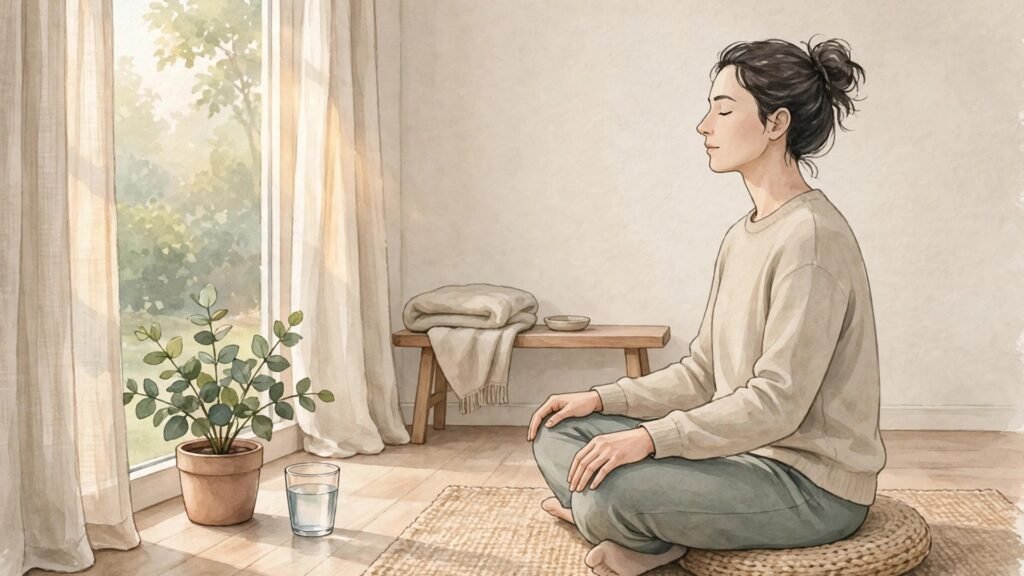
Breathing exercises to calm down are some of the simplest tools you can use when a busy day starts to feel like too much. You do not need special equipment, a quiet studio, or a long break. You only need a few minutes, a comfortable seat, and a little patience with yourself while you practise.
When stress builds up, breathing often becomes shallow and fast without us noticing. Slowing it down on purpose can help the body settle and give the mind a short pause. This guide explains three easy techniques, how to do each one step by step, and how to fit a five-minute routine into an ordinary day.
Key Takeaways
- Slow, steady breathing can help you feel calmer in just a few minutes, using nothing but a comfortable seat.
- Box breathing, the 4-7-8 pattern, and simple belly breathing are all easy to learn and easy to repeat.
- A short daily routine works better than waiting for a stressful moment and trying a technique for the first time.
Why Slow Breathing Helps You Feel Calmer
Breathing is one of the few body processes you can control directly. When you breathe slowly and deeply, you give yourself something steady to focus on instead of the racing thoughts that often come with a stressful moment. That shift in attention alone can make a tense few minutes feel more manageable.
It also helps to think of breathing exercises as a pause button rather than a cure. They are not meant to solve the problem that caused the stress, and they do not replace professional help for ongoing difficulties. They simply create a calmer space in which you can think more clearly about what to do next.
Slowing it down on purpose can help the body settle and give the mind a short pause.
Breathing Exercises to Calm Down: A Simple 5-Minute Routine
Start by sitting upright with your feet flat on the floor and your shoulders relaxed. You can close your eyes if that feels comfortable, or simply look softly at a fixed point in front of you. Try the three techniques below for about a minute or two each, and notice which one feels most natural to you.
1. Belly Breathing for Beginners
Belly breathing, sometimes called diaphragmatic breathing, means letting your belly rise as you breathe in rather than lifting your shoulders. Place one hand lightly on your belly and breathe in slowly through your nose, feeling your belly gently expand. Breathe out slowly through your mouth, feeling it fall again. Keep the pace comfortable and unforced, and repeat for about two minutes.
If your mind wanders, that is normal. Just notice it and return your attention to the feeling of your belly rising and falling. Many people find this the easiest technique to start with, because it needs no counting and no special timing.
2. Box Breathing in Four Equal Steps
Box breathing uses four equal steps, which is why some people find it easier to remember under pressure. Breathe in through your nose for a count of four, hold for a count of four, breathe out through your mouth for a count of four, and hold again for a count of four. That is one round. Repeat for four or five rounds, keeping each count steady and relaxed.
If a count of four feels too long at first, start with a count of three and build up gradually. The exact number matters less than keeping the steps even and the breathing smooth. You can practise box breathing at your desk, in a parked car, or in a quiet room before a meeting.
3. The 4-7-8 Pattern for Winding Down
The 4-7-8 pattern is a slower rhythm that many people use when they want to wind down. Breathe in quietly through your nose for a count of four, hold your breath for a count of seven, then breathe out slowly through your mouth for a count of eight. Repeat for three or four cycles, and stop if you ever feel light-headed.
This pattern works well as part of a bedtime wind-down, alongside other relaxing habits such as dimming the lights and putting your phone away. Pairing it with a regular simple night routine for better sleep can help the whole evening feel calmer.
- Belly breathing: let your belly rise on the in-breath and fall on the out-breath, with no rush.
- Box breathing: in for four, hold for four, out for four, hold for four, then repeat.
- 4-7-8 breathing: in for four, hold for seven, out slowly for eight, for three or four cycles.
- Stop and rest if you feel dizzy, and keep every breath comfortable and unforced.
How to Fit Breathing Exercises Into a Busy Day
A five-minute routine is easier to keep than a long one you never start. Try linking it to a moment that already exists in your day, such as after lunch, before your first meeting, or while waiting for the kettle to boil. A short pause like this can also help during the mid-afternoon dip, when a simple way to beat the afternoon energy slump is often more useful than another coffee.
You can also combine gentle movement with breathing. A short stretch or a slow walk before you sit down to breathe can make it easier to settle, and a beginner yoga routine at home pairs naturally with slow, steady breathing. The goal is a routine you actually enjoy, not a perfect performance.
Common Mistakes to Avoid
The most common mistake is forcing the breath. If you breathe in too deeply or hold your breath for too long, you may feel tense rather than calm, so keep everything gentle. Another mistake is judging the first try too harshly. Breathing exercises feel awkward for most people at first, and they usually feel easier after a few days of short practice.
Finally, do not use breathing exercises while driving or doing anything that needs your full attention. Choose a safe, still moment instead. This article offers general information only, not medical advice, and anyone with a breathing condition or ongoing health concerns should talk to a healthcare professional before starting a new breathing practice.
What to Watch Next
Breathing exercises to calm down work best as a small daily habit: pick one technique, practise it for five minutes, and keep it gentle and regular. Over time, you will learn which pattern suits you, when it helps most, and how to use it as a calm pause in a busy day.