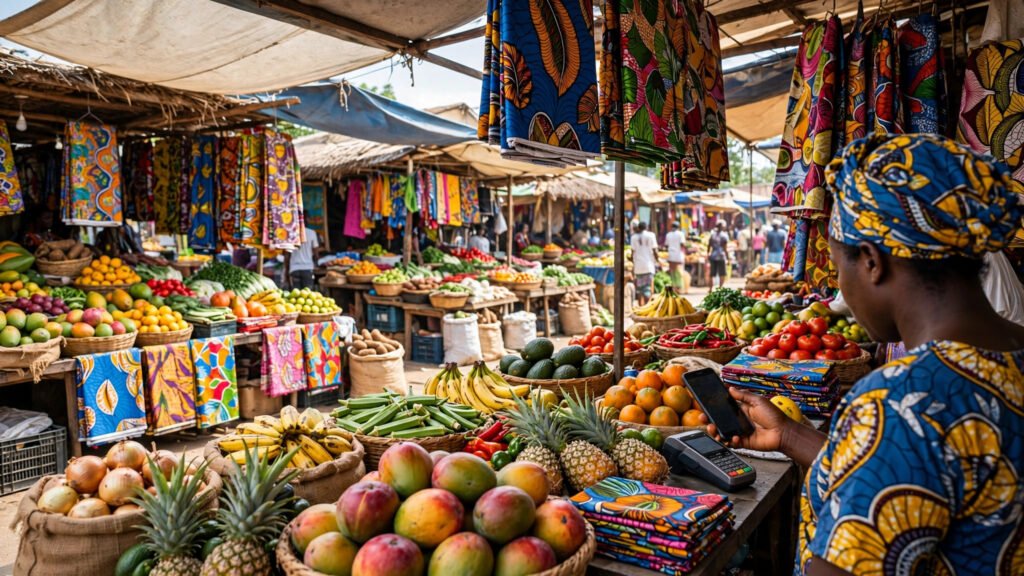
Why do so many Ghanaians reach for MoMo instead of a bank card when it is time to pay? The short answer is that MoMo meets people where they already are: on their phones, in their neighbourhoods, and in markets where cash once ruled alone.
Key Takeaways
- MoMo works on ordinary phones as well as smartphones, so it reaches far more people than card payments alone.
- Local agents in markets, shops and neighbourhoods let people put cash in and take cash out close to home.
- Cards still have a place, but for everyday payments MoMo is often faster, simpler and easier to use.
In Ghana, “MoMo” is the everyday name for mobile money, most famously MTN Mobile Money, alongside services from other networks such as Telecel Cash and AirtelTigo Money. A MoMo wallet lives on a phone number. Money can be sent to another person, used to pay a trader, or kept in the wallet until it is needed. For many users, that phone number has become more useful than a bank account number.
It works on almost any phone
One reason MoMo spread so widely is that it does not demand a smartphone, a banking app, or a card reader. On a basic phone, a user can dial a short code, follow simple on-screen menus, and confirm a payment. On a smartphone, the same wallet can sit inside an app. That flexibility matters in a country where many people own a phone but not every phone is a high-end device, and where a card terminal is not present at every stall.
This pattern is familiar across Africa. In East Africa, Kenyans pay with M-Pesa instead of bank cards for many of the same reasons: a phone-based wallet travels further than a branch network, and it works in places where card machines are rare.
The agent on the corner
Another reason is the agent network. MoMo agents work from small shops, kiosks and market stalls across Ghana’s towns and villages. A person can hand cash to an agent and see the same value appear in a wallet, or withdraw cash from a wallet when notes are needed. That turns a familiar shopkeeper into a kind of local cash point, without a trip to a bank branch or a queue at an ATM.
For traders, the same logic applies in reverse. A market seller, a taxi driver, a food vendor or a hairdresser can accept a payment on a phone and keep trading without handling large amounts of cash, finding change, or waiting for a card machine to connect. A payment arrives as a message, and both sides can check it on the spot.
In Ghana, a phone number has become more useful than a bank account number for everyday payments.
Paying people, not just shops
MoMo is not only for shopping. It is also how many Ghanaians send money to family, support relatives in another town, pay for school-related costs, settle a bill, or split a shared expense. Sending money to a phone number feels as direct as handing it over in person, but without the journey. That is especially useful when family members live in different regions and travel between them takes time and money.
Small businesses use it in a similar way. A supplier can be paid quickly, a worker can be paid without a trip to the bank, and a customer can pay in advance for goods or services. The payment leaves a record on the phone, which helps both sides remember what was paid and when.
Why cards have not taken over
Bank cards are used in Ghana, especially in larger shops, hotels and online shopping, and card use continues to grow. But cards still face practical limits for everyday life. Not everyone has a bank account or a card, not every small trader has a card terminal, and a terminal needs power, connectivity and a fee arrangement to work. MoMo, by contrast, rides on the mobile network that people already use to call and message each other.
In West Africa, a similar story plays out in different forms. In Nigeria, Nigerians pay with OPay and PalmPay instead of bank cards for everyday transfers and merchant payments, showing how phone-first wallets can grow faster than card acceptance among small traders.
- MoMo works on basic phones through short codes, not only on smartphones.
- Agents let people convert cash to wallet money and back, close to home.
- Payments go person to person, so family support and small trade move quickly.
- Traders can accept payments without a card terminal.
Cash has not disappeared
None of this means cash is gone from Ghana. Cash is still used in markets, for transport, and for small everyday purchases, and many people move between cash and MoMo during a single day. A person might pay a market trader with MoMo, take a bus with cash, and send money home by phone in the evening. The wallet does not replace cash entirely; it gives people one more way to pay, and often a more convenient one.
There are limits too. A MoMo payment needs mobile signal and, for a smartphone, battery charge. Users need to keep their phone and wallet PIN safe, and check the number and amount before confirming, because a payment sent to the wrong number can be hard to undo. Agents can also run out of cash for withdrawals at busy times. These are everyday frictions, not reasons the system fails, but they explain why cash still sits alongside it.
The wider lesson reaches beyond Ghana. In South Asia, Bangladeshis pay with bKash and Nagad instead of bank cards for similar reasons, with phone wallets filling the gap where branches and card terminals are thin on the ground.
What to Watch Next
MoMo in Ghana is best understood as a phone-first way of paying that fits how people already live and trade. It works on almost any phone, it is supported by agents close to home, it lets people pay traders and family alike, and it avoids the need for a card terminal at every stall. Cards and cash still have their place, and signal, charging and careful checking still matter. But for everyday payments, the phone has become the wallet many Ghanaians reach for first, and that habit looks set to stay.