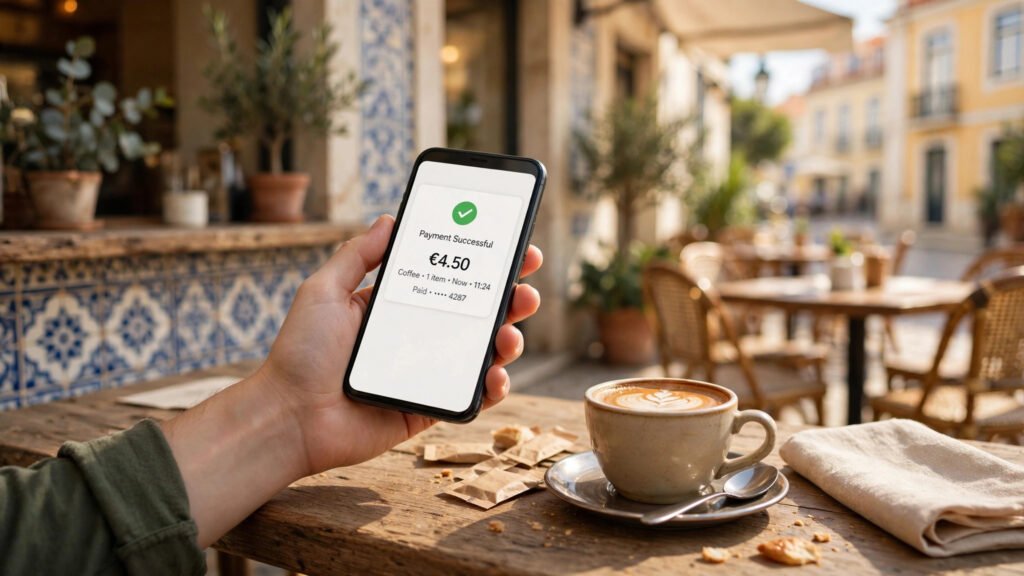
Walk into a café in Lisbon, order a coffee, and you may notice something unusual: instead of tapping a bank card, the person ahead of you opens an app on their phone, types in a phone number or scans a code, and the payment is done in seconds. That app is most likely MB WAY — a payment method so woven into daily life in Portugal that many Portuguese shoppers barely think about it anymore. But what exactly is MB WAY, and why did it catch on here when bank cards already worked perfectly well?
Key Takeaways
- MB WAY lets people in Portugal pay, send money and shop online using just a phone number linked to a bank account.
- It grew out of Portugal’s trusted Multibanco ATM network, so it felt familiar from the start.
- Its virtual cards and instant phone-number transfers solve everyday problems that physical cards handle less smoothly.
What Is MB WAY?
MB WAY is a mobile payment app linked to a Portuguese bank account. Once it is set up, a user can send money to another person using only their phone number, pay in participating stores and online shops, and create temporary virtual cards for internet purchases. There is no separate wallet balance to top up in the usual sense: the money moves directly in connection with the user’s bank account, which keeps the experience simple.
The service is operated by SIBS, the company behind Portugal’s Multibanco network — the shared ATM and card-payment system that has served Portuguese banks for decades. That connection matters. When MB WAY launched, it did not arrive as an unknown foreign brand asking people to trust it with their money. It arrived as an extension of a system Portuguese people already used every day at ATMs and shop counters.
Why Phone Numbers Beat Card Numbers
The most popular MB WAY feature is also its simplest: sending money to a phone number. Splitting a restaurant bill, paying a friend back for concert tickets, or sending birthday money no longer requires asking for an IBAN, a long string of digits most people do not know by heart. If the recipient’s number is registered, the transfer goes through quickly.
This solves a genuinely Portuguese everyday problem. In a culture where group meals, shared holiday rentals and informal favours between friends and family are constant, small transfers happen all the time. MB WAY turned an awkward banking chore into something as easy as sending a message. That convenience is a big reason it spread by word of mouth rather than advertising alone.
MB WAY turned an awkward banking chore into something as easy as sending a message.
Shopping Online Without Exposing Your Card
MB WAY also offers virtual cards — temporary card numbers generated inside the app for a single online purchase or a limited period. For shoppers who are cautious about typing their real card details into unfamiliar websites, this is a meaningful layer of protection. If the virtual number is ever misused, it can simply be discarded, while the real card stays safe.
Many Portuguese online stores accept MB WAY directly at checkout, so buyers often do not need a card at all. They confirm the payment in the app, and the order is placed. For a country where online shopping has grown rapidly, this combination of convenience and control proved very attractive, especially for people who only shop online occasionally and do not want their card details stored everywhere.
How It Compares With Cards and Other European Apps
Bank cards have not disappeared in Portugal, and MB WAY does not replace them everywhere. Cards remain the default for many in-store purchases, and contactless card payments are common. What MB WAY did was fill the gaps cards left open: person-to-person transfers, quick online checkout, and payments to small sellers who might not accept cards.
Elsewhere in Europe, similar home-grown systems have taken the same path. In the Netherlands, shoppers lean on iDEAL for online payments rather than cards; in Poland, BLIK has become the everyday way to pay; and in Thailand, PromptPay links payments to phone numbers in much the same spirit. The pattern is consistent: when a payment method is built on a trusted local banking network and solves a local habit, it can beat global card schemes at home.
- Pay friends with a phone number — no IBAN needed.
- Generate a virtual card for safer online shopping.
- Confirm payments in the app instead of typing card details.
- Built on the Multibanco network Portuguese banks already share.
Is MB WAY Only for Portuguese People?
MB WAY is designed around Portuguese bank accounts, so in practice it is mainly used by people who bank in Portugal — residents, long-term visitors with local accounts, and Portuguese citizens living abroad who kept a Portuguese account. Tourists paying for a short holiday will generally still use their own cards or international wallets, and that is fine: MB WAY was never designed to be a tourist product. Its strength is precisely that it is local, built for how people in Portugal actually bank and pay.
Small businesses benefit too. A market stall holder, a freelance tutor or a neighbourhood café can accept an MB WAY transfer without renting a card terminal, which lowers the barrier to taking digital payments. In a country with many small and family-run businesses, that flexibility helped digital payments reach places cards never fully did.
What to Watch Next
MB WAY’s story is a reminder that the best payment method is not always the most global one — it is the one that fits local habits, runs on trusted local infrastructure, and removes a real everyday friction. Its phone-number transfers made splitting costs effortless, its virtual cards made online shopping feel safer, and its Multibanco roots gave it instant trust. Whether similar local systems keep growing across Europe, or global wallets eventually absorb them, will depend on the same test MB WAY passed: does it make paying simpler for the people who actually use it?