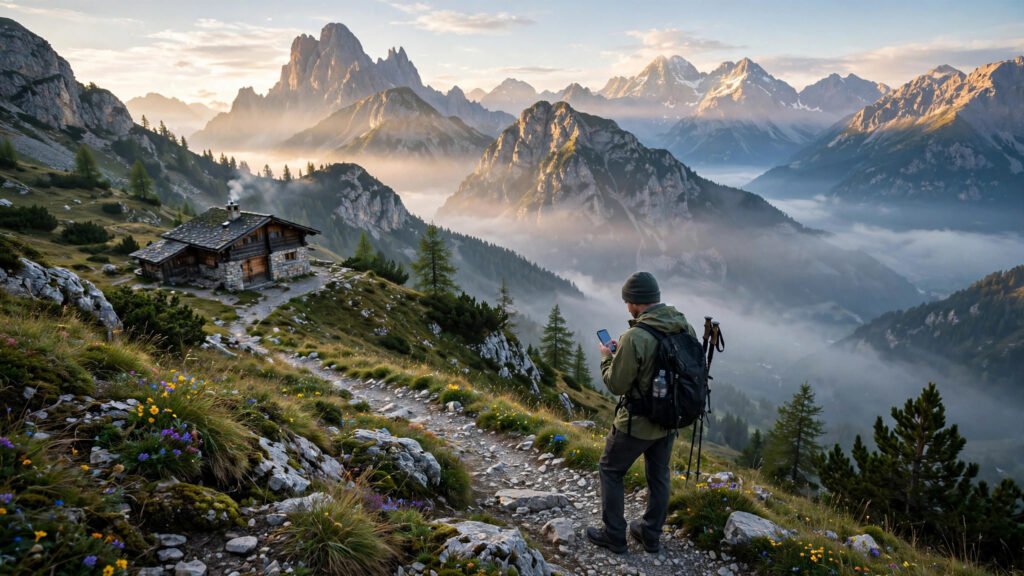
For many Slovenians, a mountain trip does not begin at the trailhead. It begins at home, on a phone screen, with a careful check of the weather, the route and the conditions waiting higher up. In a country where the Alps rise steeply from lowland valleys and where weekend hiking is a national habit, that small ritual has become part of the culture of going outdoors safely.
Slovenia is a compact country, but its mountains are serious. The Julian Alps, home to Triglav, the country’s highest peak, sit close to the Adriatic influence on one side and continental weather on the other. That combination can turn a calm valley morning into wind, cloud and rain on a ridge within hours. A phone check before leaving is, for many hikers, the simplest way to respect that changeability.
Key Takeaways
- Slovenia’s mountains can change fast, so a phone check before a hike is a safety habit, not just a convenience.
- Hikers use their phones for forecasts, route details, hut information and a way to call for help.
- The check works best when it is done before leaving home, while signal and time are still on the hiker’s side.
Why the Mountains Demand a Check First
Mountain weather does not behave like lowland weather. Temperature falls as altitude rises, wind strengthens on exposed ridges, and afternoon storms can build quickly in summer. A forecast that looks fine for Ljubljana or a valley town may say little about conditions at two thousand metres. Slovenians who hike regularly learn this early, and many pass the lesson on: look at the mountain forecast, not just the town forecast.
The phone makes that distinction easy. Dedicated mountain forecasts, radar views and webcams from huts and passes give a picture of what is happening up high, rather than only at street level. A hiker can compare sources, watch how a front is moving and decide whether to start early, choose a lower route or postpone altogether. That decision, made calmly at home, is worth far more than the same decision made halfway up a slope.
A phone check before leaving is, for many hikers, the simplest way to respect that changeability.
More Than a Forecast
The pre-trip phone check usually covers more than weather. Route descriptions and maps show distance, height gain and the hardest sections, so a group can judge honestly whether the plan fits everyone’s fitness and experience. Information about mountain huts matters too: whether a hut is open, whether it offers food and shelter, and how far the next refuge lies if plans change.
Phones also carry the safety net. A charged phone with the route saved offline, the emergency number known and a message left with someone at home turns a solo walk into a connected one. In areas where signal fades, that preparation matters even more, because the phone is most useful when its essential information was loaded before the signal disappeared. As with Finns who use their phones as ID, the device has quietly become a tool people trust with important everyday tasks.
A Habit Shaped by the Landscape
Slovenia’s geography explains why the habit is so widespread. More than half the country is forested and mountainous, and trails start close to towns and villages, so a mountain day does not require a long expedition. Families, school groups and weekend walkers share the same paths as experienced climbers. That mix makes preparation a shared responsibility: experienced hikers check conditions because they know what can go wrong, and beginners copy the habit because they see it everywhere.
The country’s hut system reinforces it. Mountain huts are social places as much as shelters, and planning a route from hut to hut is part of the pleasure of a Slovenian hike. Checking opening times, water availability and overnight options on a phone before setting off avoids disappointment and keeps groups moving at a sensible pace. In a similar way, Mongolians rely on their phones across the vast steppe, where distance itself makes the phone an essential companion.
- Check a mountain-specific forecast, not only the forecast for the nearest town.
- Save the route and hut details offline before signal runs out.
- Tell someone your planned route and expected return time.
- Carry a charged phone, but never let it replace a map, water and warm clothing.
When the Phone Says Stay Home
Perhaps the most valuable outcome of the pre-trip check is the trip that does not happen. Turning back or postponing can feel disappointing, especially after a week of looking forward to a summit, but mountain rescue advice everywhere repeats the same point: most trouble starts with a decision made too late. A phone that shows a storm building over a ridge gives a hiker permission to choose differently, without embarrassment and without risk.
That attitude also protects other people. Rescue teams in alpine countries are often volunteers, and every avoidable call-out puts them at risk too. By checking conditions first, hikers reduce the chance that someone else must come to help them. It is a quiet form of respect for the mountains and for the people who watch over them. The same logic appears in very different landscapes, as when Madagascar fishermen check their phones before heading out to sea and let the forecast shape a working day.
What to Watch Next
The habit of checking a phone before a mountain trip is likely to keep growing as forecasts improve, offline maps get better and more hikers share live conditions from huts and trails. What will not change is the reason behind it: Slovenia’s mountains reward preparation and punish carelessness, and a few minutes with a phone before leaving home remains the simplest preparation of all.