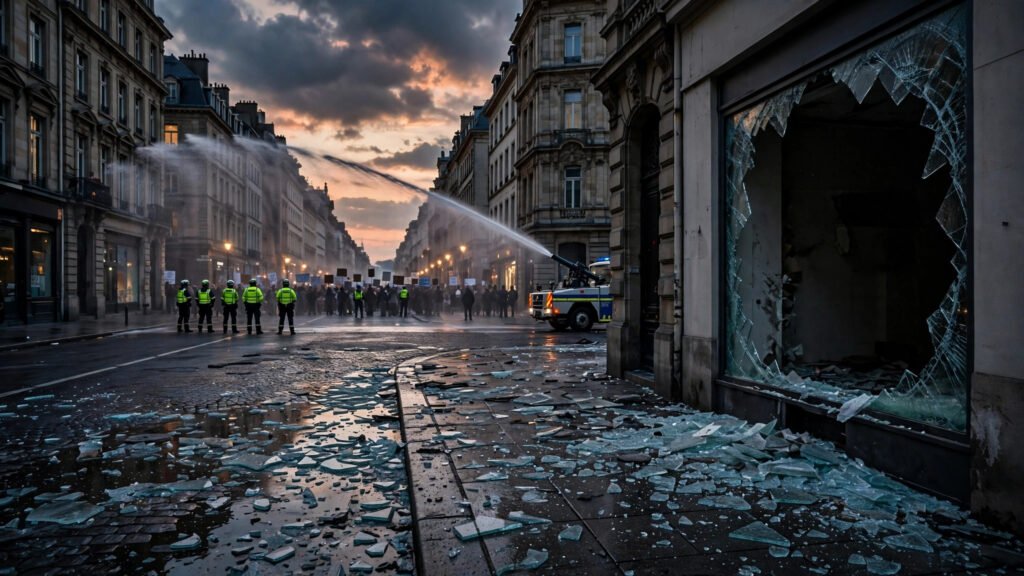
What began as a largely peaceful day of youth protest across Germany ended in running confrontations after dark on Saturday, October 31, 2026, as demonstrations organised by the group “GenZ regelt!” turned violent in several major cities. The worst scenes were in Frankfurt, where masked rioters smashed and looted shops while police fired water cannon at crowds throwing stones, fireworks and petrol bombs.
Tens of thousands of young people had taken to the streets in dozens of cities, in the latest wave of youth-led protests sweeping Europe. The demonstrations, inspired by similar movements in France and Italy, called on political leaders to listen to the concerns of a younger generation — over education funding, living costs, climate protection and social security. By evening, however, the mood changed sharply in Frankfurt, Hamburg, Cologne and Berlin, where police reported officers coming under attack and responded with water cannon and pepper spray.
Key Takeaways
- Youth-led protests organised by “GenZ regelt!” were largely peaceful during the day but turned violent in several German cities on Saturday evening.
- Frankfurt saw the worst violence, with shops looted and smashed, petrol bombs thrown at emergency workers, and police responding with water cannon and pepper spray.
- Organisers said around 120,000 people took part nationwide, fewer than the roughly 180,000 they had expected, while police reported several officers injured and large numbers of arrests.
Frankfurt: looting and petrol bombs
It was especially bad in the financial hub of Frankfurt, where police said “violent riots” were taking place. Windows were smashed at several shops, and a gun store was among the premises looted, with its windows broken. Police said they arrested a suspect and seized two weapons.
Officers in Frankfurt faced protesters hurling stones, fireworks and petrol bombs, and responded with water cannon and pepper spray. Police said Molotov cocktails were also thrown at emergency personnel. Roman Poseck, the interior minister of the state of Hesse, said that “around 100 clearly identified left-wing extremists” had infiltrated the protest in Frankfurt.
The Frankfurt demonstration had begun peacefully, like the others across the country, before bottles and firecrackers were thrown towards police as the atmosphere grew tense. A march through the city was halted after demonstrators started setting off fireworks, and sporadic blasts were heard on the street as a police helicopter hovered overhead.
What began as a largely peaceful day of youth protest ended in running confrontations after dark in several major cities.
Clashes spread to Hamburg, Cologne and Berlin
Violence was not confined to Frankfurt. Police also used water cannon in Hamburg and Cologne after they said demonstrators targeted emergency service workers with fireworks, stones and bottles. In Hamburg, protesters set barricades ablaze and fired pyrotechnics towards police before officers dispersed crowds with water cannon and pepper spray.
In Cologne, where one of the biggest demonstrations took place, police fired a water cannon to disperse a crowd after saying protesters had targeted officers with fireworks. The march there was halted after some participants covered their faces and pyrotechnics were used. In Berlin, a protest not organised by the “GenZ regelt!” movement took place in the evening, with police reporting they were pelted with eggs and bottles. A police officer in Bonn suffered minor injuries during a confrontation with a group.
Police were reported to have arrested large numbers of rioters, and several police officers were injured in the violence across the country.
What the protesters were demanding
The demonstrations were organised under the slogan “GenZ regelt!” — “Gen Z has got this!” — and formed part of a wider European wave of Generation Z protest. Demonstrators demanded better-funded schools, action on living costs and stronger climate protection, as well as investment in social security and healthcare, and opposed the possible return of compulsory military service.
Some carried signs reading “Time for resistance” and “Merz must go”, a reference to conservative Chancellor Friedrich Merz. Demonstrations were registered in 34 cities on Saturday, according to reports, with police putting the turnout at around 5,000 in Berlin and 8,000 in Frankfurt, and several thousand in Cologne. The organisers’ nationwide figure of around 120,000 participants was not officially confirmed.
The rallies followed a third weekend of youth-led protests in France, where hundreds of thousands marched over soaring living costs, and came after Germany had braced for massive Gen Z protests across dozens of cities. The German movement explicitly rejects violence, and authorities had said before the protests that they had not seen evidence of concrete plans for violence — which made the evening’s turn all the more striking.
- Frankfurt: shops looted and smashed, including a gun store; petrol bombs thrown at police; water cannon and pepper spray used in response.
- Hamburg and Cologne: water cannon deployed after fireworks, stones and bottles were thrown at emergency workers.
- Berlin: evening protesters pelted police with eggs and bottles; a Bonn officer suffered minor injuries.
- Turnout: organisers claimed around 120,000 nationwide, below the roughly 180,000 expected; police figures were lower in individual cities.
What to Watch Next
Attention now turns to how authorities and organisers respond to a day that began peacefully and ended in looting and clashes. Police will be counting the injured officers and the arrests, and assessing the damage to shops in Frankfurt, while the “GenZ regelt!” movement faces questions about how a protest movement that explicitly rejects violence saw its demonstrations end in confrontations in several cities. Whether the evening violence changes the public conversation around the young protesters’ demands — on schools, living costs, climate and social security — or overshadows them will become clear in the days ahead, as will whether further youth-led protests follow across Europe.