When your pay changes from month to month, a normal budget can feel impossible. One month covers everything with room to spare, and the next barely covers the basics. Learning how to budget with irregular income is less about predicting every rupee or dollar, and more about building a system that stays steady even when your earnings do not.
Irregular income is common for freelancers, gig workers, seasonal staff, and anyone paid by project or commission. The problem is not that you earn too little in a good month. The problem is that fixed bills arrive on fixed dates, while your income arrives whenever it arrives. A budget for irregular income solves that mismatch by smoothing your money across months, so a slow month feels ordinary instead of frightening.
Key Takeaways
- Average your last few months of income to set a realistic monthly spending baseline.
- Pay essentials first, and hold extra money from good months in a buffer for slow months.
- Run a short weekly money check so small shortfalls are caught before they become crises.
How to Budget With Irregular Income: Start With Your Average
The first step is to find your average monthly income. Look at the last six months if you can, or at least the last three, and add up what you actually received. Divide by the number of months. That average, not your best month, is the number your budget should be built on. Planning around your best month is how good months feel normal and slow months feel like emergencies.
If your average is lower than your essential spending, that is useful information, not a failure. It tells you the gap you need to close, either by trimming a regular cost or by finding steadier work. If your average covers your essentials with a little left over, you already have a workable budget. The rest of this system is about protecting that balance when income dips.
For the spending side, start simple. If you have never written a budget before, our guide on how to make a monthly budget walks through listing income and expenses in a plain, step-by-step way that works even when the income column changes.
Sort Your Spending Into Three Buckets
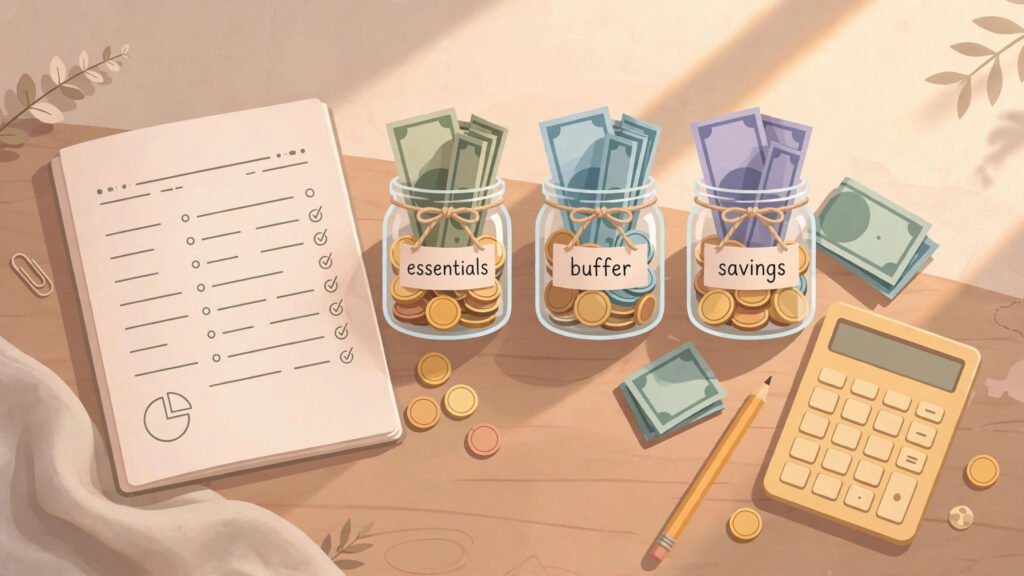
Once you know your average, split your spending into three buckets. The first bucket is essentials: rent, utilities, food, transport, and any minimum payments you must make. These get paid first, every month, without debate. The second bucket is regular but flexible spending: subscriptions, eating out, clothes, and personal care. The third bucket is savings and future costs.
In a good month, the rule is simple: fill the essentials bucket, keep the flexible bucket at its usual size, and send the extra to savings or to a buffer account. The temptation in a good month is to grow your flexible spending to match your income. That is exactly what makes the next slow month painful, because the spending stays high while the income drops.
- Essentials first: rent, food, utilities, transport, and minimum payments
- Flexible spending stays at its usual size, even in a good month
- Extra income goes to a buffer, not to a bigger lifestyle
- Review the buckets once a month and adjust only the flexible bucket
Build a Buffer Before You Build Anything Else
A buffer is a small pot of money whose only job is to cover slow months. It is different from long-term savings, though it sits alongside them. Aim first for enough to cover one month of essentials, then work toward two or three months over time. Every good month adds to it, and every slow month draws from it. That is the whole mechanism, and it is what turns an unpredictable income into a predictable monthly life.
Keeping the buffer in a separate account helps. Money sitting in your everyday account tends to get spent, while money in a separate account feels set aside. When a slow month arrives, you transfer what you need from the buffer and your essentials are covered as usual. When a good month arrives, you top the buffer back up before anything else.
If you are starting from zero, a buffer can feel far away. A small, steady habit works better than a big promise. Our guide on how to build an emergency fund on a small income shows how small weekly amounts add up, and the same approach works for an irregular-income buffer.
Planning around your best month is how good months feel normal and slow months feel like emergencies.
Use a Weekly Money Check to Stay in Control
A monthly budget review is too slow when income is irregular. Instead, run a ten-minute money check once a week. Look at what came in, what went out, what bills are due in the next two weeks, and how your buffer stands. This short check catches problems early, while they are still small enough to fix by moving a payment date or trimming one flexible expense.
The weekly check also removes the anxiety of not knowing. Many people with irregular income avoid looking at their money because they expect bad news. A short, regular check replaces that dread with a clear picture, and a clear picture is much easier to act on than a vague worry.
For costs you know are coming but not every month, like car repairs, annual fees, or holiday spending, set aside a little each month in advance. That habit is called a sinking fund, and our guide on sinking funds for beginners explains how to start one with a simple list and a fixed monthly amount.
Common Mistakes With Irregular Income
The most common mistake is treating a good month as the new normal and raising fixed costs to match it. A bigger rent, a new subscription, or a financed purchase locks in spending that a slow month cannot support. If a good month tempts you, let the buffer grow instead of the bills.
A second mistake is skipping the budget entirely because income varies. A budget built on your average works precisely because it does not depend on any single month. A third mistake is keeping everything in one account, where buffer money and spending money blur together. Separation is what makes the system hold when willpower wavers.
What to Watch Next
Budgeting with irregular income comes down to three habits: plan around your average, not your best month; pay essentials first and send good-month extra to a buffer; and check your money weekly so slow months are handled early. Start this week by working out your average and opening a separate buffer account. The system will not make your income regular, but it will make your monthly life feel regular, and that steadiness is the point.