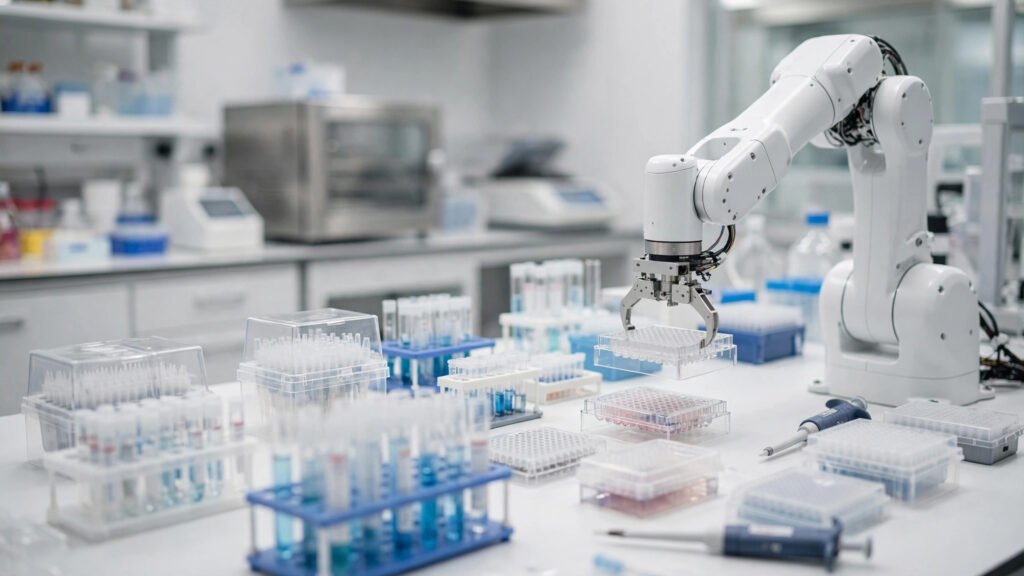
Opentrons Labworks Inc. announced a $40 million Series E financing round on October 29, 2026, to standardize AI-driven science on its laboratory robots. The company, based in Long Island City, New York, said the round was led by healthcare investor Avego, with additional investment from BroadOak Capital Partners, and that the money will be used to scale its robotics, software and data infrastructure tools.
The announcement lands at a moment when artificial intelligence is changing how science is planned, but not yet how quickly it is tested. Opentrons argues that the physical laboratory has become the bottleneck: scientists can use frontier models to generate hypotheses and design experiments far faster than laboratories can run them. Its answer is a loop in which experiments are designed, run and improved continuously, with robots doing the manual work in between.
Key Takeaways
- Opentrons raised $40 million in a Series E round led by Avego, with additional investment from BroadOak Capital Partners.
- The company says the funding will scale its robotics, software and data infrastructure for AI-driven laboratory work.
- Its systems are already deployed in more than 80 countries, including at 90 percent of the top 20 global pharmaceutical companies.
Why the lab, not just the model, matters
Most of the recent excitement about AI in science has focused on models: systems that can read papers, suggest molecules or plan an experiment. Opentrons is betting that the next gain comes from the bench itself. If an experiment still has to be set up, pipetted, incubated and measured by hand, then faster ideas simply pile up behind slower execution.
The company’s Opentrons Flex platform combines robots with AI systems that enable experiments to be designed, run and improved in a continuous loop. Every experiment run on its robots generates structured, reproducible data, the company says, and that data is the foundation for what it calls autonomous science: a setup in which AI does not only propose work, but helps carry it out and learn from the result.
That framing echoes a wider pattern across industries, where companies are buying AI faster than they are making it pay. The difference in a laboratory is that the payoff is measured in reproducible results, not just in faster drafts or summaries, so the tools have to be reliable enough for regulated, repeatable work.
A large installed base to build on
Opentrons says it has deployed more than 11,000 robots to laboratories in over 80 countries, including at 90 percent of the top 20 global pharmaceutical companies. That installed base matters because autonomous science depends on data: the more experiments run on a common platform, the more consistent the records those experiments leave behind.
The company describes itself as the leader in open, AI-native laboratory automation. Openness matters here because laboratories use many different instruments, reagents and workflows, and a system that only works inside one closed setup would be hard to adopt at scale. By building robots and software that other tools can work with, Opentrons is positioning its platform as shared infrastructure rather than a single-purpose machine.
If an experiment still has to be set up, pipetted, incubated and measured by hand, then faster ideas simply pile up behind slower execution.
What the $40 million will fund
Opentrons said the Series E will fund its next phase of growth in autonomous science. The priorities it named are AI-driven experimental execution, extending its automation capabilities, and expanding into new markets and geographies. In practice, that means more robots and software in more laboratories, and more of the data infrastructure needed to turn individual experiments into a continuous, learning system.
The company’s chief executive, James Atwood, framed the opportunity in terms of scientists’ time. Millions of scientists spend much of their day on manual work that a robot can do, the company said, and giving that time back to discovery is the biggest opportunity in science. Opentrons says it made lab automation accessible for any lab, and that its systems are built for AI to run experiments directly.
That ambition also raises questions that apply across AI, not just in the lab. As AI systems take on more capable roles, researchers are asking how their work is tested, controlled and kept safe, as shown by recent controlled tests of an AI model carrying out complex cyberattack scenarios. In science, the equivalent question is reproducibility: an autonomous experiment is only useful if another laboratory can repeat it and get the same result.
- Funding: $40 million Series E, announced October 29, 2026.
- Lead investor: Avego, with additional investment from BroadOak Capital Partners.
- Platform: Opentrons Flex, combining robots and AI systems for experiment design, execution and improvement.
- Scale: more than 11,000 robots deployed in over 80 countries.
- Reach: systems in use at 90 percent of the top 20 global pharmaceutical companies.
- Next step: AI-driven experimental execution, wider automation and expansion into new markets.
What this means for drug discovery and research
For pharmaceutical and biotech laboratories, the promise is speed without losing rigour. Drug discovery already involves testing large numbers of candidates, and automation can run those tests around the clock with consistent handling. If AI can also help design the next round of tests based on the last round’s data, the cycle from idea to result could shorten considerably.
The same logic applies beyond drug discovery, including in global health research, where funding for neglected diseases remains limited and efficient laboratories matter. Recent funding for malaria, neglected diseases and Ebola research shows how much depends on laboratories being able to run reliable, well-documented experiments with scarce resources.
None of this removes the scientist from the work. Hypotheses still have to be chosen, results still have to be interpreted, and safety and quality controls still have to be enforced. What automation changes is where human time goes: less of it on repetitive handling, and more of it on the questions only a researcher can answer.
What to Watch Next
What happens next will depend on whether Opentrons can turn this funding into wider adoption and genuinely autonomous workflows, rather than simply faster manual work. Watch for new deployments in laboratories beyond its current base, for evidence that AI-designed experiments are producing reproducible results at scale, and for how pharmaceutical and research customers judge the platform against their own quality and regulatory requirements. If those pieces come together, the laboratory itself could become the next place where AI moves from assisting science to accelerating it.