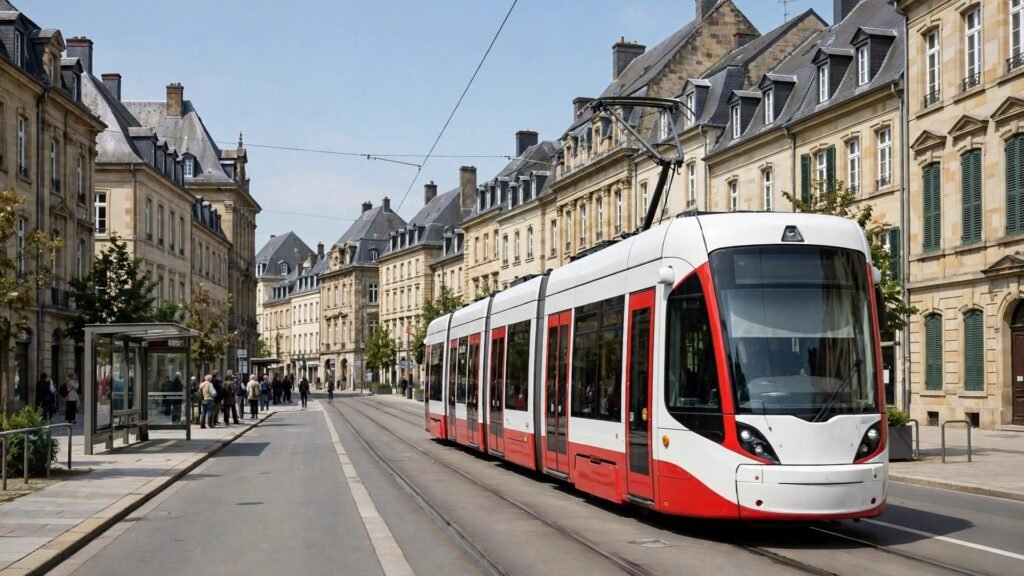
In Luxembourg, you can step onto a bus, a tram or a train and simply sit down. There is no ticket to buy, no fare to tap and no machine to wrestle with at the platform. Since March 2020, public transport in the Grand Duchy has been free to ride in second class, making Luxembourg the first country in the world to take this step nationwide.
For visitors, it feels almost too easy, and the first question is usually the same: why would a country give up fare revenue at all? The answer is a mix of traffic problems, environmental goals and simple economics. Luxembourg is small, wealthy and heavily crossed by commuters, and its roads, especially around Luxembourg City, were struggling with congestion. Making the bus, tram and train free was meant to make leaving the car at home the easiest choice, not just the cheapest one.
Key Takeaways
- Buses, trams and trains are free to ride in second class across Luxembourg.
- The policy began in March 2020 and was aimed at cutting congestion and emissions.
- First-class train travel and cross-border journeys still require a ticket.
What exactly is free
The free-fare rule covers the whole national network: city and regional buses, the Luxembourg City tram, and trains, all in second class. That includes the bus to the airport and the tram running through the capital. There are no fare gates to pass and no ticket to show for a standard ride, which removes one of the small frictions that puts people off trying public transport in a new place.
What is not free matters just as much. First-class train compartments still require a ticket, and anyone travelling across the border into France, Belgium or Germany needs a ticket for the part of the journey outside Luxembourg. Taxis, car parking and other private transport are unchanged. In other words, the free offer is generous, but it is not unlimited, and it stops at the border.
Why Luxembourg did it
Luxembourg has an unusual commuting pattern. Every working day, large numbers of workers travel in from neighbouring France, Belgium and Germany, on top of residents travelling within the country. That puts heavy pressure on a road network built for a much smaller population, and rush-hour traffic in and around Luxembourg City became a daily problem.
Free fares were also an environmental argument. Every commuter who switches from a car to a train or tram means one less vehicle on the road and lower emissions from that journey. The government framed the policy as part of a wider push for cleaner mobility, alongside investment in the tram network and rail services, rather than as a standalone gesture.
There was a practical argument too. Running a fare system costs money in itself: ticket machines, inspectors, back-office systems and fare enforcement all have to be paid for. When fare revenue covers only a small share of the total cost of running the network, as it did in Luxembourg, removing fares saves some of that administrative cost and simplifies the whole system. The remaining cost is covered from general taxation, which is how most public services are funded.
Making the bus, tram and train free was meant to make leaving the car at home the easiest choice, not just the cheapest one.
How it works in practice
For a daily rider, the change is mostly about what disappears. There is no need to work out zones, buy the right ticket or worry about a fine for a wrong fare. Regular passengers can simply board, and tourists arriving in the country get the same deal as residents, which makes the city far easier to explore without a car.
Planning a journey still matters, and that is where the phone comes in. Luxembourg’s official journey planner, mobiliteit.lu, gives timetables and routes for buses, trams and trains, so travellers can check departures before they leave. It is the same kind of everyday digital habit seen elsewhere in Europe, from how Belgians pay with Bancontact instead of cards to why Danes use a digital mailbox instead of paper letters: small digital tools that quietly remove daily friction.
- Second-class buses, trams and trains: free, nationwide
- First-class train travel: still ticketed
- Cross-border journeys: ticket needed beyond the border
- Planning tool: the mobiliteit.lu journey planner
What it means for visitors
For a tourist, free public transport changes how a trip feels. A day in Luxembourg City can be planned around the tram and buses without budgeting for fares or hunting for a ticket machine in an unfamiliar language. Day trips by train to smaller towns work the same way, as long as the journey stays inside the country.
There are still a few things to check. Cross-border day trips need a ticket for the section outside Luxembourg, so a train to a neighbouring country is not free end to end. And first-class seats, for travellers who want them, are a paid upgrade. Checking the route before travelling avoids both surprises, and the journey planner makes that check quick.
Could other countries copy it
Luxembourg’s model is easier to run in a small, wealthy country than in a large one, and that is the main reason it has not been copied everywhere. Bigger networks carry far more passengers and collect far more fare revenue, so giving up fares would leave a much larger gap in their budgets. Cities that have tried free fares usually limit them to a city centre, a single mode of transport, or certain groups such as residents or young people.
Still, the idea behind it travels well. Luxembourg shows that a public service can be treated like a road or a library: open to everyone, paid for collectively, and judged on how many people use it rather than how much it earns at the point of use. Other countries have made similar choices in different areas, from why every schoolchild in Uruguay gets a laptop to free museum entry and free school meals. The question in each case is the same: is the public benefit worth more than the revenue given up?
What to Watch Next
Luxembourg’s free transport is now a settled part of daily life, but the questions around it continue. Whether other cities copy the model in a limited form, whether cross-border fares become simpler for commuters from France, Belgium and Germany, and whether the tram and rail networks keep growing fast enough to carry everyone who chooses them, will decide how much of the original goal, less congestion and cleaner travel, the policy keeps delivering.