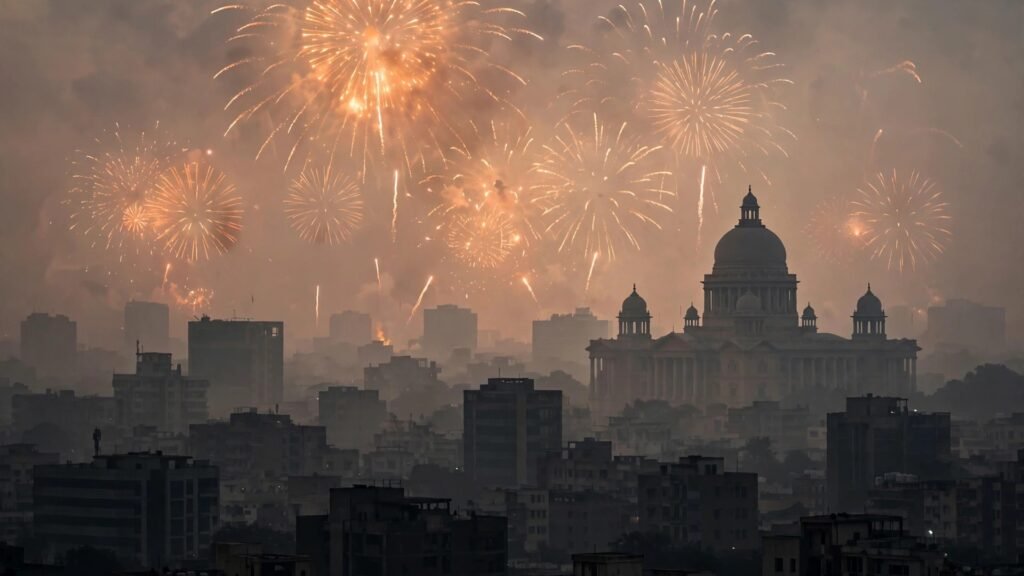
India’s Supreme Court on Thursday signalled that it is not inclined to impose a complete ban on firecrackers in Delhi and the National Capital Region (NCR), but it warned authorities in blunt terms that court orders mean little unless they are enforced on the ground. Hearing matters concerning rising air pollution in the region ahead of the Diwali festival season, a bench of Justices M. M. Sundresh and Prasanna B. Varale said the court understood public sentiment, but told the authorities not to push it towards a harsher stand.
The hearing, held in New Delhi, centred on a familiar annual problem: orders and directions on firecrackers are passed, yet compliance remains patchy and air quality still deteriorates during the festive season. Additional Solicitor General Aishwarya Bhati, appearing for the Centre, told the bench about measures taken by the Delhi government and the Commission for Air Quality Management (CAQM) to deal with air pollution. The bench’s response was that enforcement, not another round of directions, is now the test.
Key Takeaways
- The Supreme Court said it was not inclined to impose a complete ban on firecrackers in Delhi-NCR.
- The bench warned that orders become a mockery unless authorities give effect to them on the ground.
- The court suggested using respected sports persons and other public figures to spread awareness about pollution.
What the Bench Said
“It concerns every living being,” the bench observed while hearing the matter concerning the bursting of firecrackers in Delhi-NCR, according to reports of the hearing. The judges stressed that the issue was not adversarial, but that authorities had to take it seriously and take action. “There is no point in passing orders and directions unless you give effect to them on the ground, otherwise, it becomes a mockery,” the bench observed, while stressing enforcement.
The bench added: “You have to really regulate it. Every year we are trying to balance it out but unless there is cooperation from everyone, it can’t be done.” It also said: “We also understand the sentiments of the public. We are not inclined to completely ban but don’t push us to take a very harsh stand.” The remarks stop short of a final ruling on the restrictions themselves — one report of the hearing said the court reserved its order — but they set out the bench’s direction clearly: regulation and enforcement first, rather than a blanket prohibition.
There is no point in passing orders and directions unless you give effect to them on the ground, otherwise, it becomes a mockery.
Why a Complete Ban Was Not Favoured
During the hearing, Bhati told the court that last year there was a window for firecracker use, but that for the two years before that there had been a complete ban on firecracker use, and she stressed that a complete ban is not a solution. The bench agreed with that assessment. Reports of the hearing said the judges reasoned that a complete ban is likely to be breached, and that a blanket prohibition could push illegal crackers into the market while authorities continued filing cases against people.
The court also noted that it could restrict the hours for using firecrackers, an approach that would regulate the practice rather than outlaw it entirely. The amicus curiae in the case cautioned that so-called green crackers are not completely pollution-free, offering only about a 30 percent reduction in emissions, according to reports — a reminder that even a regulated alternative still adds to the pollution load. The bench’s position, as reported, was therefore a balance: protect public sentiment and the festival, but do not pretend that rules on paper are enough.
What Delhi Told the Court
Bhati told the bench that the Delhi government was better prepared than in previous years to deal with the pollution season. Reports of the hearing said the measures outlined included restrictions on vehicles entering Delhi that do not meet Bharat Stage VI (BS-VI) emission standards, with such vehicles to be banned from November 1, staggered government office timings, the deployment of 608 anti-smog guns near construction sites, and the setting up of control centres, alongside a Vayu Rakshak initiative.
The court questioned the absence of data on action taken after previous relaxations and restrictions on firecrackers, according to reports, and asked why compliance had not improved despite years of directions. That question goes to the heart of the bench’s warning: if violations continue to outnumber instances of compliance, as one report quoted the bench as observing, then the problem is not the absence of rules but the absence of follow-through.
- The bench comprised Justices M. M. Sundresh and Prasanna B. Varale.
- The hearing concerned firecrackers and air pollution in Delhi-NCR ahead of Diwali.
- The court said it was not inclined to a complete ban, but warned against pushing it to a harsh stand.
- Delhi’s reported measures include BS-VI vehicle restrictions from November 1 and 608 anti-smog guns.
- Green crackers were reported to cut emissions by only about 30 percent, not eliminate them.
- One report said the court reserved its order on the firecracker restrictions.
Awareness, Not Just Restrictions
One of the bench’s more striking suggestions was about public awareness. The judges asked why authorities could not use the services of prominent personalities for public awareness, including respected sports persons and public figures from any walk of life. “Why can’t you use the services of prominent personalities like sports persons and others for public awareness?” the bench asked. One report of the hearing said Indian cricketer Virat Kohli was cited as the kind of celebrated figure whose appeal could help persuade people to celebrate in a way that protects public health and the environment.
The court also emphasised sensitising children and young people, suggesting that educational institutions be involved in spreading awareness about pollution. The idea, as presented in the hearing, is that enforcement alone cannot change behaviour that is repeated every year; public messaging, backed by figures people listen to, has to do part of the work. The bench also suggested that the Centre give wide publicity against the use of firecrackers on television and in newspapers.
What to Watch Next
What to watch next is the order the court ultimately passes, and whether it sets restricted hours, conditions on green crackers, or new enforcement duties for Delhi and the CAQM. The other test is on the ground in Delhi itself: whether the vehicle restrictions, anti-smog guns and control centres announced for the pollution season are actually deployed, and whether violations are acted on rather than recorded. Delhi’s pollution season will also be shaped by weather systems moving across India, as recent storm coverage has shown, with Cyclone Arnab’s aftermath a reminder of how quickly conditions can change. Until the order and the enforcement arrive together, the court’s message stands: the rules exist, the sentiment is understood, and the next step belongs to the authorities charged with making the rules real.