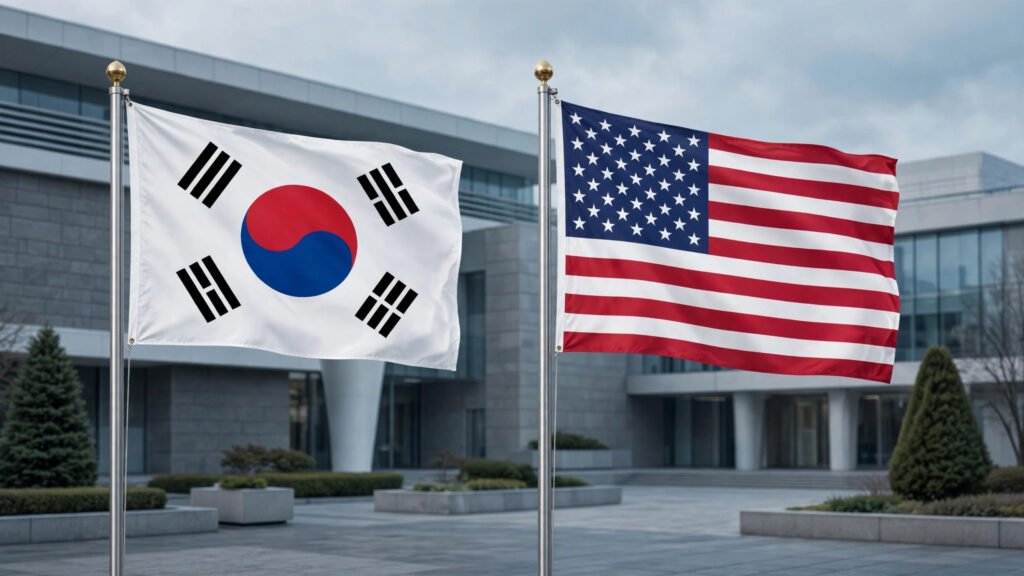
South Korea and the United States have agreed to postpone their annual Security Consultative Meeting (SCM) until early 2027, the first time in 28 years the ministerial defence dialogue has slipped past the end of the year. The delay, confirmed after talks between the two countries’ defence chiefs on October 28, has landed alongside a separate row over a United States visa refusal for the chairman of South Korea’s parliamentary defence committee, sharpening questions in Seoul about the state of the alliance.
The SCM is the allies’ flagship annual security dialogue, normally held in late October or early November. Its postponement does not suspend the alliance itself — the two sides have agreed to hold separate defence-minister talks in Washington in December — but the timing has drawn attention because it comes amid visible friction over the transfer of wartime operational control (OPCON) from Washington to Seoul, and over visa decisions affecting South Korean lawmakers.
Key Takeaways
- South Korea and the United States have postponed the annual Security Consultative Meeting to early 2027, the first time since 1998 it has been pushed into the following year.
- The defence chiefs agreed instead to meet in Washington in December, and Seoul’s defence ministry has rejected suggestions that the revised schedule signals a setback for the wartime operational control transfer.
- Separately, the US refused an official visa for National Assembly defence committee chairman Jin Seong-joon ahead of a planned November visit to US Indo-Pacific Command, with the specific grounds not disclosed.
What was agreed in the Philippines
The decision was announced after South Korean Defence Minister Kang Shin-chul and US Defense Secretary Pete Hegseth held bilateral talks on the sidelines of a regional defence ministers’ meeting in the Philippines on October 28. It was their first bilateral meeting. According to Seoul’s defence ministry, the two ministers agreed to cooperate closely to ensure a timely and smooth transfer of wartime operational control, and to hold defence-ministerial talks in Washington in December before convening the SCM in early 2027.
South Korea’s government had sought progress on setting a target for the OPCON transfer, a long-running issue in the alliance under which wartime command of combined forces would pass from the United States to South Korea. Analysts cited in Korean reporting said differences over the conditions and timing of that transfer helped make holding the SCM within the year difficult. Seoul’s defence ministry, however, rejected suggestions that the revised schedule signals a setback in the transfer process, framing the December talks and the early-2027 SCM as a continued sequence of consultations rather than a break.
Reporting also noted a further source of tension: remarks on October 14 by the commander of US Forces Korea, who said the conditions for the OPCON transfer had clearly changed and that new standards must be met. That comment drew a backlash from South Korea’s government and ruling party, which insisted the transfer should proceed. The disagreement over conditions, rather than over the principle of the transfer, is the fault line running through the current debate.
The postponement does not suspend the alliance itself, but the timing has drawn attention because it comes amid visible friction over wartime command and visa decisions affecting South Korean lawmakers.
The visa refusal at the centre of the row
Separately, Representative Jin Seong-joon of the ruling Democratic Party, chairman of the National Assembly’s National Defense Committee, disclosed that his application for an official A-2 visa had been marked “Refused” ahead of a planned visit to US Indo-Pacific Command in Hawaii from November 1 to 5. He was scheduled to lead a four-member parliamentary delegation, drawn from both ruling and opposition parties, to discuss bilateral security cooperation and ways to strengthen the alliance.
The reason for the refusal remains unclear. The US State Department said visa applications are reviewed individually and declined to comment on Jin’s specific circumstances. Jin was convicted of violating South Korea’s National Security Act in 1991 and sentenced to three years in prison, with a three-year suspension of qualifications, before being pardoned in 1995. Some South Korean lawmakers have pointed to that record, and to a US request for past court documents, as a possible factor in the screening process, while others have described the refusal as a sign of disrespect toward an allied parliament. What has not been established publicly is whether the refusal was a final decision or a stage in an ongoing review, and reporting has cautioned against treating it as a confirmed political reprisal.
Jin said on social media that he strongly regretted the refusal, arguing that denying a visa to the defence committee chairman of an allied nation’s parliament disregards the standing of the National Assembly and undermines mutual respect and trust. Lawmakers across the political spectrum have weighed in: some have stressed that disagreements should not be confused with a fundamental breakdown of the alliance, while opposition figures have called the episode a sign of unsettling turbulence. An earlier visa delay affecting another Democratic Party lawmaker, Jung Cheong-rae, which forced a change in a national audit schedule, has also been cited in Seoul as part of a pattern that needs resolving.
Why the timing matters
The SCM postponement and the visa row are separate decisions, but they have combined in Seoul’s political debate because both touch the same question: how smoothly the alliance is functioning at a moment of wider regional pressure. South Korea’s Foreign Minister Cho Hyun departed for the United States on October 29 to attend the G20 foreign ministers’ meeting in Atlanta, and he has said he intends to ask the US side to expedite visa issuance for the lawmakers. A separate bilateral meeting with US Secretary of State Marco Rubio had not been confirmed at the time of his departure, according to reports, leaving open whether the visa issue will be raised directly at ministerial level this week.
Seoul has also been working on other partnerships in parallel, including an enhanced strategic partnership with Germany agreed this week, a reminder that South Korea’s security diplomacy is not confined to a single channel. But the US alliance remains its central security relationship, and the SCM is the forum where its most sensitive defence questions — command arrangements, combined readiness and regional deterrence — are formally addressed. A meeting pushed into a new year therefore carries weight beyond its calendar date, even when both sides insist the dialogue continues.
- The 58th Security Consultative Meeting, normally held in late October or early November, will now be held in early 2027.
- Defence ministers Kang Shin-chul and Pete Hegseth agreed to separate talks in Washington in December.
- Jin Seong-joon, chairman of the National Assembly’s National Defense Committee, had his official US visa application marked “Refused” before a planned November 1-5 visit to Hawaii.
- The specific grounds for the visa refusal have not been disclosed by the US State Department.
- South Korea’s defence ministry says the revised SCM schedule does not signal a setback for the wartime operational control transfer.
- Foreign Minister Cho Hyun has said he intends to ask Washington to expedite visas for South Korean lawmakers.
What to Watch Next
What to watch next is only what the reporting already points to: whether the December defence-minister talks in Washington produce a firm date for the early-2027 SCM, whether the visa cases involving Jin and other lawmakers are resolved or clarified, and whether Foreign Minister Cho Hyun’s trip produces a bilateral meeting with Secretary Rubio at which the visa issue is raised. The other question is whether the allies close the remaining gap over the conditions and timing of the wartime operational control transfer, or whether that disagreement continues into the rescheduled meeting. Until then, the verified picture is a postponed dialogue, a December meeting in its place, and a visa row that Seoul wants resolved quickly.