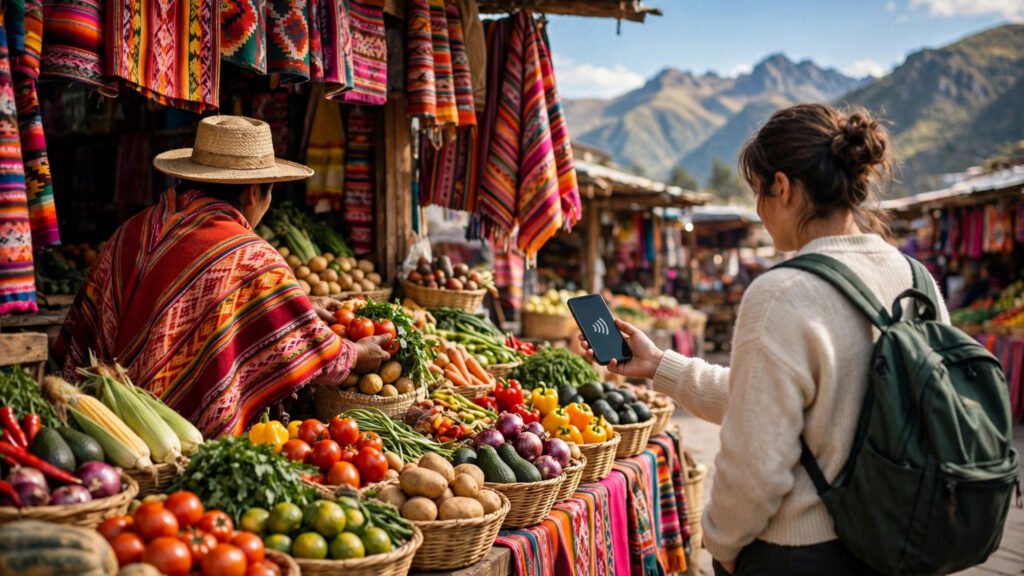
In Peru, paying for lunch, a taxi ride, or a bag of fruit at the market often ends the same way: with a phone, not a wallet. The buyer opens an app, types in the seller’s phone number or scans a code, and the money moves in seconds. For millions of everyday payments, two names come up again and again: Yape and Plin. Together, they have changed how Peruvians handle small, daily spending.
This shift did not happen because Peruvians stopped liking cash. It happened because phone payments solved a set of practical problems: finding exact change, carrying notes to a busy market, and splitting a bill between friends. A phone is already in almost every pocket, so the payment method that lives on the phone has a natural advantage.
Key Takeaways
- Yape and Plin let Peruvians send money using a phone number or a QR code, without cash or a card terminal.
- Phone payments suit small, everyday amounts, from market stalls and taxis to splitting a restaurant bill.
- Because the two apps work together, a payer and a seller do not need to use the same app to complete a transfer.
How Yape and Plin Work in Daily Life
Yape is a mobile wallet linked to a bank account or a card, and it is widely associated with Banco de Crédito del Perú. Plin works in a similar way and is offered through several Peruvian banks. In both cases, the basic idea is the same: instead of handing over notes and coins, the payer sends money straight from a phone to the other person’s account.
The most common way to pay is by phone number. A market vendor, a taxi driver, or a friend can simply share a mobile number, and the buyer sends the amount to it. QR codes are the other everyday option: the seller shows a printed or on-screen code, the buyer scans it, checks the amount, and confirms. There is no card machine to carry, no terminal to plug in, and no need for either side to have a shop or a business account.
That simplicity is exactly why small sellers adopted these apps so quickly. A fruit seller, a street food vendor, or a neighbourhood shop can accept a phone payment with nothing more than a personal phone and a printed code. For customers, the appeal is just as clear: no hunting for change, no trip to an ATM, and a record of the payment on the phone afterwards.
Why Phone Numbers Beat Cash for Small Amounts
Cash has one stubborn weakness in Peru, as anywhere else: change. A small purchase paid with a large note can stall a whole queue while the seller searches for coins. A phone payment removes that friction entirely. The exact amount moves, down to the smallest unit, and both sides can see the result straight away.
A phone is already in almost every pocket, so the payment method that lives on the phone has a natural advantage.
Phone payments also fit the way Peruvians share costs. Splitting a restaurant bill, collecting money for a group gift, or repaying a friend used to mean a pocket full of coins and a round of mental arithmetic. Now one person pays the total and the rest send their share to that person’s number within minutes. It is faster, and there is less room for the awkwardness of chasing small debts.
Security plays a part too. Carrying less cash means less to lose, and a payment made through an app leaves a trace that cash never does. If there is a question about whether something was paid, both sides can check their phones rather than relying on memory.
One Payment System, Even With Two Apps
A payment app is only useful if the other person accepts it, and this is where Peru’s setup helps. Yape and Plin are interoperable, which means a person using one app can send money to a person using the other. A buyer does not need to ask which app the seller prefers before paying, and a seller does not need to display two different codes for two different apps.
This matters most for small businesses. A vendor who accepts phone payments can serve any customer with either app, instead of turning some away. That wider acceptance is one reason phone payments spread beyond big cities into smaller towns and markets, where a card terminal was never a realistic option for a small stall.
The pattern is familiar across Latin America, where local wallets have taken a similar path. In Colombia, people pay with Nequi and Daviplata instead of bank cards, while in Argentina shoppers reach for Mercado Pago instead of cash or cards. In Pakistan, a similar shift has seen people pay with mobile wallets instead of bank cards. The apps differ, but the logic is the same: a phone number is easier to share than a card number, and a QR code is cheaper than a terminal.
- Pay with a phone number or a QR code — no card terminal needed.
- Exact amounts move instantly, so there is no problem with change.
- Small sellers can accept payments with just a phone and a printed code.
- Yape and Plin work together, so payer and seller need not use the same app.
- Every payment leaves a record on the phone for both sides.
Where Phone Payments Still Have Limits
None of this means cash has disappeared in Peru. It remains important, especially in rural areas where mobile signal can be patchy and where some sellers still prefer notes and coins. A phone payment also needs a charged phone and a connection, which is not something every traveller or worker can guarantee at every moment.
There is also a learning curve. Older Peruvians and people who have never had a bank account may need help setting up an app for the first time, and trust has to be earned: a first-time user wants to be sure the money really arrived before treating the phone as a wallet. In practice, that trust usually builds quickly, because the first few successful transfers — a market purchase, a taxi fare, a repayment to a friend — show the system working in real life.
For visitors, the lesson is simple: in much of urban Peru, a phone payment is now the normal way to settle a small amount, and carrying only large notes can be more awkward than carrying none at all. Asking a seller whether they accept Yape or Plin is as ordinary as asking whether they accept cards.
What to Watch Next
Phone payments in Peru have already moved from a novelty to a daily habit, because they fit the way people actually spend: small amounts, shared bills, and small sellers. The next test is how far the habit reaches — into rural markets, older age groups, and the remaining cash-only corners of daily life. If it keeps spreading the way it has so far, the question for many Peruvians will no longer be whether to pay by phone, but why they ever carried change at all.