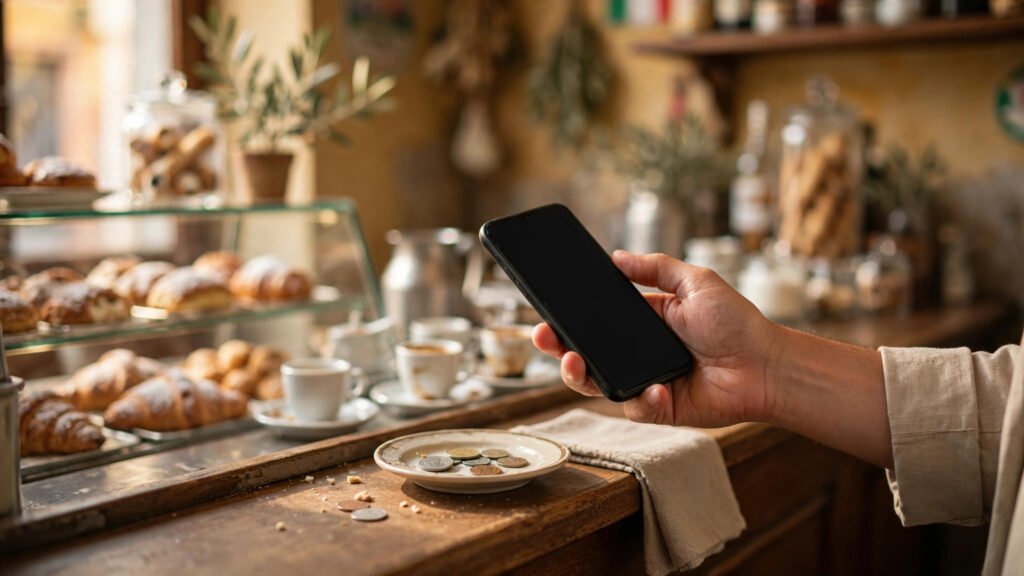
In Italy, the morning coffee at the bar used to end the same way every time: a few coins left on the saucer, a nod to the barista, and out the door. That small ritual still exists, but for a growing number of Italians it has changed. The coins stay in the pocket, the phone comes out, and the payment is confirmed on a screen. The app behind that change, more often than any other, is Satispay.
Satispay is an Italian payment app that lets people pay in shops and send money to friends without a card. It links to a bank account, and the phone becomes the wallet. Its rise says a lot about Italy itself: a country where cash was king for a very long time, where small shops and bars shape daily life, and where a homegrown answer beat the habit of coins and notes.
Key Takeaways
- Satispay is Italy’s homegrown payment app: it links to a bank account, so people can pay in shops and send money to friends without a card.
- It caught on because it fits small daily payments, from a coffee at the bar to a shared dinner bill, and because small shops found it easy to accept.
- Cash and cards have not disappeared in Italy; Satispay sits alongside them, and visitors and older customers still pay the old ways.
Cash Was Hard to Leave Behind in Italy
Italy has long been a cash-loving country, and not by accident. Daily life runs on small purchases: a coffee standing at the bar, a pastry, a newspaper, a bus ticket, vegetables from the market stall. For amounts that small, cash felt natural. It was instant, it needed no device, and it worked everywhere, from a village shop to a city café.
Small businesses shaped that habit too. Italy is full of family-run bars, bakeries, trattorias, and market stalls where the owner knows the regulars by name. In places like these, the payment is part of the social moment, not a separate transaction. Handing over coins, getting change, and moving on took seconds, and for years there was little reason to change a system that worked.
Cards slowly gained ground, especially for larger purchases and in bigger cities, but the smallest payments stayed stubbornly cash-based. That is the gap Satispay walked into: not the weekly supermarket shop, where cards were already normal, but the everyday coffee, the sandwich, the shared pizza, where cash still ruled.
How Satispay Actually Works
Satispay works differently from a card. Instead of linking a card, the user connects a bank account. To pay in a shop, the customer opens the app, chooses the shop, types in the amount, and confirms. In many shops the process runs the other way round: the shopkeeper enters the amount and the customer confirms it on their own phone. Either way, no card is tapped and no coins change hands.
Between friends, it works by contact. Sending money to a friend means picking their name from the phone’s contacts and entering the amount, which suits the moments Italians actually split costs: a dinner shared with friends, a gift collected among colleagues, a share of the rent or a holiday apartment. The app also runs occasional cashback offers with partner shops, which gives regular users one more reason to open it instead of reaching for coins.
The phone did not replace the bar or the market stall; it simply replaced the coins on the saucer. That is why the change felt easy rather than forced. Nothing about the visit changed except the last few seconds at the counter.
The phone did not replace the bar or the market stall; it simply replaced the coins on the saucer.
Why Small Shops Went Along With It
A payment method only works if shops accept it, and Satispay won over small Italian businesses one counter at a time. For a bar or a bakery, accepting it does not depend on a card machine alone; the shop can take payments through the app itself. That matters for the smallest businesses, where every piece of equipment and every step at the counter counts.
Regular customers helped even more. When the same faces come in every morning, a shopkeeper quickly learns what they prefer. Once a few regulars started paying by phone, others followed, and the shop had a reason to keep accepting it. Word of mouth did the rest, in the same way it spreads news of a good restaurant or a reliable mechanic.
The pattern is familiar across Europe. In Norway, Vipps became the everyday way to pay and send money because it was built around a phone number people already knew. In Denmark, MobilePay spread the same way, shop by shop and friend by friend. Italy’s version of the story runs on the same logic: the app that fits daily life wins, not the one with the most features.
Where Cash and Cards Still Fit
Satispay has not made Italy cashless, and it was never going to. Cash is still common, especially among older Italians, in rural areas, and in markets where a quick cash payment remains the simplest option. Tourists, too, usually pay by card or cash, since setting up a local app for a short trip makes little sense.
Cards remain a big part of Italian life as well, above all for larger purchases, online shopping, and travel. In Sweden, cash has become rare in daily life, but Italy is on a slower path, and that is not a failure. It is a country where the bar, the market, and the family shop still set the pace, and payment habits change at the pace of daily life, not faster.
- Satispay links to a bank account, so Italians can pay and send money by phone without a card.
- It fits Italy’s small daily payments: coffee at the bar, market shopping, and bills shared with friends.
- Small shops adopted it because it is simple to accept and spread through regular customers.
- Cash and cards remain common in Italy, especially for older people, tourists, and larger purchases.
- Italy follows the same European pattern as Norway and Denmark, where a local app won by fitting daily life.
What to Watch Next
Satispay’s story in Italy is still being written at the counter of the bar and the till of the market stall. If more small shops keep accepting it and more friends keep splitting bills through it, the phone will keep quietly replacing coins for the smallest payments. Cash and cards will stay part of Italian life, but the saucer by the espresso cup may increasingly hold nothing at all.