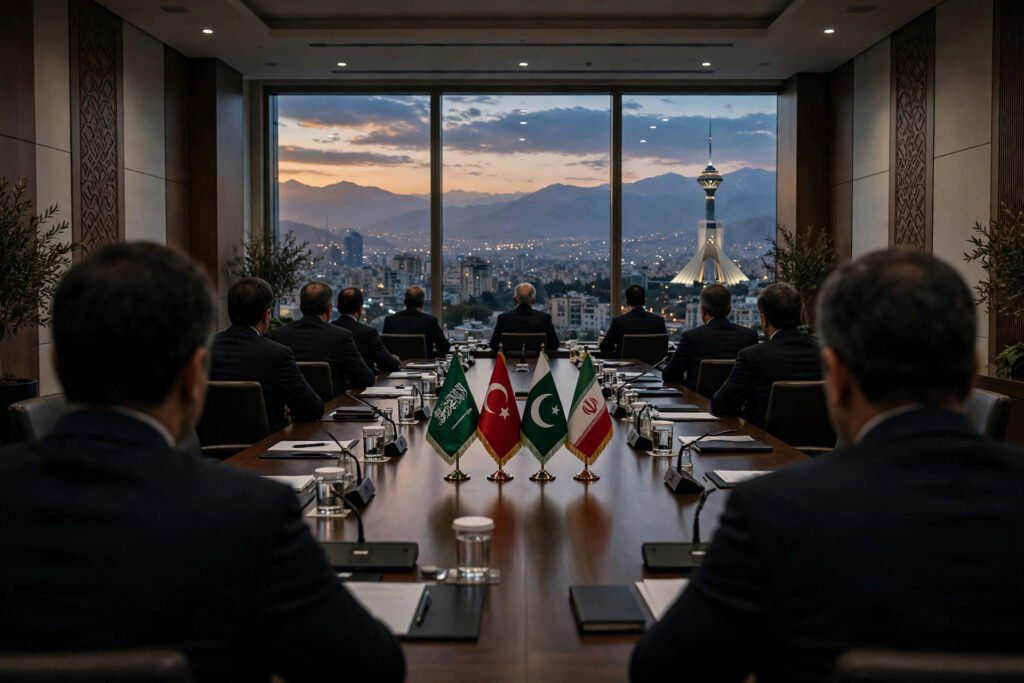
Senior officials from Saudi Arabia, Turkey and Pakistan are meeting Iran’s leaders in Tehran on Monday, October 26, 2026, in the first high-level contact between Iran and all three members of the Makkah defence bloc since Saudi Arabia was drawn deeper into the wider Iran conflict. The talks, reported by Reuters and confirmed by officials in Tehran and Riyadh, put a newly signed mutual-defence pact face to face with the country whose allies have been attacking one of its members.
Key Takeaways
- Saudi Defence Minister Prince Khalid bin Salman, Pakistan army chief Field Marshal Asim Munir and Turkish intelligence chief Ibrahim Kalin are meeting Iranian officials in Tehran on Monday, October 26.
- The meeting is the first high-level contact between Iran and all three Makkah Pact members since Saudi Arabia was drawn deeper into the conflict.
- Under the Makkah Joint Defence Agreement signed in August, an armed attack on one member is considered an attack on all.
The delegations show how seriously each capital is taking the meeting. Saudi Arabia is represented by Defence Minister Prince Khalid bin Salman, Pakistan by army chief Field Marshal Asim Munir, and Turkey by intelligence chief Ibrahim Kalin, according to Saudi and Iranian officials cited by Reuters. On the Iranian side, Deputy Secretary of the Supreme National Security Council Ali Bagheri Kani said the meeting would be held with Iran’s security chief Mohsen Rezaei, while Saudi Deputy Minister for Public Diplomacy Rayed Krimly said the participants also include Iranian President Masoud Pezeshkian.
Why This Meeting, Why Now
The timing is shaped by two pressures pulling in opposite directions. On one side, attacks by Yemen’s Iran-aligned Houthis on Saudi Arabia have spiralled over recent weeks, turning the kingdom into a pressure point in the wider conflict. On the other, rhetoric between Washington and Tehran has grown more heated, with both sides reported to have drawn up plans to restart the wider war, possibly after the United States midterm elections on November 3.
Into that standoff steps a bloc that was only created in August. Under the Makkah Joint Defence Agreement, signed by Saudi Arabia, Pakistan and Turkey, an armed attack on one member is considered an attack on all. Earlier this month the members also agreed to rush military forces into Saudi Arabia. The Tehran meeting therefore carries an unusual tension: a defence pact built to protect Riyadh is now sitting down with Tehran, the country backing the forces attacking it.
Monday’s planned talks would be the first high-level contact between Iran and all members of the three-nation bloc since Saudi Arabia was drawn deeper into the conflict.
How the Meeting Came About
The meeting was proposed by Pakistan’s army chief during his visit to Tehran last week, according to a senior Iranian official. During that visit, Asim Munir met Iranian President Masoud Pezeshkian and other senior officials, and Iranian officials told him there would be no talks with Washington until Tehran’s demands were met, according to Iranian media reports cited by Reuters.
Pakistan has also played an intermediary role in efforts to reduce tensions between Washington and Tehran, and earlier mediation efforts involving both Pakistan and Qatar helped produce an interim peace agreement in June. That deal quickly unravelled as fighting between Iran and the United States resumed weeks later, which is why Monday’s meeting is being watched less as a breakthrough and more as a test of whether a direct channel can hold.
Qatar, which has for months played a key mediating role between Tehran and Washington, also sent mediators to meet Iranian officials in Tehran on Sunday, Reuters reported. The back-to-back visits underline how many channels are now active at once, even as the public rhetoric remains confrontational.
What Each Side Says It Wants
Iranian officials framed the meeting as a step toward regional stability. Bagheri Kani said the four-party meeting in Tehran could represent an important and effective step towards building lasting regional security, and expressed hope that the initiative would contribute to establishing a stable region.
Riyadh framed it in similar terms. Krimly said the visit was aimed at de-escalation and finding diplomatic solutions to the crises in the region, and at emphasising the pivotal role of the Makkah Agreement states in restoring the security and stability of the region and working with all regional countries towards that goal.
Neither statement disclosed an agenda beyond regional coordination and security, and neither side has said what would count as success. That caution matters: the meeting is a first contact, not a negotiation with a published outcome, and its value may lie simply in the fact that it is happening at all.
- Saudi Defence Minister Prince Khalid bin Salman leads the Saudi delegation to Tehran.
- Pakistan army chief Field Marshal Asim Munir proposed the meeting during his Tehran visit last week.
- Turkish intelligence chief Ibrahim Kalin represents Turkey in the talks.
- The Makkah Joint Defence Agreement was signed in August by Saudi Arabia, Pakistan and Turkey.
- Qatari mediators met Iranian officials in Tehran on Sunday, Reuters reported.
- Both sides have drawn up plans to restart the wider war, possibly after the US midterm elections on November 3.
The Wider Crisis Around the Table
The talks do not happen in isolation. The same weekend brought a flurry of related developments across the region. United States intelligence warnings about Iranian assassination plots have widened evacuations from Middle East missions, while the United States confirmed a drawdown of non-emergency staff in Saudi Arabia because of safety risks. President Donald Trump said on Sunday that there would be no strike on Iran that day, after earlier suggesting Washington faced a choice between a deal and escalation, and he has spoken of both a possible further military operation and a possible major agreement as alternatives.
Meanwhile, Riyadh airport announced a partial reopening after a two-week closure linked to Houthi attacks, a reminder that the threat the Makkah Pact was designed to answer is not theoretical. The pact’s members must now weigh their collective-defence commitment against the diplomatic opening that Monday’s meeting represents.
What to Watch Next
What to watch next is whether Monday’s meeting produces any statement on de-escalation, whether the channel it opens survives the week, and whether the United States and Iran move from warnings toward either a settlement or renewed fighting. The other tests are whether Houthi attacks on Saudi Arabia ease or continue, whether the Makkah Pact members act together or separately in the days ahead, and whether the mediation efforts by Pakistan and Qatar can turn a first contact into a durable dialogue. Until those questions are answered, the Tehran meeting stands as a rare diplomatic opening in a crisis that has so far been defined by threats: a defence bloc and its adversary, in the same room, talking about regional security.