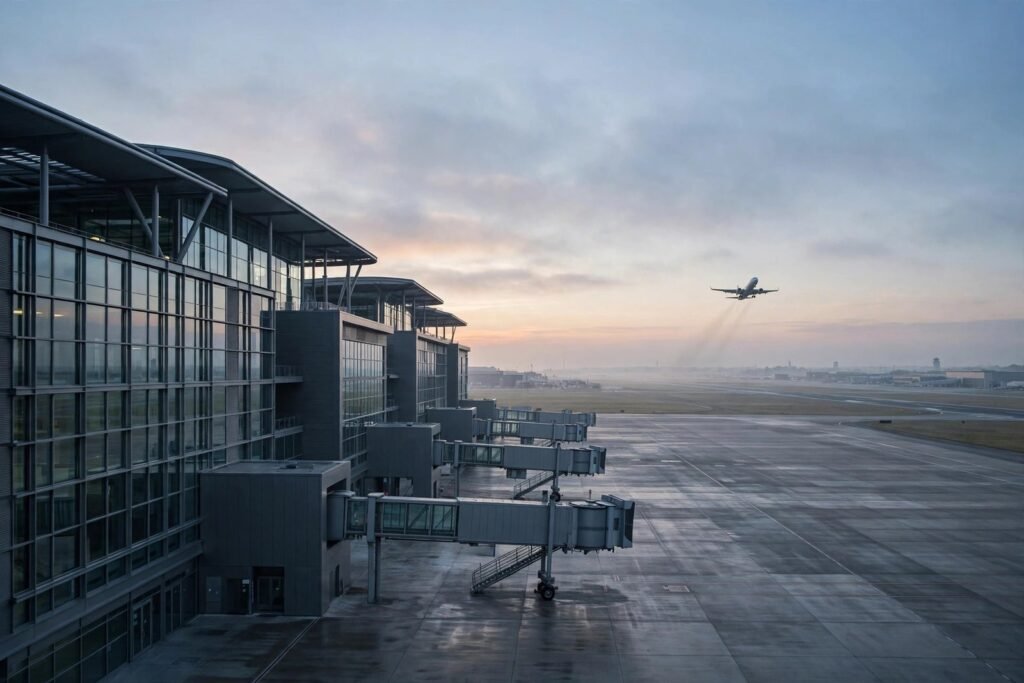
Flights have resumed at Riyadh’s King Khalid International Airport after a two-week closure following strikes by Yemen’s Houthis on the Saudi capital, but the reopening arrived with a warning, a limited schedule and fresh reports of explosions over the city. The airport said flights would resume on Sunday, October 25, 2026, and its website showed several domestic and international flights scheduled that day, including arrivals from Dubai, Paris and Cairo. At the same time, tracking data showed only a small number of flights actually departing, with the vast majority still cancelled, a reminder that a reopened airport is not the same as a normal airport.
Key Takeaways
- Riyadh’s King Khalid International Airport resumed flights on Sunday after a two-week closure following Houthi strikes.
- Terminal 1 is handling domestic flights and Terminal 2 is handling international flights operated by national carriers.
- The Houthis have warned airlines and travellers against using the airport, calling it unsafe and a military target.
The return of flights is a step back toward movement, not yet a return to normal. For passengers, airlines and the wider region, the practical question is no longer only whether the airport is open, but whether it can stay open safely day after day. That uncertainty is shaping decisions far beyond the departure board, from postponed conferences to cancelled sporting events, and it is now part of the wider story of a war whose front lines have shifted toward Saudi infrastructure.
A Two-Week Closure Ends, Tentatively
The airport had been closed for two weeks after a series of deadly attacks on the facility. The Houthis have carried out waves of strikes on the airport, including an attack this month that killed 13 people and wounded more than 300 people, described in reports as the deadliest attack in the kingdom in more than a decade. The scale of that attack helps explain both the length of the closure and the caution surrounding the reopening.
In a notice posted on Saturday, the airport set out a split-terminal arrangement for the resumption. Terminal 1 was designated for domestic flights and Terminal 2 for international flights operated by national carriers, effective Sunday, October 25, 2026. Passengers with confirmed bookings were advised to contact their airlines to verify flight status before heading to the airport, a step that remains essential while schedules change at short notice.
Early evidence of movement was limited but real. The flight-tracking site Flightradar24 showed a plane taking off from Riyadh early on Sunday, heading to the Saudi city of Jeddah, while also showing that most flights remained cancelled. The airport’s own website listed scheduled domestic and international flights on Sunday, a sign that operations had restarted even if capacity had not. For travellers stranded by the closure, even a partial schedule matters, but it also means plans can still unravel without warning.
Warnings, Explosions and a Fragile Calm
The reopening did not come with a ceasefire or a security guarantee. Houthi military spokesman Yahya Saree warned that Riyadh airport was still unsafe and a military target, and warned airlines, airport staff and travellers against using it. That warning was repeated across reports on Sunday and is now the central risk for anyone deciding whether to fly through Riyadh.
Explosions rattled Riyadh early on Sunday, after a text message was sent to residents warning of a hostile threat targeting the city. The Saudi-led military coalition fighting the Houthis said early on Sunday that it had shot down two drones in the Riyadh area. Saudi officials did not provide additional information when asked about the scope of the renewed airport operations, leaving passengers and airlines to judge the risk from a mix of official notices, tracking data and warnings from the other side.
The fighting follows the breakdown of a years-long truce between the Houthis and Yemen’s Riyadh-backed government, a collapse reported to have taken hold in the summer. As conflict disrupts everyday infrastructure, from communications to transport, the effects are felt first by civilians trying to travel, work and stay in contact with family. In the Middle East, as in other conflict zones, an airport closure quickly becomes more than a transport problem: it cuts off medical travel, business travel, family visits and the movement of goods.
The return of flights is a step back toward movement, not yet a return to normal.
Why Riyadh Airport Matters Beyond Saudi Arabia
King Khalid International Airport is a key hub for Saudi Arabia’s aviation network, and any disruption there affects flight schedules, cargo operations and the broader economy. The closure was already described as a major blow for Saudi Arabia, with the kingdom’s flagship investment conference postponed until 2027 as residents scrambled to find alternatives to enter and exit the country. The prestigious Dakar Rally motor sport race also joined a long list of events cancelled, postponed or relocated amid the fallout from the war.
Reports have also placed the fighting in the wider context of the US-Iran war and a deepening humanitarian disaster in Yemen, one of the world’s poorest countries. That wider framing matters because it suggests the airport’s future will not be decided by aviation managers alone. It will depend on whether the parties in Yemen and the wider region can contain a conflict that has already spilled across borders, and whether airlines judge the risk acceptable for their crews, aircraft and passengers.
The human cost in the region is already visible in other places where homes and communities have been caught in conflict. As families are displaced by demolitions and conflict in the region, the disruption to daily life extends far beyond any single incident, and recovery is slow even after the immediate danger passes. Riyadh’s reopening, however welcome, does not erase that wider pattern.
- Flights resumed on Sunday, October 25, after a two-week closure.
- Terminal 1 is for domestic flights; Terminal 2 is for international flights by national carriers.
- Only a small number of flights departed on Sunday, with most still cancelled.
- An attack this month killed 13 people and wounded more than 300.
- The Saudi-led coalition said it shot down two drones in the Riyadh area on Sunday.
- Passengers are advised to confirm flight status with their airline before travelling.
What Travellers Should Do Now
For now, the safest approach for travellers is to treat the reopening as tentative. Confirm bookings directly with the airline, allow extra time for changes, and be prepared for cancellations or rerouting at short notice. Travellers should also follow official airport and airline notices rather than relying on a single schedule listing, since a flight shown as scheduled is not a guarantee that it will depart.
Airlines, too, face a difficult calculation. Resuming service restores connectivity and revenue, but operating into an airport that one side in a conflict has publicly called a military target carries obvious risks for staff and aircraft. The limited number of departures on Sunday suggests that many carriers are moving cautiously, testing operations rather than restoring a full timetable at once. That caution is understandable, and it is likely to continue until the security picture becomes clearer.
What to Watch Next
What to watch next is whether the limited resumption grows into a fuller schedule in the coming days, whether the split-terminal arrangement stays in place, and whether further warnings or drone interceptions are reported around Riyadh. The key test is not a single day of departures, but a sustained period in which flights operate, passengers can plan with confidence, and the airport’s schedule stops changing at short notice. Until that happens, the reopening should be read as a tentative step back toward movement, not yet a return to normal, and travellers should keep confirming their plans before they travel.