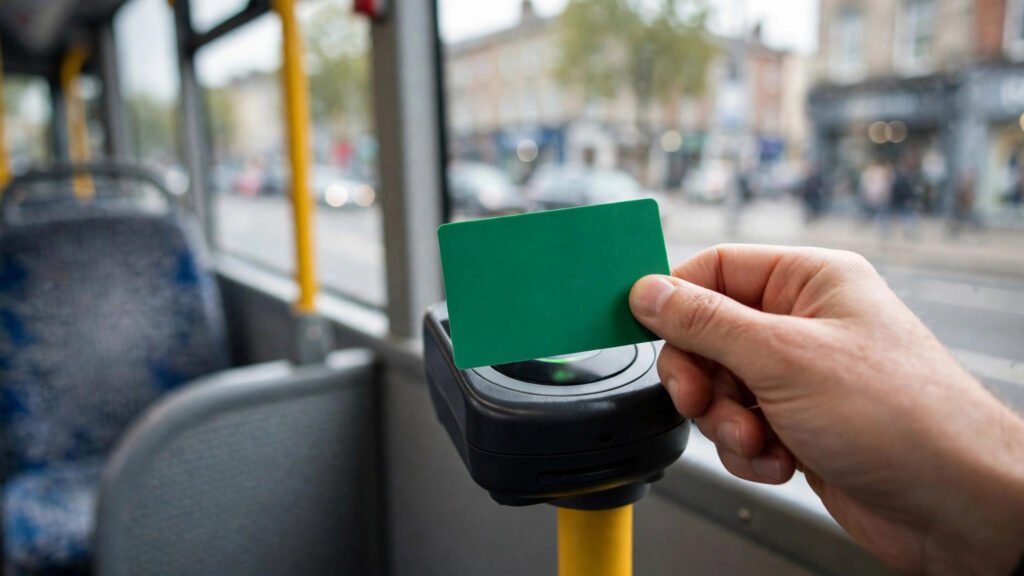
Step onto a bus in Dublin at rush hour and you will notice something quickly: very few people are fumbling for coins. Instead, most commuters simply hold a small green card against a reader by the driver, hear a beep, and walk to a seat. That card is the Leap Card, and for many people in Ireland it has quietly replaced cash as the normal way to pay for public transport.
So why do Irish commuters tap a Leap Card instead of paying cash on the bus? The short answer is that it is faster, simpler and usually cheaper — and it works across more than one kind of transport. Once you understand how it fits into daily life in Ireland, the habit makes complete sense.
Key Takeaways
- A Leap Card is a reusable smart card that stores travel credit and is tapped on a reader instead of paying cash for each journey.
- Tapping is faster at boarding, which matters most on busy city buses where every second at the door adds up.
- One card can cover bus, tram and train journeys, so commuters do not need separate tickets for each leg of a trip.
What a Leap Card actually is
A Leap Card is a reusable plastic smart card for public transport in Ireland. You load travel credit onto it, then tap it on a reader when you board a bus or tram, or at a station validator before a train journey. The reader deducts the fare for that trip from the balance on the card, and a display or beep confirms that the tap has worked.
The idea is deliberately simple. There is no ticket to buy for every single journey, no change to count, and no paper ticket to keep safe until the end of the trip. The card itself holds the value, and the commuter only needs to remember to carry it and keep it topped up. For people who travel every day, that simplicity is the whole point.
The card is part of Ireland’s wider Transport for Ireland system, which brings bus, tram and rail services under one public transport umbrella. That shared system is what allows one card to be useful across different operators and different kinds of journey, rather than being tied to a single bus company or a single route.
Why tapping beats cash on a busy bus
Cash slows a bus down. A passenger paying cash has to ask for the fare, find the right coins or notes, wait for change, and take a ticket — all while a queue builds up behind them and the bus waits at the stop. A tap, by contrast, takes a second or two. The reader beeps, the passenger moves on, and the bus keeps moving.
On a quiet rural route that difference might not matter much. On a busy Dublin bus route in the morning peak, it matters a great deal. Dozens of passengers board at popular stops, and if each one paid cash, the delays would add up stop after stop. Tapping keeps boarding quick, which helps buses stay closer to their timetables and makes the journey less frustrating for everyone on board.
There is also a practical benefit for the passenger. Carrying exact change every day is a chore, and cash fares can be awkward when you are rushing, carrying bags, or travelling with children. A card in a wallet or pocket removes that daily friction entirely. You tap and you sit down.
One card across bus, tram and train
Another reason commuters stick with the Leap Card is that it is not limited to one mode of transport. The same card can be used on Dublin Bus services, on the Luas tram network, and on commuter rail services such as DART and other suburban trains. For someone whose journey involves a bus to a tram stop and then a tram into the city centre, that flexibility is genuinely useful.
Before smart cards, a multi-leg journey often meant separate tickets, separate queues and separate payments. The Leap Card turns that into a single habit: tap on, tap off where required, and let the card handle the fare for each leg. It does not remove the need to understand the system — train journeys, for example, still need the card to be validated correctly — but it does remove much of the ticket-buying hassle.
This kind of joined-up travel is not unique to Ireland. In Japan, for example, commuters have long tapped rechargeable IC cards instead of buying paper tickets for each train or bus ride, as explained in our post about why Japanese commuters tap IC cards instead of paper tickets. The principle is the same: one stored-value card, many journeys, no ticket machine queue.
Topping up from a phone
A card that runs out of credit at the wrong moment would be more trouble than cash, so topping up has to be easy — and for Leap Card users, it is. Credit can be added at shops and ticket machines, and many users top up through the TFI Leap app on their phones. The app also lets users check their balance, so there is less chance of an unpleasant surprise at the reader.
This phone link matters because it fits how Irish commuters already manage money. Ireland has seen a big shift towards managing everyday spending from a phone, from banking apps to contactless payments, as covered in our explanation of why many Irish people bank with Revolut instead of traditional banks. Topping up a travel card from the same device people already use for banking feels natural, not like learning a new system.
For regular travellers there are also period options, such as weekly or monthly travel arrangements, which suit people who commute five days a week. The right choice depends on how often you travel, but the underlying habit is the same: load the card, tap, and travel.
Who benefits most from tapping
Daily commuters benefit most, because they make the same journeys again and again and the time saved at boarding adds up over a working week. Students and young adults, who often travel on tighter budgets and rely heavily on public transport, also benefit from a system that rewards regular use rather than one-off cash payments.
Visitors benefit too, in a different way. A visitor who buys a Leap Card does not need to work out cash fares for every bus or tram journey, or worry about having the right coins. They can load credit, tap as they go, and focus on the journey itself. For a city that welcomes large numbers of tourists, that simplicity is a real advantage.
There is a broader pattern here as well. Across Europe, travellers are moving away from cash and towards cards and phones for everyday payments, whether that is banking or transport. In Britain, for example, many people now manage their money through phone-based banks rather than visiting a high street branch, as explained in our post about why Britons bank on their phones with Monzo and Starling instead of high street banks. The Leap Card is Ireland’s transport version of the same shift: the phone and the card replace the queue and the coins.
What to watch next
The Leap Card habit is unlikely to disappear, but how people tap may keep changing. Contactless bank card payments and phone-based travel are already part of everyday life in many cities, and transport systems everywhere are gradually adding more ways to pay without cash. In Ireland, the question for commuters will be whether tapping a dedicated travel card remains the simplest option, or whether paying directly with a phone or bank card becomes just as easy.
For now, though, the Leap Card’s appeal is easy to summarise. It is faster than cash at the bus door, it works across bus, tram and train, and it can be topped up from a phone. For an Irish commuter catching the same bus every morning, that combination is hard to beat — which is exactly why the tap, rather than the coin, has become the sound of the morning commute.
Tapping keeps boarding quick, which helps buses stay closer to their timetables and makes the journey less frustrating for everyone on board.
- A Leap Card stores travel credit and is tapped on a reader instead of paying cash per journey.
- Tapping speeds up boarding on busy buses and keeps services closer to schedule.
- One card covers Dublin Bus, Luas trams and commuter rail services.
- Credit can be topped up at shops and machines or through the TFI Leap app.
- Regular commuters, students and visitors all benefit from the simpler system.
What to Watch Next
Watch whether phone and contactless bank card payments become as simple as tapping a Leap Card on Irish buses, trams and trains, and whether the dedicated travel card keeps its place as the everyday habit for commuters. For now, the tap remains the quickest way through the bus door, the easiest way across bus, tram and train, and the simplest way to travel without carrying cash.