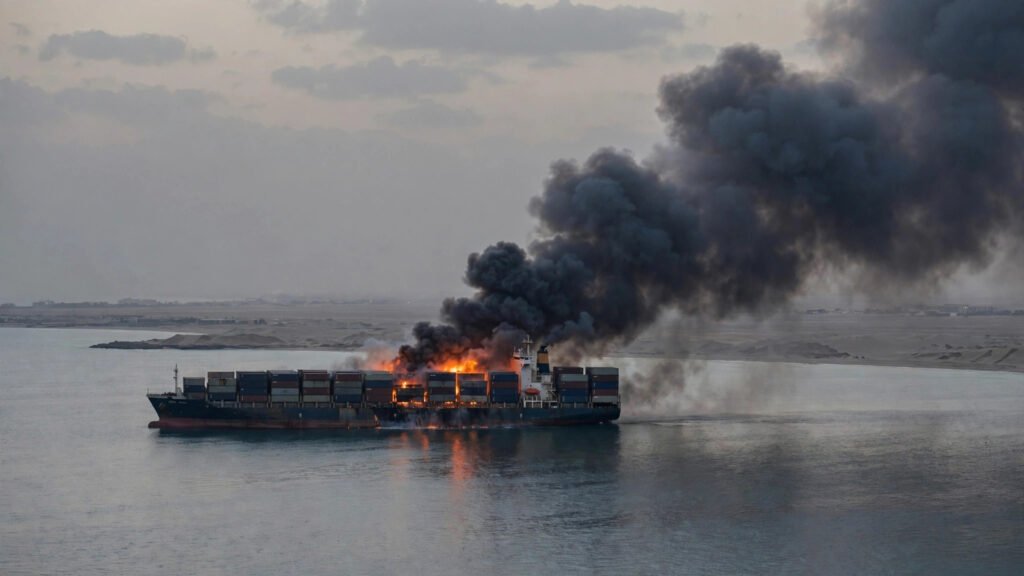
A vessel has been reported on fire in the northern Persian Gulf, 63 nautical miles southeast of Al-Faw, Iraq, according to the United Kingdom Maritime Trade Operations (UKMTO).
In a warning issued on October 26, UKMTO said it had received multiple third-party reports of the blaze. The agency did not identify the ship, confirm when the fire started, or say what caused it. The condition of the crew, the extent of any damage, and any environmental impact were all unknown at the time of the report.
UKMTO advised vessels operating in the area to transit with caution and to report any suspicious activity while authorities investigate. No authority has publicly identified the vessel, named a cause, or confirmed the condition of its crew.
Key Takeaways
- UKMTO received multiple third-party reports of a vessel on fire 63 nautical miles southeast of Al-Faw, Iraq.
- The crew’s condition, the damage, and any environmental impact remain unknown, and no cause has been confirmed.
- The incident sits near Iraq’s oil-export approaches, in a month already marked by a surge of attacks on Gulf shipping.
What UKMTO Reported
UKMTO’s warning, numbered 183-26, was based on third-party reports rather than a verified sighting by the agency itself. That distinction matters: the agency logged the incident as suspicious activity but did not establish whether the fire resulted from an external attack or another cause, such as an onboard accident.
The warning gave no name for the vessel, no cargo details, and no confirmed time for the incident. UKMTO said the information would be updated as authorities investigate, and it urged ships in the area to stay alert.
No authority has publicly identified the vessel, named a cause, or confirmed the condition of its crew.
A Second Incident in the Strait
The same day, UKMTO issued a separate, verified report about a tanker that was struck while transiting outbound through the Strait of Hormuz. According to that report, the tanker was hit by an unknown projectile at 8:39 a.m. UTC on October 23 and was disabled.
The tanker’s crew were reported safe, and no damage assessment or environmental impact report was available at the time. UKMTO again advised vessels to transit with caution and report suspicious activity.
Taken together, the two reports show risk appearing at both ends of the Gulf’s shipping map in the same 24-hour window: one incident inside the Strait itself, and one far to the north, near Iraq’s coast.
Why the Location Matters
Al-Faw sits at the head of the Persian Gulf, near the approaches to the Shatt al-Arab waterway and the offshore terminals that carry much of Iraq’s oil to world markets. Maritime monitors place the reported position inside Iraq’s exclusive economic zone, north of the Strait of Hormuz itself.
That geography is what makes this fire different from the incidents clustered around the Strait. For months, attention has focused on the narrow waterway between Iran and Oman. A burning vessel near Basra’s export approaches suggests the danger is migrating toward Iraq’s own shipping lanes, where a disruption would hit oil flows directly.
Any threat to those terminals carries wider consequences. Iraq is one of the world’s largest oil exporters, and its southern terminals handle the bulk of its crude shipments. Traders were already nervous: Houthi attacks and Saudi supply fears had pushed Brent crude to a six-month high in recent days.
A Wider Pattern of Risk
The Al-Faw fire did not happen in isolation. Reuters has reported that October has become the worst month for attacks around the Strait of Hormuz since tracking began in 2017, with 28 confirmed and reported incidents this month and 113 since the U.S.-Israeli war with Iran began on February 28. More than 30 very large crude carriers have been damaged during the conflict, including 11 in October, according to that reporting.
Iran, meanwhile, has been asserting its grip on the waterway. Its armed forces chief of staff, Major-General Ali Abdollahi, claimed during a visit to forces along the Iranian side that Tehran has full control of the Strait of Hormuz, dismissing statements by U.S. leaders as propaganda. According to the Tasnim news agency, he said the strategic waterway was completely closed to vessels that do not comply with Iranian regulations.
Tehran has also moved against individual shippers. Its Persian Gulf Strait Authority warned on October 27 that vessels belonging to South Korean shipping company Sinokor will face legal action from November 1 over alleged transit violations, and said measures had already been taken against at least seven Sinokor vessels.
The tensions extend beyond shipping. CNN has reported that U.S. forces in the Middle East are prepared to launch major operations against Iran within 96 hours of an order from President Donald Trump, while Saudi Arabia has been intercepting Houthi missiles and drones as talks continue. Riyadh has also reportedly offered the Houthis $1 billion for a ceasefire in an Iran-brokered deal.
- UKMTO Warning 183-26: vessel on fire 63 nautical miles southeast of Al-Faw, Iraq; crew status unknown.
- Separate verified report: tanker struck by unknown projectile in the Strait of Hormuz on October 23; crew safe.
- October is the worst month for Hormuz-area attacks since tracking began in 2017, according to Reuters reporting.
- Iran claims full control of the Strait and warns Sinokor vessels of legal action from November 1.
What to Watch Next
The next UKMTO update is the key thing to watch: it should clarify the crew’s condition, the damage, and whether the fire had an external cause. A second question is whether the October 23 Hormuz tanker strike is ever attributed to a specific actor, since UKMTO has so far described the projectile only as unknown. A third is whether Iran follows through on its November 1 warning against Sinokor vessels, and whether other shippers change their routes near Basra’s export approaches as a result.
Until those answers arrive, the only certainty is the warning itself: a vessel burned off Al-Faw, its crew’s fate is unknown, and Gulf shipping has one more reason to transit with caution.