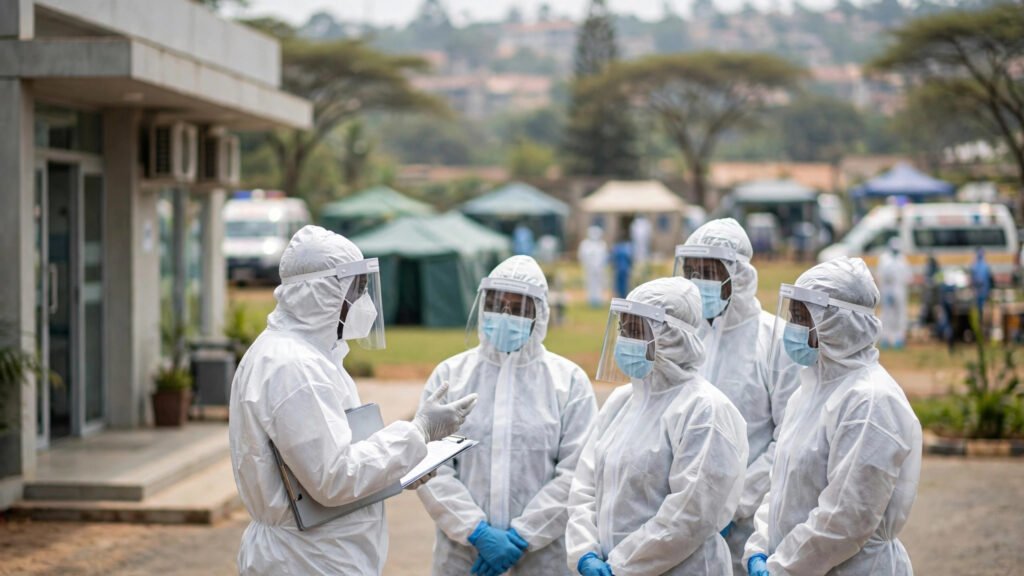
Kenya has released its first group of Ebola contacts from quarantine, marking a milestone in the country’s effort to contain its Ebola outbreak to a single infection cluster. The 20 people released on Monday completed 21 days of monitoring without developing any Ebola symptoms and are in good health, according to the director-general in Kenya’s health ministry, Patrick Amoth.
The release is the first sign that the monitoring system built around Kenya’s index patient is working as intended. Each person who came into contact with the index patient was placed under observation for the full 21-day monitoring period, the maximum incubation window health officials use for Ebola, and only cleared once that period passed without symptoms.
Key Takeaways
- Kenya has released its first 20 Ebola contacts from quarantine after 21 days without symptoms.
- Nine Ebola cases have been reported so far, with two deaths and seven patients stable and receiving treatment.
- Another 98 contacts remain in quarantine and are due to be released in four waves beginning on November 3.
A single cluster, carefully watched
Kenya has reported nine Ebola cases so far, two of whom have died. The remaining seven patients are stable and receiving treatment, Amoth said. The fact that the released contacts completed their monitoring without falling ill supports the health ministry’s assessment that transmission has so far been held to a single cluster rather than spreading more widely.
Kenya’s first case died in a hospital in Nairobi on October 5, after which eight others fell ill while in quarantine. The country announced on Friday that a second person had died. The sequence underlines why contact monitoring matters so much with Ebola: people who were exposed can fall ill days after the initial case, and catching those cases inside quarantine, rather than in the wider community, is what stops a cluster from becoming an outbreak.
We cannot afford to drop our vigilance.
Amoth said those leaving quarantine posed no risk to their families or communities, and urged Kenyans to welcome them home. He described the release as a milestone worth celebrating, while warning that the work is not yet done. That balance, between recognising progress and keeping precautions in place, is likely to define the next phase of the response.
How the outbreak reached Kenya
Ebola’s spread from Congo, where the outbreak was declared in mid-May, to Kenya has raised concerns about lapses in border screening. The virus does not respect borders, and the Kenya cases have become a case study in how quickly an infection can travel across a region when screening misses an exposed traveller.
Nigeria has said its first Ebola case in more than a decade, which it reported last week, appears to be closely related to Kenya’s index case, citing genomic analysis. The two cases both flew out of Uganda’s Entebbe airport on the same day in early October, according to Nigerian health officials. The link shows how a single travel route can connect cases in several countries, and why regional coordination matters as much as any one country’s response.
The episode is also a reminder of why governments are investing in biosecurity and faster outbreak detection, so that exposed travellers are identified before a virus can take hold in a new city.
- 20 contacts released after 21 symptom-free days in quarantine
- 9 cases reported in total, with 2 deaths and 7 patients stable in treatment
- 98 more contacts to be released in four waves from November 3
- Kenya’s first case died in Nairobi on October 5; eight others then fell ill in quarantine
- Nigeria’s first case in over a decade is genomically linked to Kenya’s index case
What happens to the 98 still in quarantine
The 98 people still in quarantine will be released in four waves beginning on November 3, provided they complete their monitoring without symptoms. The staggered release reflects the fact that contacts were exposed at different times, so their 21-day clocks end on different days.
For the released group, the return home is the end of three weeks of isolation and daily health checks. For the health ministry, it is a test of public trust: families and neighbours need to understand that a cleared contact is not a risk, or stigma could discourage future contacts from coming forward.
Kenya’s health system is operating against a difficult regional backdrop, with thousands of people recently fleeing fighting into northern Kenya. That pressure makes the discipline of the quarantine system, and the willingness of contacts to stay in it, all the more important.
What to Watch Next
The next marker comes on November 3, when the first of four waves of remaining contacts is due to be released. Health officials will also be watching the seven patients still in treatment, whose recovery would leave the outbreak with no active cases. And the regional picture will matter: if no new cases appear outside the known cluster, Kenya’s containment effort will have held. For now, the message from the health ministry is steady rather than celebratory: a milestone has been reached, vigilance must continue, and the work is not yet done.