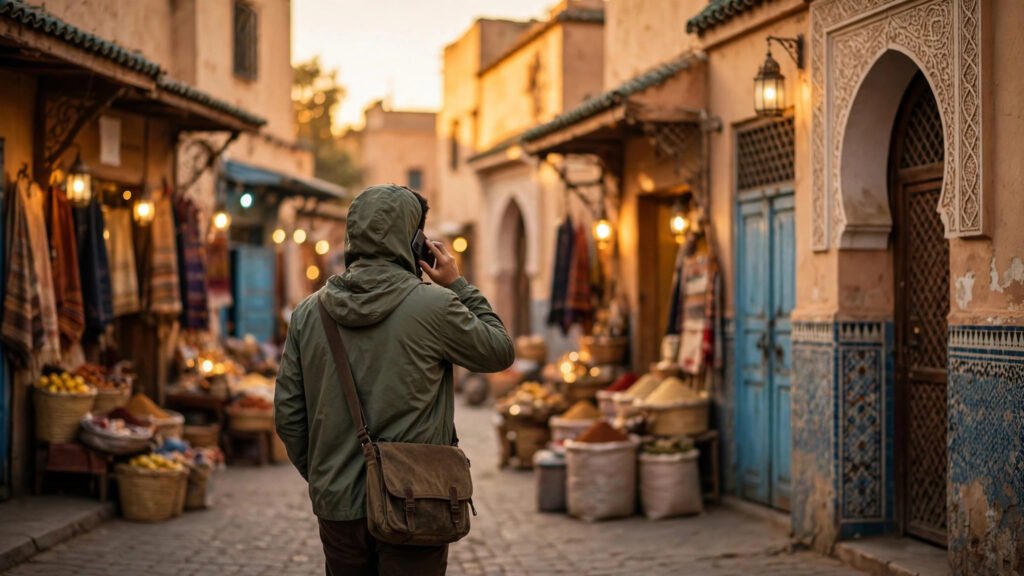
In Morocco, asking someone for their number often leads to the same next step: a WhatsApp message, and then a WhatsApp call. For millions of people, the green app is not just a messaging tool. It is the phone itself. Regular calls still exist, but they are no longer the default for everyday conversation, and the reasons go well beyond habit.
The shift did not happen overnight. It grew out of how Moroccans actually live, work and stay in touch: large families spread across cities and countries, small businesses run from a phone, and mobile data that makes an internet call feel cheaper and simpler than a traditional one. Put together, those forces made WhatsApp calls the natural first choice.
Key Takeaways
- WhatsApp calls ride on mobile data or Wi-Fi, so they often feel cheaper than traditional phone calls, especially for long conversations.
- Morocco’s large diaspora means many everyday calls cross borders, and internet calling removes the old worry about international rates.
- One app now covers chats, voice notes, groups and calls, so people rarely need to leave it to reach family, friends or customers.
The Cost Question Comes First
For most people, the first reason is the simplest: cost. A traditional phone call is charged by the minute, and the bill grows with every extra minute of conversation. A WhatsApp call, by contrast, uses a data connection. On Wi-Fi it costs nothing extra beyond the connection itself, and on mobile data it draws from a bundle many people already buy for browsing and social media.
That difference matters most for long calls. Family catch-ups, long chats with old friends and long business conversations are exactly the kinds of calls where per-minute charges add up. When the same conversation can happen over data, the choice feels obvious, and people rarely go back to paying by the minute once they are used to the alternative.
Cost also shapes how people use their phones day to day. Many Moroccans keep a close eye on mobile credit, topping up in small amounts and watching balances carefully. A call that eats credit quickly feels expensive in a very direct way. A call that uses data feels more predictable, because the data bundle is already part of the monthly routine.
One App for Family, Near and Far
The second reason is family. Morocco has a large diaspora, with Moroccans living across Europe and beyond, and staying in touch across borders used to be one of the most expensive things a family could do. International calling rates turned a simple catch-up into a luxury, and families planned calls carefully or kept them short.
Internet calling changed that calculation completely. A WhatsApp call to a relative in France, Spain, Belgium or the Netherlands costs the same in data terms as a call to someone in the next neighbourhood. Distance stops mattering. Grandparents can talk to grandchildren abroad regularly, siblings can join the same conversation from different countries, and family groups keep everyone in the same thread between calls.
That same logic applies inside Morocco too. Families are often spread between Casablanca, Rabat, Marrakech, Tangier and smaller towns, and students, workers and migrants move between cities for study and work. WhatsApp has become the everyday default in Spain as well, and the pattern is familiar: once everyone you know is already in the app, calling inside it is simply easier than dialling out.
Once everyone you know is already in the app, calling inside it is simply easier than dialling out.
Voice Notes, Groups and Everyday Business
WhatsApp calls do not exist in isolation. They sit inside an app people already open dozens of times a day for messages, photos and voice notes, and that closeness matters. A conversation can start as a text, switch to a voice note when typing is awkward, and become a call with one tap. There is no need to switch apps, look up a number or wonder whether the other person is reachable.
Groups extend the same convenience. Family groups, neighbourhood groups, school groups and work groups keep whole circles in one place, and group calls let several people talk at once without organising a conference call. For celebrations, condolences and everyday coordination, the group is often where news travels first.
Small businesses lean on the same habit. Shopkeepers, artisans, drivers and freelancers use WhatsApp to talk to customers, confirm orders and answer questions, because customers are already there. In Vietnam, a local app plays a similar role, showing how one dominant chat app can become the default channel for both personal and business life. In Morocco, that app is WhatsApp, and the call is just one feature of a much larger daily routine.
- WhatsApp calls use data or Wi-Fi instead of per-minute phone charges.
- International calls to the Moroccan diaspora cost no more in data terms than local ones.
- Chats, voice notes, groups and calls all live in one app people already open daily.
- Small businesses reach customers where they already are, without a separate phone system.
Where Regular Calls Still Win
None of this means regular calls have disappeared. They still have clear advantages. A traditional call works even when mobile data is weak, when the internet connection drops, or when the other person has no data left. It also works for reaching official numbers, businesses and services that are not on WhatsApp, and for anyone who simply prefers a normal phone number.
Call quality is another factor. On a strong Wi-Fi or 4G connection, a WhatsApp call can sound excellent. On a weak signal, it can stutter, delay or drop, and in those moments a regular call is often more stable. In Nigeria, many people juggle two SIM cards to manage coverage and cost, a reminder that across the region people adapt their phone habits to the networks around them rather than trusting one option completely.
Older Moroccans and people in areas with patchy internet also still rely on regular calls more often. For them, the traditional phone network is familiar and dependable, and there is no reason to change a system that already works. WhatsApp calling is dominant, but it is not universal, and the two systems live side by side.
What to Watch Next
The habit of calling through WhatsApp is unlikely to fade, because the forces behind it are still in place: data bundles keep getting more central to everyday phone use, families remain spread across borders, and the app keeps adding calling features that make group and video calls easier. At the same time, regular calls will keep their place for official contact, weak-signal moments and anyone outside the app.
What may change is how the two systems blend. As internet coverage improves and data becomes even more routine, the line between a phone call and an internet call will keep blurring for younger Moroccans in particular. For now, though, the pattern is clear: when Moroccans want to talk, they usually open WhatsApp first and dial second, if they dial at all.