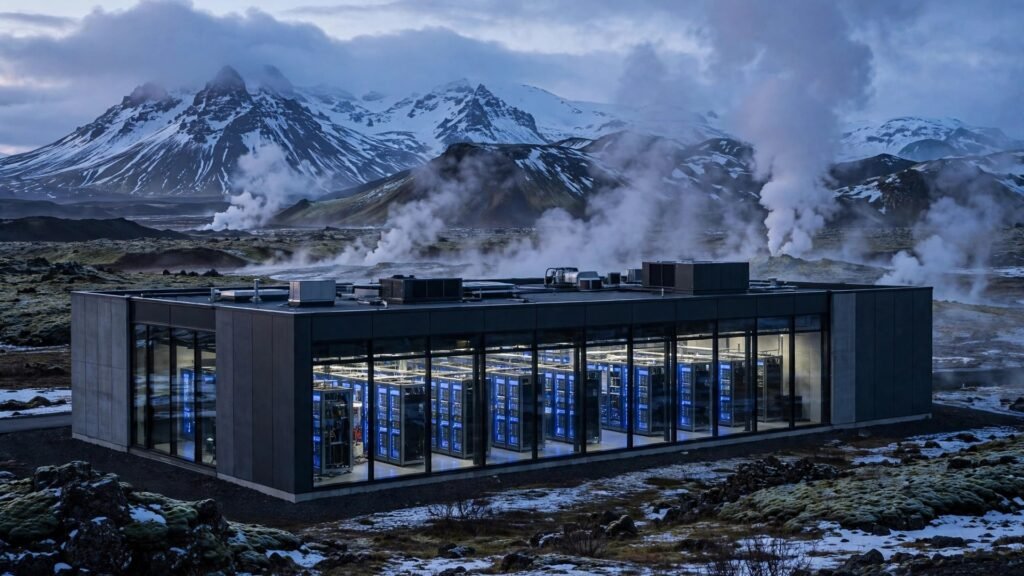
In a country of volcanoes, glaciers and long, cold winters, some of the world’s most power-hungry buildings are quietly humming away: data centres. Iceland, a North Atlantic island better known for waterfalls and hot springs, has become an unlikely home for the servers that store photos, stream video and train artificial intelligence models. So why build a data centre on a volcanic island in the middle of the ocean?
The short answer is energy — and cold air. Data centres need two things in huge amounts: electricity to run the servers, and cooling to stop them overheating. Iceland can offer both in ways that few other places can, and that combination has turned a remote island into a serious player in the global internet.
Key Takeaways
- Iceland’s electricity comes almost entirely from renewable sources, mainly geothermal heat and hydropower.
- The cold climate provides natural cooling for servers for much of the year, cutting energy use.
- Undersea cables connect Iceland to Europe and North America, so data can travel to and from the island quickly.
Power From Volcanoes and Rivers
Iceland sits on the Mid-Atlantic Ridge, where two tectonic plates are slowly pulling apart. That geology gives the country abundant geothermal energy: heat from beneath the earth that can be turned into electricity and used to warm homes and greenhouses. Rivers fed by glaciers and rainfall add hydropower, and together these two sources supply nearly all of the country’s electricity.
For a data centre operator, that matters for two reasons. First, the power supply is renewable, which helps companies meet climate goals and answer questions from customers about the carbon footprint of their services. Second, Iceland’s grid is not dependent on imported fossil fuels, which can make energy costs more stable over the long term than in places where prices swing with global oil and gas markets.
Free Cooling From the Cold Air
A server room generates an enormous amount of heat. In warm countries, keeping servers cool can use almost as much energy as running them in the first place, with air conditioning working around the clock. In Iceland, the average temperature stays low for most of the year, so operators can often cool their buildings with outside air instead — a method known as free cooling.
That simple fact changes the economics of a data centre. Less energy spent on cooling means lower running costs and a smaller environmental footprint. Some facilities also reuse the waste heat from their servers, for example to warm nearby buildings or greenhouses, turning a problem into a resource.
In Iceland, the average temperature stays low for most of the year, so operators can often cool their buildings with outside air instead.
Connected to the World by Cable
Being an island in the North Atlantic might sound like a disadvantage for the internet, but Iceland is connected to Europe and North America by undersea fibre-optic cables. Those cables carry data across the ocean at high speed, so a server in Iceland can serve users in London or New York with only a small delay.
That delay, known as latency, matters more for some services than others. Live video calls and fast-paced online games need the lowest possible latency, so they are usually served from data centres close to the user. But for storing backups, training AI models, rendering video and running many cloud services, a slightly longer journey across the ocean makes little difference — and the savings on power and cooling can more than make up for it.
The same logic explains why other cold, energy-rich places attract data centres too. Fast, affordable internet infrastructure in northern Europe, and the Nordic region’s push toward clean electricity — visible in Norway’s near-total shift to electric cars — show how the region has built its reputation on reliable, low-carbon technology.
Why AI Made Iceland Even More Attractive
The rise of artificial intelligence has made data centres bigger and hungrier than ever. Training a large AI model can require thousands of powerful chips running for weeks, and every one of them needs power and cooling. As demand for computing grows, operators are looking harder for places where clean power is available at scale — and Iceland’s renewable grid is a strong selling point, just as it is for the new power technology being built for AI data centres elsewhere.
There are limits, of course. Iceland is a small country, and its power grid and workforce are not infinite. New projects compete with homes, businesses and other industries for electricity, and local debates about how much of the country’s energy should go to data centres are part of the story. Iceland’s advantage is real, but it is not unlimited — and operators must make the case that their projects bring jobs and investment, not just power bills.
- Geothermal and hydropower give Iceland a nearly fully renewable electricity supply.
- Cold air cuts cooling costs, one of a data centre’s biggest expenses.
- Undersea cables link Iceland to Europe and North America for fast data transfer.
- AI growth is increasing demand for exactly the clean, steady power Iceland offers.
What to Watch Next
Iceland’s data centre story is, at heart, a story about matching a global need with a local advantage: cheap, clean power and free cooling on a cold volcanic island. As AI keeps growing and companies face more pressure to cut emissions, places that can offer renewable electricity will keep attracting attention. The question for Iceland is how to balance that opportunity with the needs of its own people — and whether its glaciers, volcanoes and cold air can keep powering the internet’s next chapter.