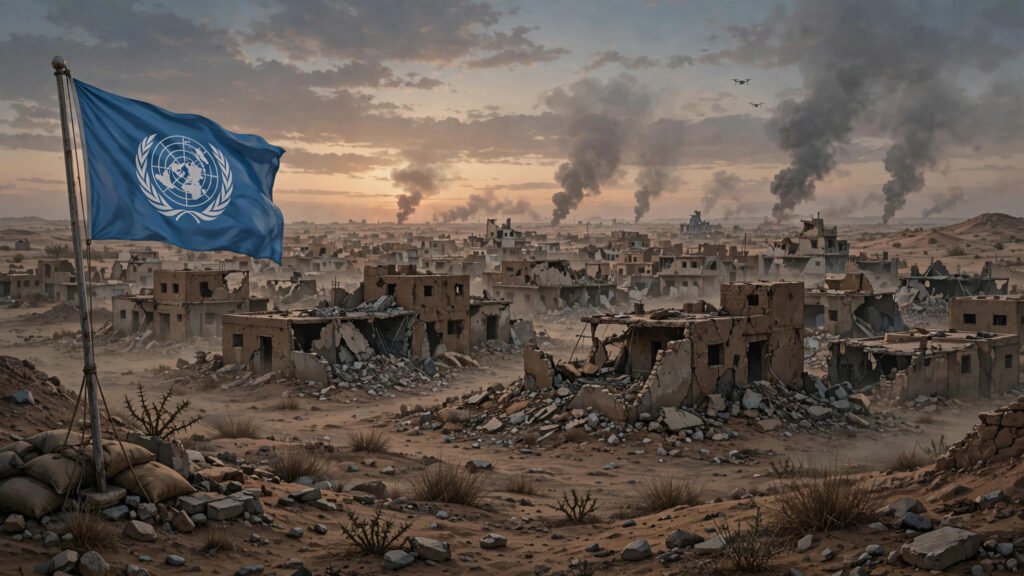
A United Nations fact-finding mission has warned that foreign weapons, foreign fighters and expanding drone warfare are making Sudan’s war more dangerous for civilians, and it has called for the arms embargo on Sudan to be extended to the whole country. The findings were presented to the United Nations General Assembly’s Third Committee in New York on October 28, 2026, in a working paper focused on the devastation facing civilians and worsening insecurity in El Obeid, the capital of North Kordofan State.
The mission, formally known as the Independent International Fact-Finding Mission for the Sudan, is mandated by the UN Human Rights Council. Its chair, Mohamed Chande Othman, told the committee that the conflict was becoming increasingly dangerous because of expanding drone warfare and external military assistance. Investigators said they had identified networks operating across several countries that allegedly facilitated weapons transfers, logistical support and foreign military participation.
Key Takeaways
- The UN mission says foreign arms networks and foreign fighters are fuelling Sudan’s war and increasing the danger to civilians.
- Investigators highlighted expanding drone warfare and attacks on infrastructure, with El Obeid singled out as a city at grave risk.
- The mission called for the arms embargo to cover all of Sudan, not only Darfur, and for stronger action against those financing or facilitating serious violations.
What the mission says it found
According to the mission, its investigation found reasonable grounds to believe that a transnational network operating across several countries supported military operations by the Rapid Support Forces, known as the RSF. The mission also documented the recruitment and deployment of former Colombian military personnel and other foreign fighters, alongside reports of weapons, military technology and logistical support reaching the conflict from outside Sudan.
The mission stressed that these are its own independent findings, and that its inquiries into foreign involvement are continuing. It said further findings could test whether states named in its reporting take steps to stop weapons and fighters from crossing their territory into Sudan. The mission also called for accountability across the whole chain of responsibility, including those who finance, supply, facilitate or otherwise enable serious violations.
Investigators said they had identified networks operating across several countries that allegedly facilitated weapons transfers, logistical support and foreign military participation.
The war in Sudan began in April 2023, when a dispute over plans to integrate the Sudanese Armed Forces and the RSF escalated into open conflict. Since then, tens of thousands of people have been killed and around 13 million people have been displaced, making it one of the world’s largest displacement crises. Aid agencies say famine conditions have spread in parts of the country and the humanitarian situation continues to deteriorate.
El Obeid at the centre of the warning
El Obeid, a strategic city that the mission says is partially surrounded by the RSF, features prominently in the new warning. Investigators documented repeated drone attacks attributed to the RSF in and around the city, alongside damage to schools and sites housing displaced people. They said those attacks, combined with pressure on medical care, electricity and water, have made access to basic services more difficult for residents.
At the same time, the mission reported a climate of fear and intimidation in areas under the control of security structures linked to the Sudanese Armed Forces and their allies, including allegations of surveillance, arbitrary detention, sexual violence against female detainees and deaths in custody. The mission said some of the conduct it documented could constitute serious violations of international humanitarian law, including war crimes, and it called for stronger measures against individuals and organisations contributing to such violations.
The pattern described in El Obeid is not isolated. Recent reporting from Sudan has described deadly strikes on crowded civilian areas, including market strikes in Nyala that reportedly killed more than 100 people and an earlier drone strike on a Nyala market. Those incidents, reported separately from the mission’s El Obeid paper, underline why investigators say civilians far from the front lines remain exposed.
- Drone warfare is expanding, with attacks reported on schools, displaced people’s sites and critical infrastructure.
- El Obeid’s residents face a double pressure: bombardment and insecurity, plus shrinking access to health care, power and water.
- The mission says October saw some of the deadliest individual attacks since the war began in April 2023.
- Investigators want the International Criminal Court’s mandate extended to cover all of Sudan, beyond its current Darfur-only referral.
October’s deadliest reported attacks
Othman told the committee that October had seen some of the deadliest individual attacks in Sudan since the war began. He cited a drone attack in Blue Nile State that reportedly killed at least 30 displaced people, including women and children, and injured others. He also referred to reports that at least 72 gold miners were killed in two airstrikes on a mining area near the Sudanese-Egyptian border on October 10.
In Abyei, a drone strike on October 19, attributed to the Sudanese Armed Forces, reportedly killed at least 80 people and injured others, according to the mission’s account. These figures are reports cited by the mission and by news outlets covering its presentation, and casualty numbers in Sudan are often difficult to verify independently because access for journalists and investigators is severely restricted.
The mission’s member Joy Ngozi Ezeilo supported expanding the embargo, as well as extending the mandate of the International Criminal Court to all of Sudan. The court’s jurisdiction currently stems from a 2005 Security Council referral limited to Darfur. Mission member Mona Rishmawi said both sides of the conflict and their allies were effectively destroying a country with a population of 56 million people.
Why the arms embargo matters now
At present, the UN arms embargo applies to Darfur, not to the whole of Sudan. The mission argues that this gap matters because weapons and support networks operate across borders and across regions, not only inside Darfur. Extending the embargo, in the mission’s view, would strengthen the legal basis for stopping transfers and for holding facilitators to account.
That proposal, however, faces a divided Security Council. The United States has urged the council to push for a humanitarian truce and to expand the arms embargo on Sudan, but China and Russia have opposed widening the embargo, according to recent reporting on council discussions. The mission’s findings add pressure on council members, but they do not by themselves change the embargo.
The humanitarian stakes behind that debate are stark. Across Sudan, 33.7 million people, including 17.3 million children, urgently need food support this year, according to UN figures cited in recent coverage, and an estimated 825,000 children face severe acute malnutrition. Earlier this week, the United States, the United Kingdom and 31 other countries warned about famine in Sudan, a warning that frames the mission’s call for civilian protection in urgent terms.
What to Watch Next
What happens next will depend on three things the mission itself highlighted: whether the Security Council moves on a wider arms embargo, whether states named in the mission’s reporting act to stop weapons and fighters crossing their territory, and whether investigators’ continuing inquiries produce further findings on foreign involvement. For civilians in El Obeid and other besieged areas, the immediate question is simpler and more urgent: whether drone attacks ease, whether access to medical care, electricity and water improves, and whether accountability follows for the violations the mission has documented.