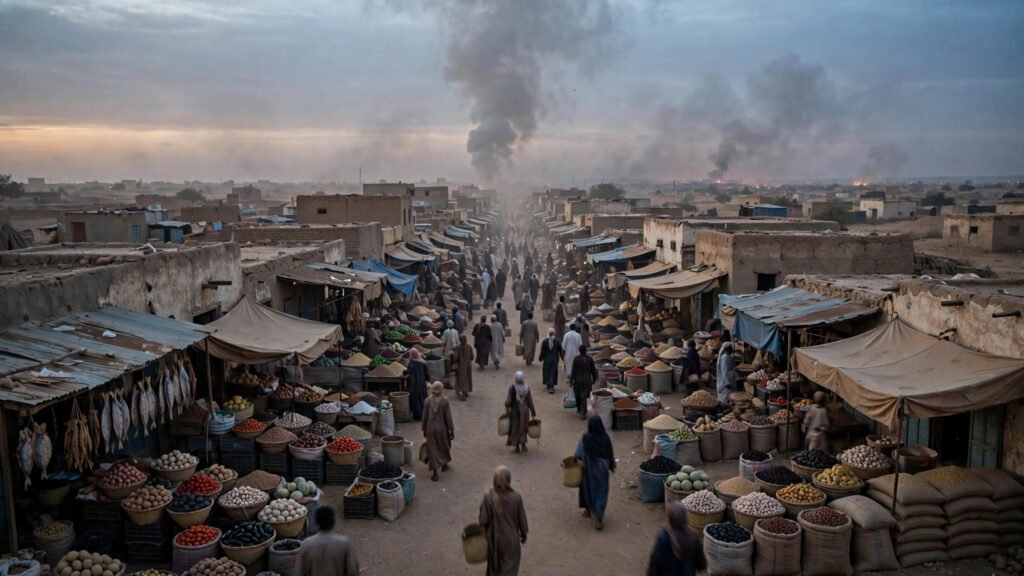
A drone strike on a market in Nyala, the de facto capital of Sudan’s paramilitary Rapid Support Forces (RSF) in Darfur, killed 21 people and wounded at least 40 others, medics and witnesses said on Tuesday, October 27, 2026. The strike, reported on Monday evening, hit a market in the north of the city that residents said was frequented by young men, particularly RSF fighters, and it came on a day when both sides of Sudan’s war traded drone attacks across the country.
One resident said the market in northern Nyala was struck on Monday at around 8:00 p.m. local time. A medic at Nyala Hospital put the toll at 21 killed and more than 40 injured, while saying he was unable to identify how many of the dead were RSF fighters. The reports cited did not confirm who launched the Nyala strike, and that gap matters: in a war fought increasingly by drones, the first reports of a strike often establish where it happened and how many people were hurt before responsibility is established.
Key Takeaways
- A drone strike on a market in northern Nyala killed 21 people and wounded at least 40 others, a medic at Nyala Hospital said.
- The strike hit on Monday evening, around 8:00 p.m. local time, in a market residents said was frequented by young men, particularly RSF fighters.
- Reports cited did not confirm who launched the Nyala strike, or how many of the dead were RSF fighters.
What Happened in Nyala
Nyala is the largest city in Darfur and the place where the RSF has declared an administration rivalling the army-backed, internationally recognised government in Khartoum. Sudan’s military, at war with the RSF since April 2023, regularly strikes Nyala, according to reporting on Tuesday. That history is part of why a market strike there carries a particular weight: the city is both a civilian centre and a military and administrative hub for one side of the war, so an attack on a busy public place raises immediate questions about who was targeted and who was caught in the blast.
The accounts from Nyala were consistent on the core facts. Witnesses described a drone hitting the northern market on Monday evening. The medic’s toll — 21 killed, more than 40 injured — was reported by news agencies citing medical and witness sources. What the reports did not settle was the breakdown of casualties between fighters and civilians, or the identity of the force behind the strike. Readers should treat both questions as unconfirmed until further reporting, rather than filling them in from the pattern of earlier strikes on the city.
Twenty-one people were killed in last night’s bombing, and more than 40 others injured.
A Day of Strikes on Both Sides
The Nyala strike did not happen in isolation. On the same day, a drone attack on the Al-Markhiyat transformer station in Omdurman cut electricity across large parts of Khartoum, as covered in our report on the drone attack on Khartoum’s power station. A source in the national electricity company told AFP that RSF drones carried out that strike, disrupting power across large parts of Khartoum and Al-Jazira states. That attribution came from the company source; Anadolu had earlier noted that no official statement on responsibility for the Khartoum-area strike had been issued as of early Tuesday.
The Khartoum strike followed a coordinated attack a day earlier on power stations in eastern Sudan. Sudan’s state electricity company accused the RSF of launching drone attacks on five substations, in Sennar, Gedaref, Al-Jazira and White Nile states, causing extensive damage and leaving millions without power. The pattern across Monday and Tuesday therefore runs in both directions: a deadly strike on a market in an RSF-held city, and strikes on power infrastructure in army-held territory. Together, they show how the war’s drone campaign now reaches markets, substations and neighbourhoods far from any single front line.
- 21 people killed and more than 40 injured in the Nyala market strike, according to a medic at Nyala Hospital.
- The strike hit a market in northern Nyala on Monday at around 8:00 p.m. local time.
- Nyala is the RSF’s de facto capital in Darfur, where it has declared a rival administration.
- Monday’s power-station attacks cut electricity across Sennar, Gedaref, White Nile and Al-Jazira states.
- Tuesday’s Al-Markhiyat strike cut power across large parts of Khartoum.
- Drone strikes in the first three weeks of October alone killed more than 300 people, according to a United Nations tally cited by AFP.
Why Drone Warfare Has Changed This War
Sudan’s war began in April 2023, after the army and the RSF fell out over how the paramilitary force would be integrated into the military. Since then it has killed tens of thousands of people and displaced nearly 13 million, according to United Nations and international estimates, and it has produced the world’s largest hunger and displacement crises. AFP reported that the conflict is now being fought primarily with drones, with both sides launching sophisticated attacks from across the country, and that drone strikes in the first three weeks of October alone killed more than 300 people and injured hundreds more, according to a United Nations tally.
That shift explains why civilian places keep appearing in strike reports. Drones can reach a market in Darfur, a substation in Omdurman and a power station in the east within the same cycle of retaliation, and each strike carries both a military purpose and a civilian cost. Power stations, airports and fuel facilities have all featured in recent reporting, and the United Nations has repeatedly warned that attacks on power infrastructure threaten health and other services for millions of people. The humanitarian stakes were underlined separately when the United States, the European Union and 31 countries warned of famine risk in Sudan, as covered in our report on warnings that Sudan faces famine.
The wider region is feeling the same pressures. Fighting on Ethiopia’s southern border has pushed tens of thousands of people into Kenya in recent days, as covered in our report on Ethiopians fleeing to Kenya. Sudan’s war is distinct — a civil war, not a border dispute — but the displacement, the strain on host communities and the difficulty of getting aid to people caught between armed groups are shared across the region.
What to Watch Next
What to watch next is only what this article has already set out: whether further reporting confirms who launched the Nyala market strike and how many of the dead were fighters or civilians, whether the casualty toll changes as hospitals update their figures, whether further drone strikes are reported in Darfur or on Sudan’s power grid in the coming days, and whether the RSF or the army responds to the accusations about this week’s attacks. Until those confirmations arrive, the verified picture remains the one in the reports cited: 21 people killed and more than 40 injured in a drone strike on a market in northern Nyala on Monday evening, a second day of strikes on Sudan’s electricity grid, and a war in which drones now carry much of the fighting — and much of its civilian cost.