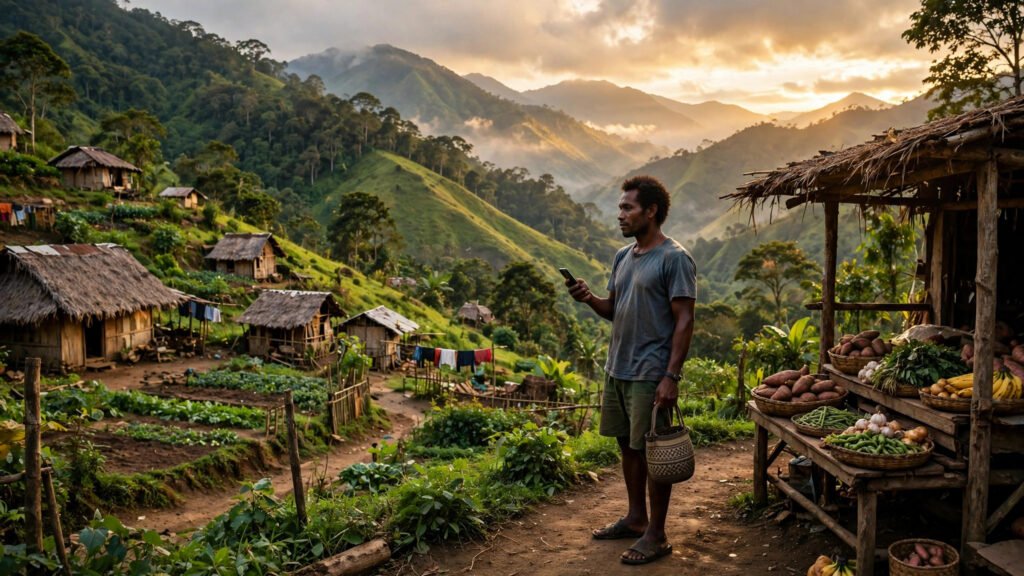
In Papua New Guinea, a bank branch is not always a short walk away. For many people, reaching one can mean a long journey over rugged country, across rivers and mountains, or along roads that are not always easy to travel. In that setting, the phone in a person’s pocket has quietly taken on a job that a building once did: checking a balance, sending money to family, paying for goods, and keeping savings within reach.
This is not about loving technology for its own sake. It is about distance, time, and everyday practicality. When the nearest branch is far away, a phone that can move money saves a whole day of travel. That simple advantage explains why mobile banking and mobile money have become part of daily life for so many Papua New Guineans, even in places where branches are few and far between.
Key Takeaways
- Distance is the main driver: long, difficult journeys to a branch make phone-based money far more practical.
- A phone can act as a branch for the basics: sending, receiving, and storing money without travelling to town.
- Cash, agents, and charging still matter, so the phone complements rather than fully replaces older ways of paying.
Why Distance Changes Banking
Papua New Guinea is a country of mountains, dense forest, islands, and scattered settlements. Towns with bank branches serve wide areas, and many villages sit a long way from them. A trip to town can cost time and transport money, and it may not even be possible on a given day if weather or transport gets in the way.
For a farmer selling produce, a teacher working far from home, or a parent supporting family in another province, that journey is a real burden. If money can be sent or received by phone instead, the trip is no longer needed for every transaction. The phone does not remove the distance, but it stops the distance from deciding whether money can move at all.
The same logic appears in other Pacific countries, where phones have become everyday money tools. In Samoa, for example, many people are receiving money on a phone instead of at a bank, and in Fiji people are paying with a phone instead of cash. The details differ from place to place, but the underlying reason is familiar: the phone is already in hand, while the branch may be hours away.
What a Phone Does Instead of a Branch
At its simplest, phone banking in Papua New Guinea covers the transactions people need most often. Money can be sent to a relative, received from family working elsewhere, and kept in an account that can be checked without visiting a counter. Small traders can accept payment by phone at a market stall, and buyers can pay without carrying large amounts of cash.
That matters for safety as well as convenience. Carrying cash on a long journey brings its own risks, and keeping money at home is not always secure either. A phone account offers a middle path: money held in a system that can be accessed again, rather than in a pocket or a drawer.
For people who earn irregularly, such as market sellers and seasonal workers, the phone also fits how money actually arrives. Income does not always come in a neat monthly pay packet, so being able to receive and use small amounts as they come in is more useful than waiting for a trip to town. A similar pattern shows up far away too, where people are topping up their phones in small amounts instead of monthly plans to match the way they earn and spend.
The phone does not remove the distance, but it stops the distance from deciding whether money can move at all.
Agents, Markets, and Everyday Trust
Phones do not work alone. In many areas, local agents play a central role, helping people put cash into a phone account or take cash out of it. A small shop, a market trader, or a community agent can become the human face of a system that otherwise lives inside a handset.
That human link matters, because trust is built person by person. Someone trying phone banking for the first time is more likely to trust it if a familiar face can explain it, help with a first transaction, and answer questions in person. Over time, that trust spreads by word of mouth, just as news of a reliable market or a good transport route spreads.
Markets are a natural place for this to grow. A seller who can accept a phone payment does not have to wait for a buyer to have exact change, and a buyer who has just been paid by phone can spend it at the next stall. The phone becomes part of the market itself, not a separate banking chore.
- Distance to branches makes phone money a practical necessity, not just a convenience.
- Agents and market traders give phone banking a trusted, human face in local communities.
- Small, frequent transactions fit irregular incomes better than rare trips to town.
- Cash still matters for many daily purchases, so phones and cash work side by side.
The Limits Are Real Too
None of this means the phone solves everything. Mobile coverage is not the same everywhere, and signal can be weak or absent in remote valleys and on outer islands. A phone also needs charging, and power is not always reliable or easy to reach. When the battery dies or the signal drops, the branch in the pocket stops working.
Cost is another barrier. Handsets, credit, and data all cost money, and for a household on a tight budget those costs have to be weighed against food, school, and transport. Digital skills matter as well: a system only helps if people can use it confidently, understand what a message means, and spot a scam.
Cash, too, remains essential. Many small purchases, transport fares, and market trades still happen in cash, and not every seller accepts phone payments. The honest picture is therefore a mix: phones handling more and more of the money that used to require a branch visit, while cash continues to cover the everyday exchanges where it is simplest.
What to Watch Next
The question for Papua New Guinea is not whether phones will replace branches outright, because for many people they already cover the most frequent banking tasks. The more useful question is how far coverage, charging, and trusted local agents can extend, and whether phone services keep fitting the way people actually earn, send, and spend.
If those pieces keep improving, the phone will keep acting as the nearest branch for more communities. If they stall, distance will keep deciding who can bank easily and who cannot. Either way, the reason phones took on this role is unlikely to change: when the branch is far away, the branch that fits in a pocket wins.