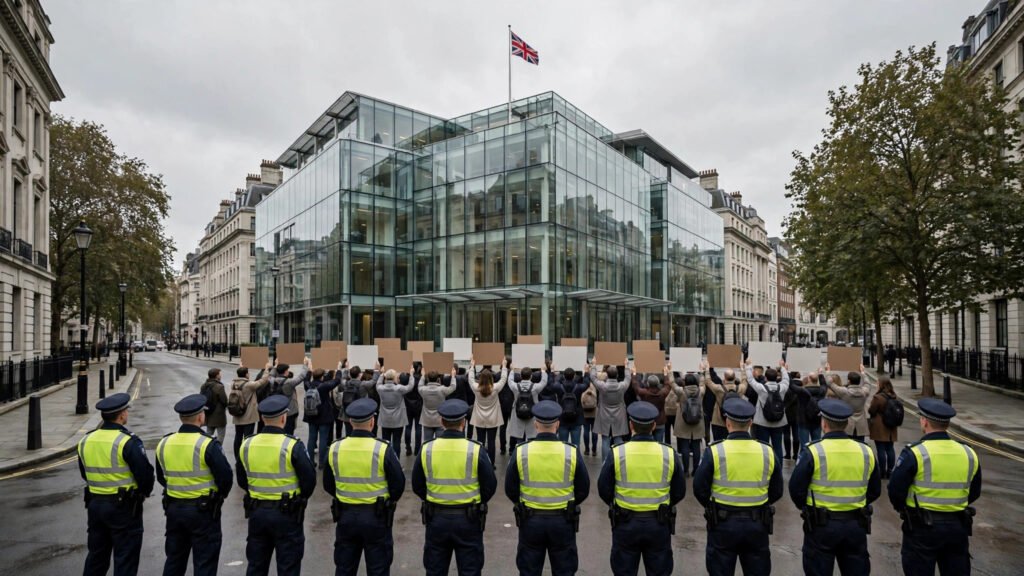
London police arrested 139 people on Saturday during a protest outside the United States Embassy in London, after demonstrators expressed support for Palestine Action, a group banned in the United Kingdom under anti-terrorism laws. The Metropolitan Police said most of those detained were arrested for expressing support for a proscribed organisation, and officers remained at the scene with further arrests expected.
The demonstration, described by organisers as a lunchtime mass action, took place in Nine Elms in south-west London. Officers began making arrests shortly after the protest started, and by the evening the police total had reached 139. Many of those taking part were older demonstrators, and several held placards reading, in the words reported from the scene, “I oppose genocide, I support Palestine Action.”
Key Takeaways
- London police arrested 139 people outside the US Embassy on Saturday, mostly for expressing support for a proscribed organisation.
- Organisers say more than 4,000 people have now been arrested since the Palestine Action ban took effect in July 2025.
- The protest came days before a UK Supreme Court hearing on November 4 that will test the ban itself.
What Happened Outside the US Embassy
Police said the arrests began after hundreds of people gathered outside the embassy. A dispersal order covering parts of the area, including the embassy grounds, was in place during the day. The Metropolitan Police said in an evening update that officers were continuing to make arrests, so the final total could rise beyond the 139 already confirmed.
The protest was organised by Defend Our Juries, a campaign group opposed to the ban on Palestine Action. The group said the demonstration was deliberately timed ahead of the Supreme Court hearing, and it put the wider arrest total since July 2025 at more than 4,000. That figure, cited by campaigners, covers people detained for defying the ban at a series of protests across the country.
A parallel demonstration was also reported outside the US consulate in Edinburgh. Reports from that gathering said no arrests were made there, in contrast to the large police operation in London.
The arrests came days before a Supreme Court hearing that will test whether the ban itself should stand.
Why Palestine Action Is Banned
The UK government proscribed Palestine Action in July 2025, making membership of the group, or certain forms of support for it, a criminal offence. Under the ban, the maximum sentence is up to 14 years in prison. The government placed the group on the same proscribed list as other banned organisations, a step that has remained highly contested in public debate and in the courts.
Palestine Action is a direct-action protest group that has campaigned against UK military support for Israel. Its members have previously targeted defence facilities, including sites linked to Israeli defence company Elbit Systems, and the government cited those actions when it moved to ban the group. Supporters of the group argue that opposing the ban, and expressing support for its aims, should not be treated as terrorism.
The legal challenge to the ban has already travelled through the courts. The Court of Appeal ruled in June that the proscription was justified and proportionate, after an earlier court stage went the other way. The Supreme Court is now due to hear an appeal against the ban, with a two-day hearing scheduled to begin on November 4. That hearing is the reason campaigners chose this weekend for a fresh round of protests.
A Wider Pattern of Arrests
Saturday’s arrests in London fit a pattern seen at earlier protests against the ban, where police have detained large numbers of people for holding placards or otherwise expressing support for Palestine Action. Campaigners say the repeated arrests show that the law is being used against peaceful protest, while police say they are enforcing a proscription that Parliament has approved.
The London protest also took place during a weekend of youth-led and cost-of-living demonstrations across Europe. In France, hundreds of thousands of people marched in a third weekend of protests, as reported in France’s third weekend of youth protests, while in Germany demonstrations turned violent in Frankfurt, as covered in Germany’s Gen Z protests. Police also cleared a housing protest camp in Lisbon, as reported in the Lisbon housing protest camp clearance. The London arrests were distinct from those protests, because they turned on the specific legal question of support for a banned organisation.
- 139 people arrested outside the US Embassy in London on Saturday, October 31.
- Most arrests were for expressing support for a proscribed organisation, police said.
- Defend Our Juries says more than 4,000 people have been arrested since July 2025.
- The UK ban carries a maximum sentence of up to 14 years in prison.
- The US government also imposed sanctions on Palestine Action in August.
What to Watch Next
The arrests came days before a Supreme Court hearing that will test whether the ban itself should stand. The hearing, scheduled to begin on November 4, will hear the appeal against Palestine Action’s designation as a terrorist organisation, and its outcome will shape whether future protests of this kind lead to further arrests.
Police have also said further arrests remained possible after Saturday’s operation, and campaigners have signalled further protests around the hearing. For now, the confirmed facts are the 139 arrests in London, the continued police presence at the embassy, and the court date that both sides are now waiting for.