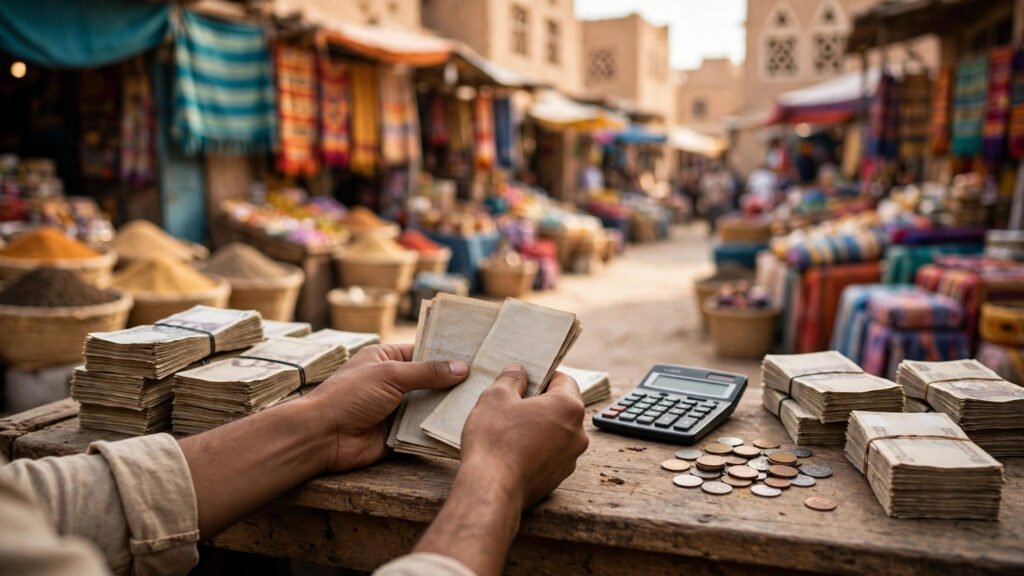
In Yemen, everyday money still changes hands in cash. A shopper pays with notes at the market, a family collects money sent from abroad at an exchange shop, and a trader settles a deal in person rather than by card. Visitors used to tapping a card for everything often ask the same question: why do Yemenis still rely on cash and money exchangers instead of bank cards?
The short answer is that cash and exchangers work where the card system often does not. Years of conflict have disrupted banks, branches, and payment networks, while cash can be handed over anywhere, without a terminal, a signal, or a working account. For many Yemenis, cash is not a preference for the old ways — it is the payment method that is actually available.
Key Takeaways
- Cash works everywhere in Yemen — in markets, villages, and small shops — without a card terminal or a reliable connection.
- Money exchangers fill the gap left by a disrupted banking system, handling transfers, currency exchange, and payments for families.
- Bank cards exist, but limited acceptance, patchy infrastructure, and low trust keep them from becoming the everyday default.
Why Cash Still Rules Daily Life
Cash has one great advantage in Yemen: it needs nothing else to work. A payment in cash does not depend on electricity, mobile signal, a card machine, or a bank’s systems being online. In a country where power cuts and network outages are a part of daily life in many areas, that reliability matters more than convenience.
Most everyday trade in Yemen also happens in cash-friendly places. Open markets, street stalls, small grocery shops, and rural traders deal in notes and coins. A card reader is of little use at a stall that has no terminal, and for a small trader the cost and hassle of card equipment can outweigh any benefit. Cash keeps the transaction simple: the buyer hands over the money, the seller hands over the goods, and the deal is done.
For many Yemenis, cash is not a preference for the old ways — it is the payment method that is actually available.
What Money Exchangers Actually Do
Money exchangers, known locally as sarrafs, are a familiar sight in Yemeni towns and cities. They do far more than swap one currency for another. For many families, the exchange shop is the closest thing to a bank branch: it is where money sent from relatives abroad is collected, where savings in one currency are converted into another, and where larger payments are arranged.
That role grew because the formal banking system has been badly disrupted. Branches have closed or reduced their services in many areas, and moving money between different parts of the country through banks can be slow or uncertain. Exchange networks, by contrast, are widespread and personal. A customer often knows the exchanger, the transaction is completed face to face, and the money is in hand the same day.
Remittances are a big part of this story. Many Yemeni families depend on money sent home by relatives working abroad, and exchangers are a common way for that money to arrive. The family member abroad sends the money through an exchange network, and the family at home collects it in cash from a local shop. For households that have no bank account at all, this may be the only practical way to receive it.
Why Bank Cards Have Not Taken Over
Bank cards are not unknown in Yemen, but several barriers keep them from becoming the default. The first is acceptance. Card terminals are mainly found in larger shops, hotels, and businesses in major cities, while the small shops and markets where most daily spending happens rarely take cards. A card that cannot be used for the weekly shop is not much use as an everyday tool.
The second barrier is access to banking itself. Opening and keeping a bank account is harder when branches are scarce, identification and paperwork are difficult, and people have learned not to rely on a system that may be interrupted. Many Yemenis, especially outside the main cities, have simply never had a reason to open an account when cash and exchangers already meet their needs.
Trust is the third barrier, and it may be the most important. When banks have been disrupted and cash withdrawals have at times been restricted, people understandably prefer money they can hold. Cash in hand feels safer than a balance that depends on a distant system working. That caution is not unique to Yemen — in Ethiopia, many people similarly turned to telebirr instead of cash and cards because the phone-based option fitted local realities better than the card system.
Where Phones Fit In
Phones are changing the picture, but slowly and in their own way. Mobile wallets and phone-based transfers are growing in Yemen, and for some users they offer a middle path: money can be sent by phone and collected in cash from an agent or shop. That suits a cash economy, because the last step is still a familiar cash handover.
Even so, phone payments face the same obstacles as cards. They need a charged phone, a signal, and enough trust in the service to leave money in a digital wallet. In areas where electricity and connectivity are unreliable, a wallet balance can feel less dependable than notes in a pocket. The result is a mixed system: phones help move money over distance, but cash still settles most face-to-face trade.
- Markets and small shops: cash needs no terminal, signal, or electricity.
- Exchange shops: collect remittances, swap currencies, and arrange payments face to face.
- Bank cards: useful in larger city businesses, but rarely accepted where daily spending happens.
- Mobile wallets: growing as a way to send money, with cash still collected at the other end.
How Yemen Compares With Its Neighbours
Yemen’s cash habit stands out even in a region where payment habits vary widely. Across the Red Sea, Saudi shoppers increasingly tap cards and phones, with many paying through mada and Apple Pay instead of cash, because terminals are everywhere and banks are stable. Yemen’s story is the reverse: where the infrastructure for cards is thin, people built their everyday economy around what works — cash and trusted exchangers.
The comparison with other African countries is instructive too. In Mozambique, for example, many people pay with mobile money instead of bank cards, because phones reached further than branches. Yemen has some of the same ingredients — patchy branches and widespread phones — but conflict and unreliable power have slowed the same shift, leaving cash and exchangers in the central role for longer.
What Would Have to Change
For cards or phone payments to replace cash in Yemen, the basics would have to improve first: more reliable electricity and mobile networks, wider acceptance in small shops and markets, and a banking system people can count on day after day. None of that happens quickly, and none of it is only about technology. People will switch when the new method is as dependable as cash — available everywhere, working in a power cut, and accepted by the shopkeeper they already know.
Until then, the exchanger’s counter and the market stall remain the heart of Yemen’s payment system. They are not a failure of modernisation so much as an adaptation to difficult conditions: a system built by ordinary people around the tools that actually work.
What to Watch Next
Yemen’s reliance on cash and money exchangers comes down to reliability: cash works without power, signal, or a terminal, exchangers reach families that banks do not, and cards are accepted in too few everyday places to replace either. Phones are slowly adding a new layer, letting money travel further before it is collected as cash. What to watch next is whether steadier power, better connectivity, and wider acceptance in small shops gradually turn that phone layer into a real alternative — or whether cash and the exchanger’s counter remain, for a long time yet, the way Yemen pays.