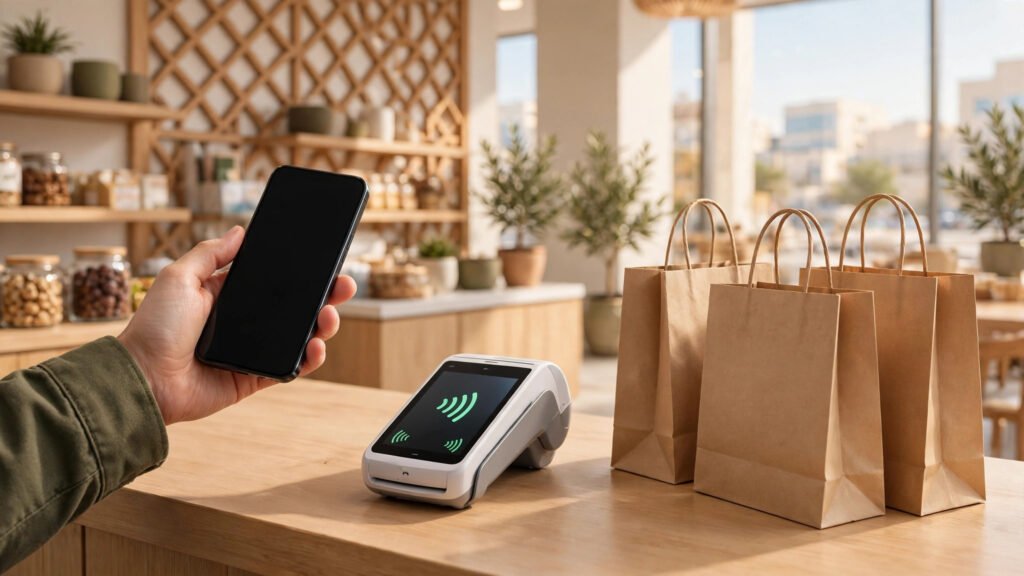
Walk into a supermarket in Riyadh, a coffee shop in Jeddah, or a small bookstore in Dammam, and you will notice something quickly: many customers do not reach for their wallets at all. They hold their phone near the card machine, wait for a beep, and walk away. Cash is still accepted in most places, but for a growing number of Saudis, the phone has simply become the easier way to pay.
This shift did not happen by accident. It grew out of a national payment system, phones that most people already carry everywhere, and shops that upgraded their card machines to accept contactless payments. Together, those three pieces made tapping a phone feel normal, fast, and ordinary.
Key Takeaways
- mada is Saudi Arabia’s national payment scheme, and most bank cards in the Kingdom carry it.
- mada Pay and Apple Pay let shoppers pay by holding a phone near a contactless terminal instead of handling cash or a physical card.
- The habit stuck because the same tap works in supermarkets, cafes, petrol stations, and many small shops, and the phone is already in the shopper’s hand.
What Is mada, and Why Does It Matter?
mada is Saudi Arabia’s national payment scheme. In simple terms, it is the homegrown card network that Saudi banks use, alongside international networks. Most debit cards issued by Saudi banks carry the mada logo, which means they work at card machines across the country without needing a separate international card.
That matters because it gives almost every bank customer a card that works everywhere locally. When a payment system is built into the cards people already receive from their banks, shoppers do not have to sign up for something new or pay for a special product. The card is already in their pocket, and the phone version of it is only one setup step away.
How Does Paying With a Phone Actually Work?
Paying with a phone uses the same contactless technology as tapping a bank card. The shopper adds their bank card to a wallet app on their phone, such as mada Pay or Apple Pay, and confirms it with their bank. At the till, they hold the phone near the card machine, confirm with a fingerprint, face scan, or passcode, and the payment goes through the same card account.
Nothing about the money itself changes. The purchase is still charged to the shopper’s bank card, and the shop still receives the payment through its card machine. The only thing that changes is the object used to trigger the payment: a phone instead of a plastic card, and no cash changing hands at all.
The phone has simply become the easier way to pay, because it is already in the shopper’s hand when they reach the till.
Why Did Shops Across Saudi Arabia Accept It So Quickly?
A payment method only becomes a habit when shoppers can use it almost everywhere, and that is what happened in Saudi Arabia. Supermarkets, pharmacies, restaurants, coffee shops, petrol stations, and delivery couriers widely accept card and contactless payments, so a shopper who leaves cash at home rarely gets caught out.
For shop owners, card machines also remove small daily frictions. There is no change to count, no cash drawer to balance at the end of the day, and no trip to deposit takings. For customers, there is no need to visit an ATM before shopping or to worry about carrying notes for a large grocery bill. When both sides of the till prefer the same method, the habit reinforces itself.
Why Do People Prefer the Phone Over Cash?
Convenience is the biggest reason. Most people already carry their phone everywhere, check it constantly, and use it for messages, maps, and banking. Adding payments to the same device means one less thing to remember. There is no wallet to open, no card to find, and no notes to fold back into a pocket.
There is also a record-keeping benefit. Every phone payment appears in the bank app, so shoppers can check what they spent, where they spent it, and when. With cash, that trail disappears the moment the notes leave the hand. For people who budget carefully or share household expenses, that automatic record is genuinely useful.
- One device for messages, maps, banking, and payments
- No ATM visit needed before shopping
- Every payment shows up automatically in the bank app
- Works at supermarkets, cafes, petrol stations, and many small shops
How Does Saudi Arabia Compare With Other Countries?
Every country has found its own route to paying without cash. In India, shoppers widely use UPI apps that move money straight between bank accounts. In Brazil, the instant payment system Pix lets people pay with a phone in seconds. In Argentina, many shoppers scan QR codes at the till instead of carrying cash.
Saudi Arabia’s version is different in one important way: it is built on the cards people already have. Rather than replacing cards with a new system, mada Pay and Apple Pay put those same cards inside the phone. That is why the change felt gradual rather than disruptive. Shoppers did not have to learn a new way to pay; they just stopped taking the card out of their wallet.
Where Does Cash Still Have a Place?
Cash has not disappeared, and it still has a role. Small tips, some market stalls, and older shoppers who are simply more comfortable with notes all keep cash alive. Visitors who arrive without a Saudi bank card may also find cash simpler for small purchases, and some people keep a small amount of cash as a backup in case their phone battery dies.
That backup habit is worth keeping. A phone payment depends on a charged phone, a working card machine, and a mobile signal or stored card on the device. Cash needs none of those things. The realistic picture is not a country without cash, but a country where cash is now the exception rather than the default for everyday shopping.
What Should New Users Check Before They Start?
Anyone setting up phone payments for the first time should start with the basics. Make sure the phone has a screen lock, because the lock is what protects the wallet app. Add only cards from the shopper’s own bank account, and confirm the setup through the bank’s own app or verification step rather than through a link in a message.
It is also worth checking the first few payments in the bank app, just to confirm they appear as expected. If a card ever needs to be removed, it can be removed from the wallet app, and the physical card keeps working as normal. The phone is a convenient copy of the card, not a replacement for the bank account behind it.
What to Watch Next
The direction of travel is clear: the phone is becoming the default way many Saudis pay for everyday shopping, built on the mada cards they already carry. Cash still has a place as a backup and for small, informal payments, but it is no longer the first thing shoppers reach for. As more shops, services, and government counters accept contactless payments, the tap of a phone at the till is likely to become even more ordinary, and the wallet, for many people, will keep getting lighter.