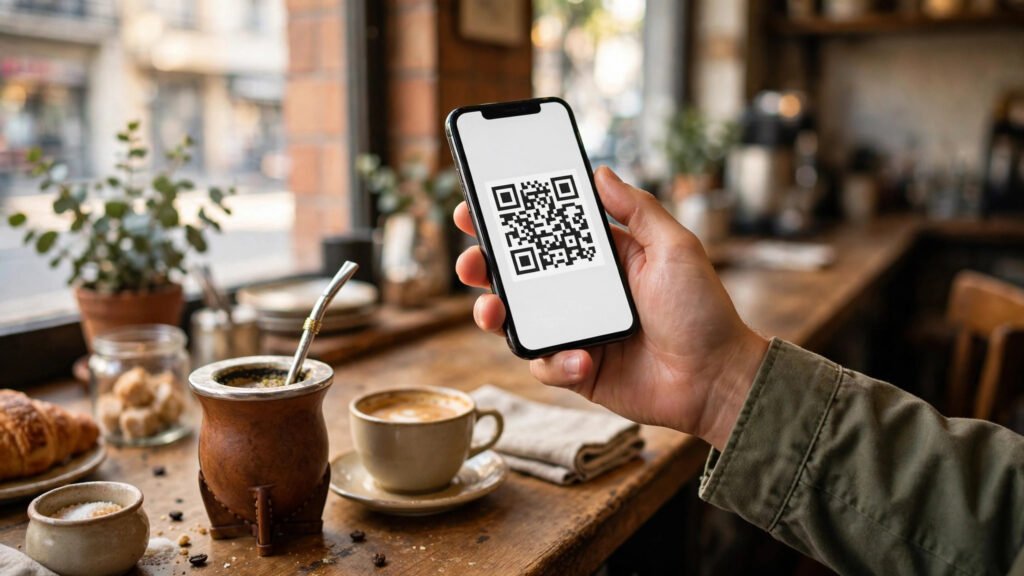
Walk into a café in Buenos Aires, order a coffee and a medialuna, and when the bill arrives, you may notice something: instead of reaching for banknotes, many Argentinians simply point their phone at a small printed square on the counter. A quick scan, a confirmation beep, and the payment is done. QR code payments have become an everyday sight across Argentina — from street kiosks to supermarkets. But why did this particular way of paying take off so strongly here, when in other countries cards still rule? The answer lies in a mix of Argentina’s banking history, its smartphone habits, and a system designed to work for everyone.
Key Takeaways
- QR code payments in Argentina work across competing wallets and banks, so one printed code can accept many different apps.
- They let small sellers accept digital payments without buying card machines, which helped the habit spread far beyond big stores.
- For many Argentinians, paying by phone became a practical daily habit shaped by local banking and cash realities, not just a tech trend.
One Code, Many Wallets
The most important feature of Argentina’s QR payment system is that it is interoperable. In plain terms, that means the QR code printed at a shop’s counter is not locked to a single company. A customer using one wallet app can scan the same code as a customer using a different bank’s app, and the payment still goes through. That single detail removed a lot of friction. Shop owners did not need to display five different codes for five different apps, and customers did not need to worry whether their app would work at a particular counter.
This interoperability grew out of rules for instant transfers between accounts in Argentina. Once money could move between accounts quickly and cheaply, the QR code became a simple front door to that system: scan, confirm, done. It also meant that a seller did not need expensive card-terminal hardware. A printed code, sometimes just taped to a counter, was enough to start accepting digital payments.
Why Small Sellers Embraced It First
For a small business — a kiosk, a bakery, a market stall — traditional card machines come with costs, contracts and paperwork. A QR code asks for almost none of that. That low barrier mattered enormously in a country where small and informal businesses are a huge part of daily commerce. When the corner shop can accept a phone payment as easily as a big supermarket, the whole neighbourhood starts scanning.
Customers, in turn, found the system convenient. There is no need to carry exact change, no need to hand over a card, and the payment record sits right inside the app. For people who already used a wallet app to send money to friends or family, paying a shop with the same app was a small step, not a leap. Similar patterns have appeared elsewhere in the region — for example, why Brazilians pay with Pix instead of cards and why Chileans pay with their phones instead of cash — but Argentina’s version grew around its own wallets and transfer system.
A printed code, sometimes just taped to a counter, was enough to start accepting digital payments.
Cash, Phones and Daily Reality
Argentina’s relationship with cash has long been complicated. Cash machines can run dry, large notes are bulky, and carrying large amounts of cash feels risky. In that setting, a phone payment that leaves a clear record has obvious appeal. At the same time, smartphones are widespread, and mobile data is part of daily life for most city dwellers. The pieces were already in place; the QR code simply connected them.
There is also a habit factor. Once a person pays with a QR code at the bakery, the pharmacy and the bus stop, the behaviour becomes automatic. Friends show friends how it works, shopkeepers remind customers to scan, and soon nobody thinks of it as new technology at all — it is just how you pay. Younger Argentinians, who grew up with phones in hand, adopted it fastest, but the simplicity of scanning a code meant older customers could join in too, without learning a complicated app.
What QR Codes Still Cannot Do
QR payments are not a complete replacement for everything. Cash still matters in Argentina, especially in rural areas, at informal markets, and wherever mobile signal is weak or a phone battery has died. Some people still prefer cash for small purchases or for privacy, and not every seller has made the switch. A phone payment also depends on connectivity: no signal, no scan.
That is why the realistic picture is a mix, not a takeover. QR codes sit alongside cash and cards, each used where it fits best. The same mixed reality shapes phone habits in other countries too, such as why Mexicans top up their phones at corner shops, where old and new payment habits live side by side.
- Interoperability is the key: one shop code works with many different wallet and bank apps.
- Low cost for sellers helped QR payments reach kiosks, bakeries and market stalls, not just big chains.
- Cash remains important in rural areas and wherever connectivity is weak.
- The habit spread socially — friends, family and shopkeepers taught each other to scan.
What to Watch Next
QR code payments in Argentina are now part of everyday life rather than a novelty, and their story shows how a simple, shared standard can change how a whole country pays. What to watch next is whether that same simplicity keeps spreading — to more rural areas as connectivity improves, to new kinds of purchases, and to new features inside the wallet apps people already use. Cash is unlikely to disappear, but the little printed square on the counter is not going away either. For Argentinians, scanning to pay has become, quite simply, the normal thing to do.