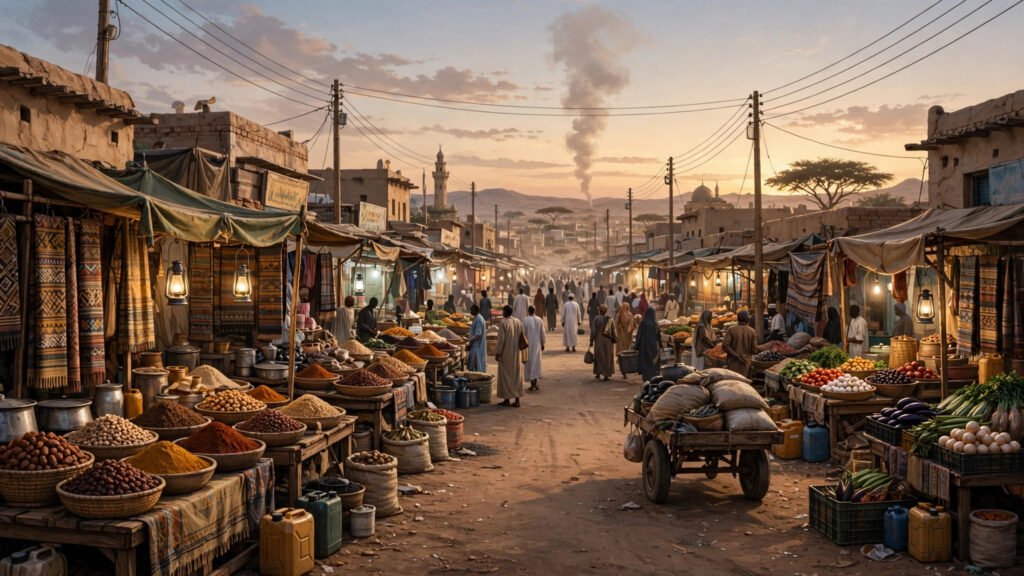
A drone strike on a busy market in Nyala, the capital of South Darfur in Sudan, has left the death toll sharply disputed, with reports ranging from 21 dead to more than 100 dead. The attack, on Monday evening, struck a market in the north of the city, which serves as the de facto capital of the paramilitary Rapid Support Forces (RSF), according to residents and medical sources cited by news agencies.
Nyala has been regularly struck during the war between the Sudanese army and the RSF, which began in April 2023. The latest strike is one of the deadliest reported incidents in the city in recent weeks, and it has renewed attention on the rising civilian cost of drone warfare in Sudan.
Key Takeaways
- A drone strike hit a market in Nyala, South Darfur, on Monday evening, with the first medical reports putting the toll at 21 dead and more than 40 injured.
- Doctors Without Borders later said a hospital it supports received 36 bodies, while a Sudanese rights group reported more than 100 dead and 113 wounded.
- The figures could not be independently verified amid limited information from the city, and the competing tolls remain unresolved.
What happened in Nyala
A resident told Al Jazeera that the attack took place at about 8pm local time, or 18:00 GMT, on Monday at a market in the north of Nyala. Another account identified the site as Tangooj market. The city is the RSF’s de facto capital in Darfur, and the market was busy with traders and shoppers at the time of the strike, according to witnesses.
On Tuesday, a medic at Nyala Hospital told AFP, via Al Jazeera, that 21 people were killed and more than 40 others were injured. The Sudan Doctors Network gave a similar preliminary figure on Wednesday, reporting 21 dead and more than 40 wounded, and said its statement had been delayed by difficulties reaching field documentation sources inside Nyala, ongoing military operations and security restrictions.
The United Nations Children’s Fund (UNICEF) said on Thursday that at least five children were killed and two others injured in a drone attack on a market in Nyala on Monday, according to the Pan-African News Agency. UNICEF’s account underlines that children were among the victims, even as the overall toll remains contested.
The figures could not be independently verified amid limited information from the city.
Why the toll figures differ so widely
Doctors Without Borders, known by its French acronym MSF, said in a statement on October 27 that the Nyala Teaching Hospital it supports had received 36 bodies, 21 of them wearing civilian clothing. Medical teams reported more than 150 wounded patients in the emergency room, including people with shrapnel injuries and serious burns. MSF attributed the market attack to the Sudanese Armed Forces and said a second strike hit a civilian neighbourhood.
Emergency Lawyers, a Sudanese rights group tracking violence against civilians, later reported a far higher toll, saying more than 100 people were killed and 113 wounded, mostly women and children. The group’s account was carried by Al Jazeera and the Associated Press on October 29.
The RSF’s self-declared administration reported an even higher figure, saying 188 civilians had died and 356 others were injured. Those figures could not immediately be independently confirmed, and no single source has provided a complete, independently verified count of all victims from the market and the nearby neighbourhood struck that evening.
An army-aligned spokesperson, Mohamed Didan of the Special Operations Forces, described a precise and targeted air strike that he said killed more than 150 militia recruits at Dumaya camp, west of Nyala. That account points to a different location and a different description of the target, and it does not resolve the dispute over the market casualties. The Sudanese Armed Forces had not issued a statement on the market attack itself by Tuesday, according to one report.
- First hospital report: 21 dead, more than 40 injured.
- MSF-supported hospital: 36 bodies received, more than 150 wounded treated.
- Emergency Lawyers: more than 100 dead, 113 wounded, mostly women and children.
- RSF administration claim: 188 civilians dead, 356 injured, unconfirmed.
- UNICEF: at least five children killed, two injured.
A wider wave of drone attacks
The Nyala market strike did not happen in isolation. Reporting on October 30 described a wave of drone attacks across Sudan in recent days, with more than 160 people reported killed in western regions since Friday, according to medics and rights groups. The attacks have been blamed on both the RSF and government troops, who have been fighting since 2023.
In Khartoum, Emergency Lawyers said drone attacks on Monday killed three children. The United Nations has reported additional drone strikes in several parts of Khartoum in recent days, including near the capital’s airport. Separately, the UN Human Rights Office said drone attacks killed at least 1,120 civilians during the first half of 2026, while another UN figure cited in reporting put drone-strike deaths at at least 306 during the first three weeks of October alone. The two figures cover different periods and should not be treated as competing totals for the same event.
The strike also follows an earlier drone attack on another market in Nyala on October 16, which killed at least four people and wounded many others, according to reporting on the latest incident. The pattern has added to famine warnings and to concern about attacks on places where civilians gather, from markets to transport hubs.
The broader context is a war that has also drawn scrutiny over foreign arms and drone warfare in Sudan, with a UN mission examining how weapons and drone technology are reaching the warring parties. For civilians in Nyala, however, the immediate question is simpler and still unanswered: how many people died in the market on Monday evening, and how many of them were civilians.
What to Watch Next
What to watch next is whether any authority or independent monitor can produce a verified count for the Nyala market strike, and whether the Sudanese Armed Forces issue a statement on the market attack itself. Further reporting may also clarify how many of the dead were civilians, how many were fighters, and how the second strike on a civilian neighbourhood fits into the overall toll. Until then, the figures remain what the reporting says they are: conflicting, attributed, and unverified, in a war where access to the affected city remains severely limited.