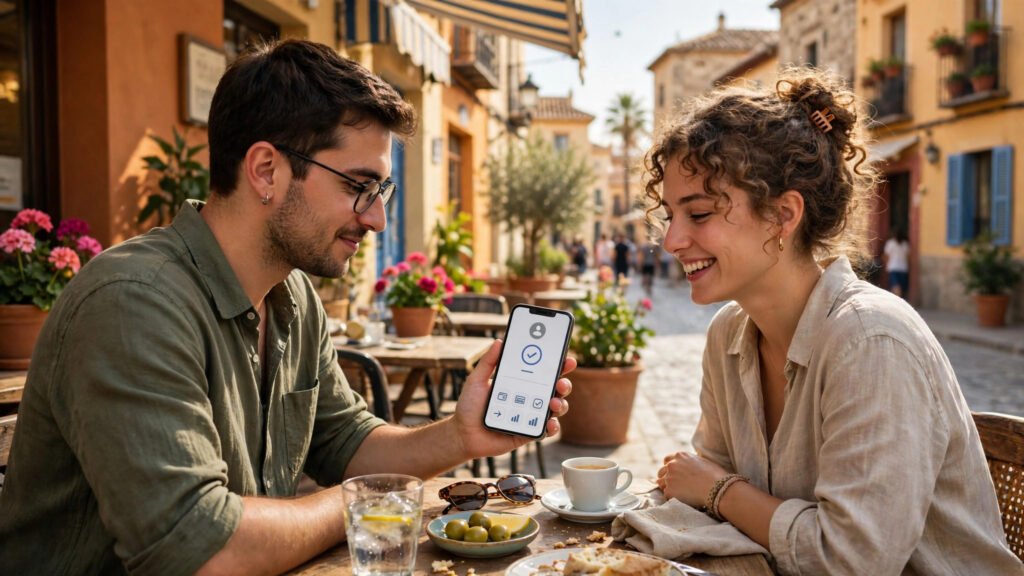
In Spain, splitting a dinner bill rarely involves counting coins or asking the waiter for separate card payments. More often, one person pays and everyone else sends their share straight from their phone. The tool behind that habit is Bizum, the instant payment service built into the apps of most Spanish banks, and it has quietly become one of the most everyday ways Spaniards move money.
So why do Spaniards reach for Bizum instead of cash or cards? The short answer is that it removes the friction from the moments when cash feels awkward and cards feel slow: paying a friend back, sharing a gift, or settling up after a meal. It works with something everyone already knows — a phone number — and the money moves between bank accounts in seconds.
Key Takeaways
- Bizum lets Spaniards send money using only the recipient’s phone number, inside their own bank’s app.
- It fits the social moments cards and cash handle badly, especially splitting bills and paying friends back.
- Because most Spanish banks take part, the recipient usually does not need a separate app or account.
What Bizum Actually Is
Bizum is not a separate bank and not a wallet that holds your money apart from your account. It is a payment service created by Spanish banks that sits inside the mobile banking apps people already use. When someone sends money with Bizum, it moves directly from one bank account to another, and the sender only needs the recipient’s mobile number.
That design is a big part of its appeal. There is no new username to remember, no separate balance to top up, and no need to ask a friend which app they use. If both people bank with participating banks, the transfer works the same way for both of them. For many Spaniards, Bizum simply feels like a feature of their bank rather than a product they chose.
Bizum simply feels like a feature of their bank rather than a product they chose.
Why It Beats Cash for Everyday Sharing
Cash still has its place in Spain, especially for small purchases at markets and bars, but it is awkward between friends. Nobody wants to be the person who never has change, and working out who owes what after a group meal can turn a pleasant evening into a small accounting exercise.
Bizum solves the social problem more than the technical one. One person pays the restaurant bill by card or cash, and the rest send their share on the spot, while everyone is still at the table. There is no debt to remember the next day and no need to carry the right notes and coins. The same logic applies to shared gifts, group trips, and splitting rent among flatmates — the situations where small amounts change hands between people who trust each other.
- Send money with just a phone number — no bank details to exchange.
- Transfers arrive in seconds between participating banks.
- No separate wallet balance to top up or manage.
- Works inside the banking app people already use every day.
Why It Beats Cards Between Friends
Cards are excellent for paying shops, but they were never designed for paying each other. You cannot easily tap your card against a friend’s phone to hand over your share of lunch, and asking a shop to split one bill across several cards often slows everyone down.
Bizum fills exactly that gap. It is built for person-to-person payments, so the flow matches the situation: pick a contact, type an amount, send. Similar instant-payment habits have grown up elsewhere in Europe too — Poles pay with BLIK for much the same reason, and the Dutch settle up with Tikkie and iDEAL — but in Spain the answer happens to be Bizum, because it arrived through the banks themselves.
How Bizum Spread So Quickly
Bizum’s spread owes a lot to trust. Because it lives inside familiar banking apps, people did not have to learn a new company or hand their money to an unfamiliar brand. Their bank was already the place they checked their balance, so sending money from the same app felt like a small step rather than a leap.
Word of mouth did the rest. Once one friend in a group used Bizum to settle a bill, the others had a reason to switch it on in their own banking app. Social payments spread through social circles, and in Spain — where meals, celebrations, and group outings are a regular part of life — there were plenty of chances for the habit to catch on.
Over time, Bizum has also moved beyond payments between friends. Many online shops in Spain now offer it at checkout, and charities accept donations through it, so the same phone-number simplicity now covers more kinds of payment. That wider use reinforces the habit: the more places accept it, the more natural it feels to use it everywhere. The pattern echoes other countries where phone-based payments took over everyday life, as Ghanaians paying with MoMo shows in a very different banking landscape.
When Cash and Cards Still Win
Bizum has not replaced everything. Cash remains handy for tips, small market stalls, and places where phones are not practical, and cards remain the default for most in-store shopping. Bizum also depends on both sides banking with participating institutions, so it is strongest inside Spain and less useful for sending money abroad.
That is the point, though. Spaniards did not adopt Bizum because it does everything — they adopted it because it does one everyday job better than the alternatives. For paying a shop, the card still wins. For paying a friend, Bizum is simply the easiest option on the table.
What to Watch Next
Bizum’s story in Spain is a story of a simple idea fitting a social habit: send money with a phone number, inside the bank app people already trust, and settle up in seconds. As more shops, charities, and services accept it, the line between paying friends and paying businesses keeps blurring. What is unlikely to change is the reason it caught on in the first place — it makes the small, social payments of everyday life feel effortless.