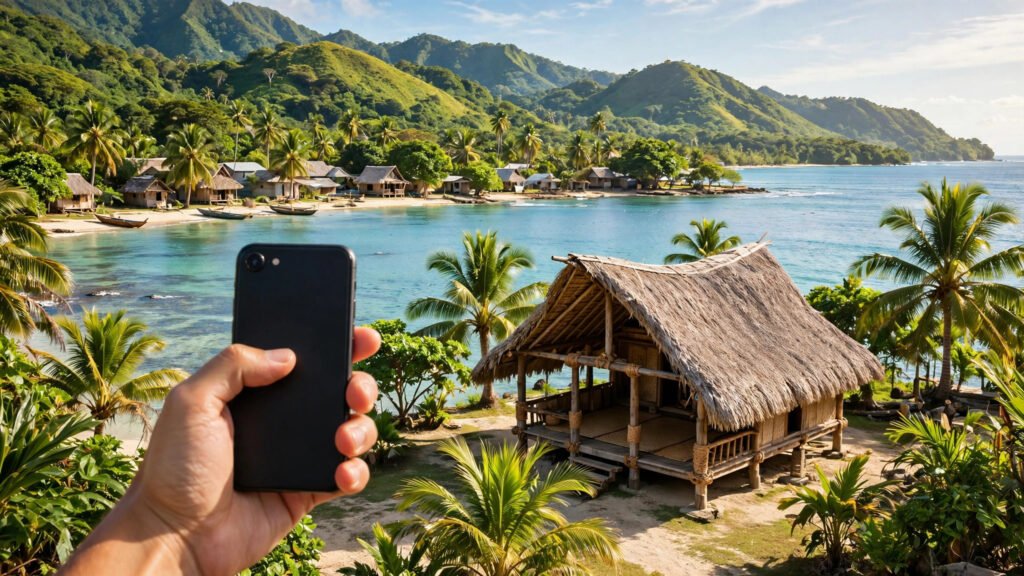
Samoa is a Pacific island country made up of two main islands, Upolu and Savai’i, along with a handful of smaller islands. Villages are spread along the coasts, families are large and closely connected, and many Samoans live overseas in New Zealand, Australia and the United States. In a country shaped by sea, distance and extended family, a natural question arises: why do Samoans run so much of daily life on their phones?
The short answer is that the phone fits the Samoan way of life. It carries money between relatives, it carries news between villages, it helps a small trader reach a customer, and it keeps a family together when its members live on different islands or in different countries. In Samoa, the phone is less a gadget and more the place where family, money and village news meet.
Key Takeaways
- Samoa’s villages are spread across islands, so the phone bridges distances that would otherwise need a long journey.
- Mobile money lets families send and receive support without travelling to a bank branch.
- Phones also carry village and church news, small-business orders and weather warnings across the islands.
Two Islands, One Extended Family
Family in Samoa means the aiga, the extended family, and its members often do not live in one place. Some live in Apia, the capital on Upolu. Others live in villages on Savai’i, and many more live abroad. A phone call or message is what keeps that wide family in daily contact: checking on parents, sharing news of a child, or arranging help when it is needed.
Money sent home by relatives overseas is an important part of household life in Samoa, and the phone has made that support easier to arrange. A relative can confirm that money has arrived, discuss what it is needed for, and plan the next step without waiting for a visit or a letter. Similar patterns appear across the Pacific, where distance also defines daily life. In Vanuatu, islanders rely on their phones across scattered islands for much the same reason: when the sea sits between you and almost everything else, the device in your pocket becomes the shortest route to the people you need.
Money, Markets and Small Business
Mobile money in Samoa works much like it does elsewhere in the Pacific: a wallet linked to a phone number, topped up through an agent or a shop, and used to send money, pay a bill or pay a trader. Where a bank branch is far away, that matters. A payment can be confirmed quickly, a debt can be settled from a distance, and a small business can keep trading even when its customers are scattered.
For market vendors, fishermen, handicraft makers and small tourism operators, the phone is also a shopfront. A vendor can tell a regular customer what will be available at the market that day. A guesthouse owner can confirm a booking. A craft maker on Savai’i can take an order from someone on Upolu without either of them travelling first. Each small exchange saves time, and together they make island trade more flexible. In Uganda, people pay with mobile money instead of bank cards for similar reasons of access and convenience, and the same logic holds in Samoa: the phone meets people where they already shop and trade.
Church, Village and Community News
Village and church life are central in Samoa, and the phone has become part of how that life is organised. Announcements about church services, village meetings, school events and family gatherings travel quickly through calls and messages. When a community needs to share news, it no longer has to wait for everyone to be in the same place at the same time.
Phones also matter for safety. Samoa sits in a region where tropical cyclones are a serious part of life, and when a storm approaches, warnings and updates can reach people directly on their phones. A village can check on another village, a boat owner can decide not to set out, and a family can prepare while there is still time. No phone can stop a cyclone, but timely information helps people make safer choices.
- Extended families stay in daily contact across Upolu, Savai’i and overseas.
- Mobile money moves support between relatives without a trip to a bank branch.
- Market sellers and small tourism operators take orders and payments by phone.
- Church and village announcements reach the whole community quickly.
- Storm warnings and safety news travel straight to people’s pockets.
What Phones Cannot Replace Yet
Phones help, but they do not solve everything. Mobile coverage does not reach every village equally, and a phone is only useful when it is charged and within signal. On more remote parts of Savai’i, charging a phone can itself be a task, and a weak signal can turn a simple call into a frustrating one.
Cost is another limit. Handsets, credit and data all cost money, and for households with tight budgets, every top-up is a choice against something else. There is also a learning curve, especially for older residents and people new to mobile money. Trust has to be built: checking a recipient before confirming a transfer, guarding account details, and recognising messages that try to trick people into sending money. These habits matter as much as the technology, because a mistaken transfer can be hard to undo.
The wider lesson goes beyond Samoa. Across remote and island regions, phones often fill gaps left by distance. In Mongolia, people bank on their phones across the steppe because the nearest branch can be a long journey away. Samoa’s islands tell the same story in their own landscape: when settlements are scattered and travel is hard, a phone connects people to services, family and information.
In Samoa, the phone is less a gadget and more the place where family, money and village news meet.
None of this means the phone replaces Samoan life as it has always been lived. Markets still gather people in person, church still brings villages together, and visits still matter in ways no call can replace. The phone simply fills the gaps between those moments, keeping people connected in the days and weeks when a journey is not possible.
What to Watch Next
The direction of travel is clear: as coverage improves and more services reach smaller villages, the phone is likely to become even more central to life in Samoa. The practical questions to watch are the ones this article has already raised. Will coverage and charging become easier in the most remote villages? Will mobile payments become simpler and safer for everyone, including older residents? And will warnings and news reach every community in good time when the next storm approaches?
For now, the core answer remains unchanged. In a country made of islands and extended families, the mobile phone is the thread that runs between them, carrying voices, money, trade and warnings across water and distance that would otherwise keep people apart.